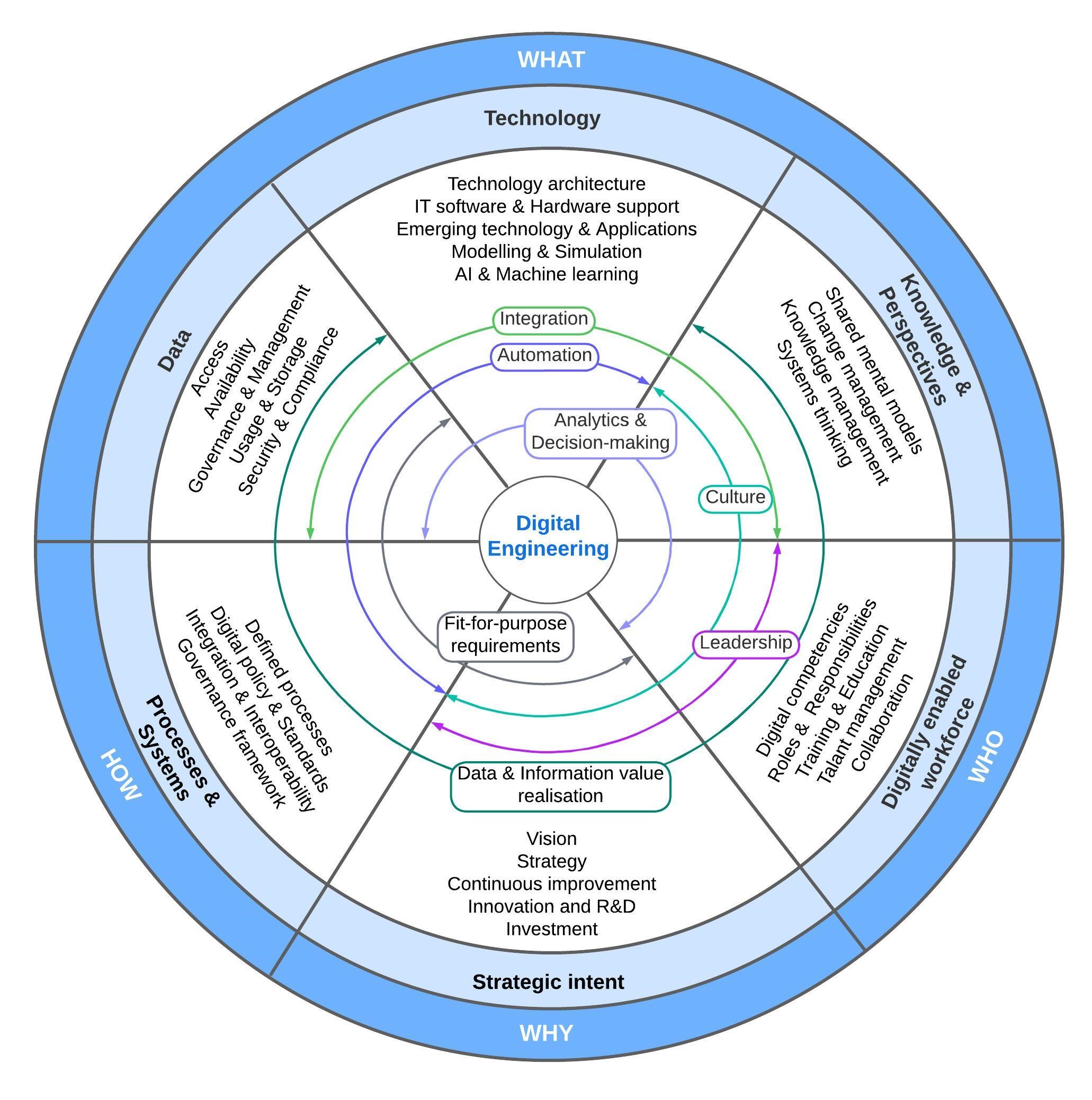
図1. デジタルエンジニアリングのシステム的枠組み
Fundamentals for Digital Engineering
The world has witnessed exponential growth in technological advancement in recent years, and systems engineering (SE) is no exception. SE is transforming the way we design, analyze, and manage complex systems. This transformational change leverages the use of advanced technologies such as Artificial Intelligence (AI), Big Data, and Internet of Things (IoT). However, the evolution of SE goes well beyond just technology advancements. This chapter discusses digital engineering (DE) as a systemic intervention, a holistic approach to SE transformation that involves people, processes, data, and technology.
近年、世界は技術の指数関数的な進歩を目の当たりにしてきた。システムズエンジニアリング(systems engineering、SE)も例外ではない。SE は、複雑なシステムの設計、分析、管理のあり方を変革しつつある。この変革は、人工知能(Artificial Intelligence、AI)、ビッグデータ、モノのインターネット(Internet of Things、IoT)といった先端技術の活用に支えられている。しかし、SE の進化は単なる技術の進歩にとどまるものではない。本章では、デジタルエンジニアリング(digital engineering、DE)を、人、プロセス、データ、技術を巻き込んだ SE 変革への全体的なアプローチ、すなわちシステム的な介入として論じる。
The INCOSE Vision 2035 statement (INCOSE 2021) provides insights into the global context for SE, highlighting key trends and influencing factors expected to drive changes in the practice of SE. Some of the principal takeaways include but are not limited to the impacts of digital transformation: *Digital transformation, sustainability, smart systems and complexity growth, and advancements in modeling, simulation, and visualization are trends that impact enterprise competitiveness. *The future SE will leverage digital transformation in its tools and methods and move towards a fully model-based SE environment. *The changing nature of systems includes more embedded and application software, increasing amounts of data to process, and cyber-physical systems. *The systems of the future will be engineered by an evolving, diverse workforce reshaped by digital transformation and systems of systems. *Data science techniques will be infused into the SE practice, with trusted data being managed as a critical asset. *Digital technology, including the broader application of AI, enables the transformation of how enterprises capture, reuse, exploit, and protect knowledge through digital representation and semantic integration of all information. *Evolving digital ecosystems will enable automation and autonomy to perform increasingly complex tasks. All engineering disciplines today have evolved, and modern SE needs to be supported by large amounts of data. This requires the transformation of SE practices to DE in which technological innovations are assembled to allow for an integrated digital approach that supports life cycle activities and develops a culture among stakeholders of working more efficiently and effectively (DoD 2018). DE is not a destination but a journey towards the digital transformation of engineering and enterprises. This journey requires a paradigm shift from a traditional paper-based SE to a more integrated approach that leverages digital technology to accelerate the formalization and integration of knowledge, fostering collaboration and adopting a more agile approach to SE.
INCOSE ビジョン 2035 の声明(INCOSE 2021)は、SE を取り巻くグローバルな文脈への洞察を与え、SE の実践に変化をもたらすと予想される主要なトレンドと影響要因を浮き彫りにしている。主な要点にはデジタルトランスフォーメーションの影響が含まれるが、それだけにとどまらない。
今日、あらゆる工学分野が進化を遂げており、現代の SE は大量のデータに支えられる必要がある。そのためには、SE の実践を DE へと変革しなければならない。DE では、技術革新を組み合わせることで、ライフサイクル活動を支援し、ステークホルダーの間により効率的かつ効果的に働く文化を育む統合的なデジタルアプローチが可能になる(DoD 2018)。DE は到達点ではなく、エンジニアリングとエンタープライズのデジタルトランスフォーメーションに向けた道のりである。この道のりには、従来の紙ベースの SE から、より統合的なアプローチへのパラダイムシフトが必要である。そのアプローチとは、デジタル技術を活用して知識の形式化と統合を加速し、協働を促進し、よりアジャイルな SE のアプローチを採用するものである。
DE provides an integrated digital approach that uses authoritative sources of systems data and models as a continuum across disciplines to support lifecycle activities from concept through disposal (DoD, 2018). ABAB (2021) defines DE as a collaborative way of working, using digital processes to enable more productive methods of planning, designing, constructing, operating, and maintaining assets. Collaboration with suppliers and partners is improved through DE, reducing the risk of errors and delays. DE is reshaping the landscape of how capabilities, assets and projects are designed and managed across many industries, including defense, transportation, construction, healthcare delivery, and other sectors. Examples include: *In the defense sector, DE enables the development of innovative weapon systems, reduction in acquisition timelines and improvement of the force's readiness (Zimmerman et al. 2019). *In transportation, DE improves the design and optimization of infrastructure systems, such as roads, bridges, and airports, to improve safety and efficiency (Wu et al. 2022). DE drives the improvement of the resilience of critical infrastructure systems, such as power grids, water systems, and transportation networks (Suprun et al. 2022). *In construction, DE enables the design and construction of smarter and more sustainable buildings and infrastructure and the reduction of construction costs and waste (Opoku et al. 2021). *In healthcare, DE enables development of new medical devices, optimization of hospital operations, and improvement in patient outcomes (Awad et al. 2021). The list goes on.
DE は、権威あるシステムデータとモデルの情報源を分野横断的な連続体として用いることで、概念段階から廃棄までのライフサイクル活動を支援する統合的なデジタルアプローチを提供する(DoD 2018)。ABAB(2021)は DE を、デジタルプロセスを用いて資産の計画、設計、建設、運用、維持をより生産的に行えるようにする、協働的な働き方と定義している。DE によってサプライヤーやパートナーとの協働が改善され、誤りや遅延のリスクが低減する。
DE は、防衛、輸送、建設、医療サービスの提供をはじめとする多くの産業において、能力、資産、プロジェクトの設計と管理のあり方を変えつつある。以下に例を挙げる。
DE is underpinned by the view of enterprises as socio-cultural-technical systems (Sony & Naik, 2020). DE is a systemic intervention that comprises four fundamental components: Why, What, Who and How. These components work together to enable fundamental shifts in organizational culture, practices, and technologies to achieve enterprise digital transformation. Figure 1 provides a holistic view of the dimensions and elements that make the DE intervention.
DE の基盤には、エンタープライズを社会・文化・技術システムとして捉える見方がある(Sony & Naik 2020)。DE は、なぜ(Why)、何を(What)、誰が(Who)、どのように(How)という4つの基本的な構成要素からなるシステム的な介入である。これらの構成要素が連携することで、組織の文化、実践、技術における根本的な転換が可能になり、エンタープライズのデジタルトランスフォーメーションが達成される。図1は、DE という介入を構成する次元と要素を全体的に示したものである。
図中の英語
The why component is critical for establishing the goals and objectives of the DE initiative, as well as for ensuring that it aligns with the broader organizational strategy. DE is not exclusively about technology but the fact that technology enables organizations to transform their business operations and systems and create better-informed decisions around their organizational objectives and strategy.
「なぜ(Why)」の構成要素は、DE イニシアチブの目標と目的を定め、それをより広い組織戦略と確実に整合させるうえで重要である。DE は技術だけの問題ではない。重要なのは、技術によって組織が事業運営とシステムを変革し、組織の目的と戦略について、より十分な情報に基づいた意思決定を行えるようになるという点である。
As part of the process, the immediate targets of transforming SE practices include the digitalization of engineering artifacts, information, and model sharing, while the long-term strategic vision is focused on aligning investments into technological innovations and advanced engineering practices with organizational goals and objectives (Huang, 2020). The organizational view of digital transformation opportunities and innovation should be considered as part of a more extensive continuous improvement process.
このプロセスの一環として、SE の実践を変革するうえでの当面の目標には、工学成果物のデジタル化と、情報とモデルの共有が含まれる。一方、長期的な戦略ビジョンは、技術革新と高度な工学実践への投資を組織の目標と目的に整合させることに主眼を置く(Huang, 2020)。デジタルトランスフォーメーションの機会とイノベーションに関する組織の見方は、より広範な継続的改善プロセスの一部として捉えるべきである。
A clear DE strategy provides a roadmap for digital transformation, outlining the steps needed to achieve organizational outcomes. They should also consider the organization's culture and how DE transformation will impact the workforce as well as its existing systems and processes. A successful strategy involves stakeholder collaboration to ensure buy-in and alignment with the organization's goals and leadership development. DoD DE Strategy (DoD 2018) identifies the following goals that could be applied to DE activities: (i) model use for decision-making; (ii) developing the authoritative source of truth (AST); (iii) enhancing technological innovation; (iv) establishing collaborative environments; and (v) transforming the workforce and cultural.
明確な DE 戦略は、デジタルトランスフォーメーションに向けたロードマップとなり、組織のアウトカムを達成するために必要なステップを示す。戦略では、組織の文化に加え、DE 変革が人材や既存のシステムとプロセスにどのような影響を与えるかも考慮すべきである。成功する戦略には、賛同を得て組織の目標との整合を確実にするためのステークホルダーとの協働と、リーダーシップの育成が含まれる。DoD の DE 戦略(DoD 2018)は、DE 活動に適用できる目標として、(i) 意思決定のためのモデルの使用、(ii) 権威ある真実の源(authoritative source of truth、AST)の開発、(iii) 技術革新の強化、(iv) 協働環境の確立、(v) 人材と文化の変革、を挙げている。
A systemic approach to DE drives a shift from a technology-focused acquisition approach to a whole ecosystem view that supports all enablers for genuine transformation, including workforce readiness and awareness of the legal and policy environment. Moreover, the strategic view on DE allows organizations to realize the value of data and information. Industries must collectively recognize the importance of valuing and managing data and information as critical assets.
DE へのシステム的なアプローチは、技術に焦点を当てた取得アプローチから、エコシステム全体を捉える見方への転換を促す。この見方は、人材の即応性や法的・政策的環境への認識を含め、真の変革を実現するあらゆる要因を支えるものである。さらに、DE を戦略的に捉えることで、組織はデータと情報の価値を認識できるようになる。産業界は、データと情報を重要な資産として評価し管理することの重要性を、業界全体として認識しなければならない。
The who component of DE focuses on the workforce. This component is critical for ensuring industries have the necessary skills and capabilities to embark on the DE journey. It involves identifying the skills, roles, responsibilities, and capabilities needed for the successful digital transformation of engineering and enterprises. It is essential to have a digitally enabled workforce trained and capable of using technological innovation to effectively leverage digital tools and methods.
DE requires a new comprehensive set of skills and competencies beyond traditional SE and IT. It requires a combination of technical and specific data management expertise, such as modeling and simulation, data analytics, AI, and cybersecurity, as well as soft skills, such as communication, collaboration, and leadership. The DE competency framework developed by Hutchison and Tao (2022) identifies the foundational digital competencies: (i) digital literacy; (ii) DE value proposition; (iii) DoD Policy/Guidance; (iv) decision-making; (v) software literacy.
Social and cultural aspects of DE also include the need for a shift in mindset and culture. DE requires a more collaborative agile approach to design, develop, and deploy complex systems and a willingness to adapt and embrace change. It also requires a culture of innovation, continuous improvement and learning as technologies and tools evolve rapidly. The growing worldwide demand for digital and systems engineers exceeds the available supply (INCOSE 2021). Many enterprises initiate internal in-house training programs to develop their workforce further. Nevertheless, there is a need for training and education programs and a life-long learning pipeline that empower more system engineers with strong multi- and transdisciplinary competencies, including digital, business, leadership and systems thinking, needed to enable collaboration across a broad range of the engineering and management workforce globally.
DE の「誰が(Who)」の構成要素は、人材に焦点を当てる。この構成要素は、産業界が DE の道のりに踏み出すのに必要なスキルと能力を確実に備えるうえで重要である。これには、エンジニアリングとエンタープライズのデジタルトランスフォーメーションを成功させるために必要なスキル、役割、責任、能力を特定することが含まれる。訓練を受け、技術革新を用いてデジタルツールと手法を効果的に活用できる、デジタルで力を得た人材が不可欠である。
DE には、従来の SE や IT の枠を超えた、新たな包括的スキルとコンピテンシーが必要となる。モデリングとシミュレーション、データ分析、AI、サイバーセキュリティといった技術面および具体的なデータ管理の専門性と、コミュニケーション、協働、リーダーシップといったソフトスキルの組み合わせが必要である。Hutchison と Tao(2022)が開発した DE コンピテンシー枠組みは、基礎的なデジタルコンピテンシーとして、(i) デジタルリテラシー、(ii) DE の価値提案、(iii) DoD の政策/ガイダンス、(iv) 意思決定、(v) ソフトウェアリテラシーを挙げている。
DE の社会的・文化的側面には、マインドセットと文化の転換の必要性も含まれる。DE には、複雑なシステムの設計、開発、展開に対する、より協働的でアジャイルなアプローチと、変化に適応しそれを受け入れる意欲が求められる。また、技術やツールが急速に進化する中では、イノベーション、継続的改善、学習の文化も必要である。
デジタルエンジニアとシステムエンジニアに対する世界的な需要は高まり続けており、現在の供給を上回っている(INCOSE 2021)。多くのエンタープライズは、人材をさらに育成するために社内研修プログラムを立ち上げている。それでもなお、研修・教育プログラムと生涯学習のパイプラインが必要である。これらは、より多くのシステムエンジニアに、デジタル、ビジネス、リーダーシップ、システム思考を含む強力な学際的・超学際的コンピテンシーを身につけさせるものであり、世界中の幅広い工学・管理人材の協働を可能にするために必要とされる。
The what component captures dimensions of integration, being data, technology, and knowledge and perspectives. SE faces a significant obstacle today due to the extensive fragmentation among the engineering tools and data landscape (INCOSE 2021). In DE, the use of common integrated models helps overcome these challenges. Integration across different tools, technological solutions and data is becoming a focus for enabling collaboration, analytics, and data-informed decision-making. Integration also ensures that the data generated by different tools are standardized and can be seamlessly shared across different engineering disciplines.
「何を(What)」の構成要素は、統合の次元、すなわちデータ、技術、知識と視点を扱う。今日の SE は、工学ツールとデータの状況が広範に断片化していることから、大きな障害に直面している(INCOSE 2021)。DE では、共通の統合モデルを用いることが、こうした課題の克服に役立つ。異なるツール、技術ソリューション、データにまたがる統合は、協働、分析、データに基づく意思決定を可能にするうえでの焦点となりつつある。統合はまた、異なるツールによって生成されたデータが標準化され、異なる工学分野の間でシームレスに共有できることを確実にする。
Data is at the heart of DE, and enterprises need to invest in the capabilities for seamless collection, management, and analysis of data to support their digital transformation. Real-time data can improve how complex systems and assets are operated, enable informed decision-making, and allow better responses to disruptions, failures, and environmental concerns. Nevertheless, collecting the trusted data alone is insufficient to improve SE practices. The key is to support an integrated approach enabling the use of high-quality data, security, privacy, and accessibility in a form that allows sharing, visualization, and analysis. For the systems and assets to be managed efficiently, it is crucial to enable consistent, informed decision-making that relies on high-quality, robust data. An organization's insights are only as good as its data. In other words, the value maximization from the physical system requires the value maximization from the data and information. Valuing and managing data and information as critical assets allow a fundamental shift towards data-driven decision-making built on a 'digital by default' culture.
データは DE の中核であり、エンタープライズはデジタルトランスフォーメーションを支えるために、データをシームレスに収集、管理、分析する能力に投資する必要がある。リアルタイムデータは、複雑なシステムや資産の運用方法を改善し、情報に基づく意思決定を可能にするとともに、機能中断、故障、環境上の懸念へのより良い対応を可能にする。とはいえ、信頼できるデータを収集するだけでは、SE の実践を改善するには不十分である。鍵となるのは、共有、可視化、分析が可能な形で、高品質なデータ、セキュリティ、プライバシー、アクセシビリティを活用できるようにする統合的なアプローチを支えることである。システムと資産を効率的に管理するには、高品質で堅牢なデータに依拠した、一貫性のある、十分な情報に基づく意思決定を可能にすることが極めて重要である。組織の洞察は、そのデータの質に左右される。言い換えれば、物理システムから最大の価値を引き出すには、データと情報から最大の価値を引き出す必要がある。データと情報を重要な資産として評価し管理することで、「デジタル・バイ・デフォルト(digital by default)」の文化の上に築かれた、データ駆動型の意思決定への根本的な転換が可能になる。
Knowledge is another critical enterprise asset. Both data and knowledge must be managed appropriately for an enterprise to continue to learn and advance. The knowledge and perspectives component of DE encompasses the importance of understanding and sharing common mental models across stakeholders and establishing a shared understanding of DE. Failure to address the underlying cultural shift, a change in mindset, and a new way of thinking will result in "putting a new coat of technological paint over the same crumbling organizational walls" (Forsythe & Rafoth 2022). Hence, DE must be approached as a cultural transformation, where stakeholders across the enterprise are encouraged to adopt new ways of thinking and working together. This requires a top-down commitment to the new approach and investment in training, education, and tools to enable all stakeholders to understand and work within the new paradigm. This shift in mindset and culture can be difficult and requires leadership to drive the change (Laskey et al. 2021).
知識もまた、エンタープライズにとって重要な資産である。エンタープライズが学び続け、前進し続けるためには、データと知識の双方を適切に管理しなければならない。DE の知識と視点の構成要素には、ステークホルダーの間で共通のメンタルモデルを理解し共有することの重要性と、DE についての共通理解を確立することが含まれる。根底にある文化の転換、マインドセットの変化、新しい考え方に取り組まなければ、「崩れかけた同じ組織の壁に、技術という新しいペンキを塗る」結果に終わる(Forsythe & Rafoth 2022)。したがって、DE には文化的な変革として取り組まなければならない。そこでは、エンタープライズ全体のステークホルダーが、新しい考え方や協働の仕方を取り入れるよう促される。そのためには、新しいアプローチに対するトップダウンのコミットメントと、すべてのステークホルダーが新しいパラダイムを理解し、その中で働けるようにするための研修、教育、ツールへの投資が必要である。こうしたマインドセットと文化の転換は困難を伴うことがあり、変化を推進するリーダーシップが必要となる(Laskey et al. 2021)。
The technology component is critical for ensuring organizations have the infrastructure, tools, and platforms to support DE. Technology transforms how enterprises capture, reuse, exploit, and protect knowledge through digital representation and semantic integration of all information. Evolving technology, including digital twins, modeling and simulation tools, and data analytics and visualization tools with the broader application of AI, ML, and IoT, will enable automation and autonomy to perform increasingly complex tasks, providing further opportunities for humans to add value through innovation.
技術の構成要素は、組織が DE を支えるインフラ、ツール、プラットフォームを確実に備えるうえで重要である。技術は、あらゆる情報のデジタル表現と意味的統合を通じて、エンタープライズが知識を獲得し、再利用し、活用し、保護する方法を変革する。デジタルツイン(digital twin)、モデリングとシミュレーションのツール、データ分析・可視化ツールなど、AI、ML、IoT のより幅広い応用を伴う進化する技術によって、自動化と自律性がますます複雑なタスクを担えるようになり、人間がイノベーションを通じて価値を付加する機会がさらに広がる。
The key shift enabled by DE as an integrated approach is a move to collaborative data-driven problem-solving practices. This drives culture transformation and organizational commitment to a 'single source of truth' approach to decision-making.
統合的なアプローチとしての DE が可能にする鍵となる転換は、協働的でデータ駆動型の問題解決の実践への移行である。これにより、文化の変革と、意思決定における「単一の真実の源(single source of truth)」アプローチへの組織のコミットメントが促進される。
The how component of DE focuses on processes and systems. As the future of SE, DE is model-based, leveraging next-generation modeling and simulation powered by global digital transformation (INCOSE 2021). The right processes and systems in place provide consistent digital transformation to deliver value throughout system elements, disciplines, the life cycle, and the enterprise. Defined processes and structured procedures ensure that information fits its intended purpose and can be shared and reused. Moreover, organizations must develop a systematic approach to integrate DE tools and techniques into their existing processes and systems to allow for a seamless flow of data, information, knowledge, and expertise.
DE の「どのように(How)」の構成要素は、プロセスとシステムに焦点を当てる。SE の未来として、DE はモデルベースであり、グローバルなデジタルトランスフォーメーションに支えられた次世代のモデリングとシミュレーションを活用する(INCOSE 2021)。適切なプロセスとシステムが整っていれば、システム要素、分野、ライフサイクル、エンタープライズ全体を通じて価値を提供する一貫したデジタルトランスフォーメーションが実現する。定義されたプロセスと構造化された手順は、情報が意図された目的に適合し、共有・再利用できることを確実にする。さらに組織は、データ、情報、知識、専門性がシームレスに流れるよう、DE のツールと技法を既存のプロセスとシステムに統合する体系的なアプローチを構築しなければならない。
DE opens new opportunities but also introduces new integration challenges. One of the critical challenges is the need for interoperability and standardization. Standardized or commonly shared digital representation forms, semantics, and vocabulary are critical for sharing digitalized engineering artefacts, especially digital models.
DE は新たな機会を切り開く一方で、新たな統合上の課題ももたらす。重要な課題の一つは、相互運用性と標準化の必要性である。デジタル化された工学成果物、とりわけデジタルモデルを共有するには、標準化された、あるいは共通に共有されたデジタル表現の形式、意味論、語彙が重要となる。
The core concept in DE is using digital models integrated with simulation, multi-disciplinary analysis, and immersive visualization environments. In other words, one of DE's key technical aspects is using model-based systems engineering (MBSE). MBSE provides a common language and framework for communicating and managing system requirements, design, and implementation. MBSE also enables system designers and engineers to simulate and test system behavior in a virtual environment, reducing the need for physical prototypes. The transformation to DE is happening step by step, and the evolution goes beyond just MBSE. While MBSE is a critical component of DE, it is only one part of a more significant shift towards digital transformation (McDermott et al. 2022). DE involves a fundamental shift in mindset and requires organizations to embrace a more collaborative approach to problem-solving, with stakeholders from across the organization working together to develop more efficient, effective, and responsive solutions to rapidly changing industry demands.
DE の中核概念は、シミュレーション、多分野分析、没入型の可視化環境と統合されたデジタルモデルを用いることである。言い換えれば、DE の主要な技術的側面の一つは、モデルベースシステムズエンジニアリング(model-based systems engineering、MBSE)の使用である。MBSE は、システムの要求事項、設計、実装を伝達し管理するための共通の言語と枠組みを提供する。また MBSE によって、システムの設計者やエンジニアは仮想環境でシステムの振る舞いをシミュレーションしテストできるようになり、物理的なプロトタイプの必要性が低減する。DE への変革は段階的に進んでおり、その進化は MBSE だけにとどまらない。MBSE は DE の重要な構成要素であるが、デジタルトランスフォーメーションに向けたより大きな転換の一部にすぎない(McDermott et al. 2022)。DE にはマインドセットの根本的な転換が伴い、組織はより協働的な問題解決のアプローチを受け入れる必要がある。そこでは、組織全体のステークホルダーが協力し、急速に変化する産業の需要に応える、より効率的で効果的、かつ応答性の高いソリューションを開発する。
The key shift enabled by DE processes and systems is a move towards the end-to-end digital representation of the enterprise to address long-standing challenges associated with complexity, uncertainty, and rapid change in deploying and using systems. DE also drives a shift from confined and ad-hoc use of models for immediate benefits to continuous and coherent use of models across the lifecycle to drive and accelerate organizational outcomes.
DE のプロセスとシステムが可能にする鍵となる転換は、エンタープライズのエンドツーエンドのデジタル表現への移行である。これは、システムの展開と使用における複雑さ、不確実性、急速な変化に伴う長年の課題に対処するためのものである。DE はまた、目先の利益のためにモデルを限定的かつ場当たり的に使用する状態から、組織のアウトカムを推進し加速するために、ライフサイクル全体にわたってモデルを継続的かつ一貫して使用する状態への転換を促す。
DE goes beyond using specific software tools and models. It builds upon the principles of SE, leveraging technologies and modeling and simulation methods to enhance data-driven decision-making and optimize system performance. DE is about creating a culture of innovation, collaborative problem-solving, and continuous improvement, changing how we connect, understand, and navigate our environments.
DE は、特定のソフトウェアツールやモデルを使用することにとどまらない。DE は SE の原則の上に成り立ち、技術やモデリング・シミュレーションの手法を活用して、データ駆動型の意思決定を強化し、システム性能を最適化する。DE とは、イノベーション、協働的な問題解決、継続的改善の文化を創り出し、私たちが自らを取り巻く環境とつながり、それを理解し、その中を進んでいく方法を変えることである。
ABAB. 2021. Digital twins: An ABAB Position paper. Australasian BIM Advisory Board.
Awad, A., S.J. Trenfield, T.D. Pollard, J.J. Ong, M. Elbadawi, L.E. McCoubrey, A. Goyanes, S. Gaisford, and AW Basit. 2021. "Connected healthcare: Improving patient care using digital health technologies." Advanced Drug Delivery Reviews, 178, 113958.
DoD. 2018. Digital Engineering Strategy. US Department of Defense.
Forsythe, J., and J. Rafoth. 2022. Being Digital: Why Addressing Culture and Creating a Digital Mindset are Critical to Successful Transformation. INSIGHT, 25: 25-28.
Huang, J., A. Gheorghe, H. Handley, P. Pazos, A. Pinto, S. Kovacic, A. Collins, C. Keating, A. Sousa-Poza, G. Rabadi, R. Unal, T. Cotter, R. Landaeta, and C. Daniels. 2020. Towards digital engineering: the advent of digital systems engineering. International Journal of System of Systems Engineering, 10(3), 234-261.
Hutchison, N., and H.Y.S. Tao. 2022. The Digital Engineering Competency Framework (DECF): Critical Skillsets to Support Digital Transformation. INSIGHT, 25: 35-39.
INCOSE. 2021. Engineering solutions for a better world: Systems Engineering Vision 2035. International Council on Systems Engineering.
Laskey, K.J., M.L. Farinacci, and O.C. Diaz. 2021. Digital Engineering Fundamentals: A Common Basis for Digital Engineering Discussions. MITRE Technical Report. The MITRE Corporation, McLean, VA.
McDermott, T., K. Henderson, A. Salado, and J. Bradley. 2022. Digital Engineering Measures: Research and Guidance. INSIGHT, 25: 12-18.
Opoku, D.G.J., S. Perera, R. Osei-Kyei, and M. Rashidi. 2021. Digital twin application in the construction industry: A literature review. Journal of Building Engineering, 40, 102726.
Sony, M., and S. Naik. 2020. Industry 4.0 integration with socio-technical systems theory: A systematic review and proposed theoretical model. Technology in Society, 61, 101248.
Suprun, E., S. Mostafa, R.A. Stewart, H. Villamor, K. Sturm, and A. Mijares. 2022. Digitisation of Existing Water Facilities: A Framework for Realizing the Value of Scan-to-BIM. Sustainability, 14, 6142.
Wu, J., X. Wang, Dang, Y., and Z. Lv. 2022. Digital twins and artificial intelligence in transportation infrastructure: Classification, application, and future research directions. Computers and Electrical Engineering, 101, 107983.
Zimmerman, P., T. Gilbert, and F. Salvatore. 2019. Digital engineering transformation across the Department of Defense. The Journal of Defense Modelling and Simulation, 16(4):325-338.
DoD. 2018. Digital Engineering Strategy. Arlington, VA: US Department of Defense. Available at: https://ac.cto.mil/wp-content/uploads/2019/06/2018-Digital-Engineering-Strategy_Approved_PrintVersion.pdf
Hutchison, N., and H.Y.S. Tao. 2022. "The Digital Engineering Competency Framework (DECF): Critical Skillsets to Support Digital Transformation." INCOSE INSIGHT, 25: 35-39.
Laskey, K.J., M.L. Farinacci, and O.C. Diaz. 2021. Digital Engineering Fundamentals: A Common Basis for Digital Engineering Discussions. MITRE Technical Report. The MITRE Corporation, McLean, VA.
McDermott, T., K. Henderson, A. Salado, and J. Bradley. 2022. "Digital Engineering Measures: Research and Guidance." INCOSE INSIGHT, 25: 12-18.
Zimmerman, P., T. Gilbert, and F. Salvatore. 2019. "Digital engineering transformation across the Department of Defense." The Journal of Defense Modelling and Simulation, 16(4):325-338.
None.