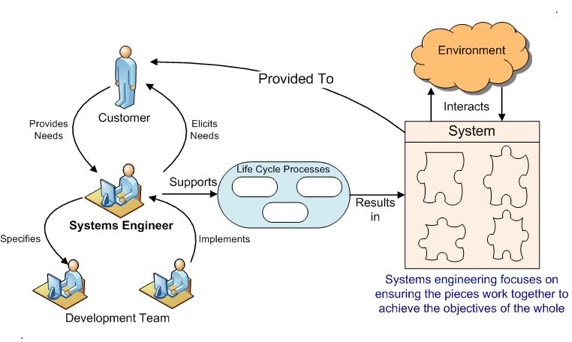
図1. システムズエンジニアリングの主要要素。(SEBoK Original)
Introduction to Systems Engineering
The primary focus of the SEBoK is on the current baseline of knowledge describing the practice of domain independent systems engineering (SE). This Knowledge Area (KA) contains topic articles which provide an overview of SE practice and discuss its economic value, historic evolution and key relationships.
SEBoK の主眼は、分野に依存しないシステムズエンジニアリング(Systems Engineering、SE)の実践を記述する、現時点での知識のベースラインにある。本知識領域(Knowledge Area、KA)には、SE の実践を概観し、その経済的価値、歴史的変遷、主要な関係について論じるトピック記事が収められている。
Systems Engineering is a transdisciplinary and integrative approach to enable the successful realization, use, and retirement of engineered systems, using systems principles and concepts, and scientific, technological, and management methods. (INCOSE 2023)
Successful systems must satisfy the needs of their customers, users and other stakeholders. Some key elements of systems engineering are highlighted in Figure 1 and include: *The principles and concepts that characterize a system, where a system is an interacting combination of system elements that accomplish a defined objective(s). The system interacts with its environment, which may include other systems, users, and the natural environment. The system elements that compose the system may include hardware, software, firmware, people, information, techniques, facilities, services, and other support elements. *A systems engineer is a person or role who supports this transdisciplinary approach. In particular, the systems engineer often serves to elicit and translate customer needs into specifications that can be realized by the system development team. *In order to help realize successful systems, the systems engineer supports a set of life cycle processes beginning early in conceptual design and continuing throughout the life cycle of the system through its manufacture, deployment, use and disposal. The systems engineer must analyze, specify, design, and verify the system to ensure that its functional, interface, performance, physical, and other quality characteristics, and cost are balanced to meet the needs of the system stakeholders. *A systems engineer helps ensure the elements of the system fit together to accomplish the objectives of the whole, and ultimately satisfy the needs of the customers and other stakeholders who will acquire and use the system.
システムズエンジニアリングは、システムの原則と概念、ならびに科学的、技術的、管理的な手法を用いて、エンジニアード・システムの実現、使用、廃止を成功裏に行えるようにする、分野横断的かつ統合的なアプローチである。(INCOSE 2023)
成功するシステムは、その顧客、利用者、その他のステークホルダーのニーズを満たさなければならない。システムズエンジニアリングの主要な要素のいくつかを図1に示す。それらには次のものが含まれる。
図中の英語
INCOSE. 2023. Systems Engineering Handbook: A Guide for System Life Cycle Processes and Activities, version 5.0. Hoboken, NJ, USA: John Wiley and Sons, Inc, ISBN: 978-1-119-81429-0.