
図1. コンテキストにおける SEBoK Part 2。(SEBoK Original)詳細は Structure of the SEBoK を参照。
Foundations of Systems Engineering
Part 2 of the SEBoK provides the conceptual foundations of systems engineering. It equips systems engineers with an understanding of the principles, theories, and practices that underpin their discipline, while also connecting them to the broader traditions of systems science and systems practice. By presenting this wider integrative context, Part 2 makes systems knowledge more accessible both within engineering and to a wider community of practitioners and researchers working across diverse domains.
SEBoK の Part 2 は、システムズエンジニアリングの概念的基礎を提供する。システムズエンジニアに、自らの分野を下支えする原則、理論、実践についての理解をもたらすとともに、システム科学とシステム実践のより広い伝統へと結びつける。このより広い統合的コンテキストを示すことで、Part 2 は、エンジニアリングの内部においても、多様な領域で活動する実践者や研究者のより広いコミュニティにとっても、システムズの知識をより利用しやすいものにしている。
図中の英語
This knowledge is included in the SEBoK firstly to help systems engineers benefit from an understanding of the foundations of their discipline, and to provide them with access to some of the theories and practices of systems science and other fields of systems practice. Including this wider integrative systems science context in the SEBoK should also help to make SE knowledge more accessible to a wider audience outside of its traditional domains.
この知識が SEBoK に含まれているのは、第一に、システムズエンジニア(systems engineers)が自らの分野の基礎を理解することで恩恵を得られるようにし、さらに、システム科学(systems science)やその他のシステム実践分野の理論と実践の一部にアクセスできるようにするためである。このより広い統合的なシステム科学のコンテキストを SEBoK に含めることは、SE の知識を、その伝統的な領域(domains)の外にいるより幅広い読者にとっても利用しやすくするのに役立つはずである。
Each part of the SEBoK is divided into knowledge areas (KAs), which are groupings of information with a related theme. Part 2 contains the following KAs:
SEBoK の各 Part は知識領域(Knowledge Area、KA)に分けられる。知識領域とは、関連するテーマのもとにまとめられた情報のまとまりである。Part 2 には以下の知識領域が含まれる。
*Systems Fundamentals introduces essential definitions, concepts, principles, and heuristics that underpin all of SE. *The Nature of Systems explores the diversity of systems in the world, from natural and engineered to socio-technical, and the universal patterns they share. *Systems Science surveys theoretical advances and enduring insights that support systemic understanding across domains. *Systems Thinking describes the perspectives, principles, and heuristics that guide how we frame and approach complex problems. *Representing Systems with Models highlights the role of abstraction and modeling in understanding, designing, and managing systems. *Systems Approach Applied to Engineered Systems presents structured methods for applying systems concepts directly to real-world engineering practice
Systems Fundamentals(システムズの基礎)は、SE 全体を下支えする本質的な定義、概念、原則、ヒューリスティクスを紹介する。 The Nature of Systems(システムの本質)は、自然システムからエンジニアリング対象システム、さらには社会技術システムに至るまで、世界に存在するシステムの多様性と、それらが共有する普遍的なパターンを探求する。 Systems Science(システム科学)は、領域を越えたシステム的理解を支える理論上の進展と、永続的な洞察を概観する。 Systems Thinking(システム思考)は、複雑な問題をどう捉え、どう取り組むかを導く視点、原則、ヒューリスティクスを記述する。 Representing Systems with Models(モデルによるシステムの表現)は、システムを理解し、設計し、管理するうえでの抽象化とモデリングの役割を強調する。 Systems Approach Applied to Engineered Systems(エンジニアリング対象システムへのシステムズアプローチの適用)は、システムの概念を現実世界のエンジニアリング実践に直接適用するための構造化された方法を示す。
Most systems engineers are practitioners, applying processes and methods that have been developed and evolved over decades. SE is a pragmatic approach, inherently interdisciplinary, yet specialized in its focus on integration and whole-system effectiveness. Practitioners typically work within a specific domain, using approaches tailored to that domain’s problems, constraints, risks, and opportunities. These approaches capture the accumulated knowledge of domain experts regarding the most effective ways to apply systems engineering.
Specific domains in which systems approaches are used and adapted include:
Each domain involves different kinds of systems and requires different skill sets. Yet across this diversity, there are underlying unifying systems principles that can enhance the effectiveness of systems approaches in any domain. In particular, shared knowledge of systems principles and terminology improves communication and enables systems engineers to integrate complex systems that span traditional domain boundaries (Sillitto 2012). This integrated approach is increasingly needed to solve today’s complex system challenges, but as these different communities come together, they may find that assumptions underpinning their worldviews are not shared.
ほとんどのシステムズエンジニアは実践者であり、数十年にわたって開発され進化してきたプロセス(processes)と方法を適用している。SE は実践的なアプローチであり、本質的に学際的でありながら、統合とシステム全体の有効性に焦点を当てるという点で専門化されている。実践者は通常、特定の領域の中で、その領域の問題、制約、リスク、機会に合わせて調整されたアプローチを用いて活動する。これらのアプローチは、システムズエンジニアリングを適用する最も効果的な方法について、領域の専門家が蓄積してきた知識を捉えたものである。
システムズアプローチ(systems approaches)が用いられ、適合されている具体的な領域には、以下のようなものがある。
複数の工学(engineering)分野を統合するテクノロジー製品 指令統制、航空交通管理、医療情報学などの、情報リッチなシステム 航空機、民間旅客機、自動車、列車などのプラットフォーム サービスや能力の提供に焦点を当てる場合もある、組織システムとエンタープライズシステム * 道路ネットワーク、橋梁、建築物、通信ネットワークなどの土木エンジニアリング/インフラシステム
領域ごとに扱うシステムの種類は異なり、必要とされるスキルセットも異なる。しかし、こうした多様性を越えて、どの領域においてもシステムズアプローチの有効性を高め得る統一的なシステム原則が根底に存在する。特に、システム原則と用語についての知識を共有することで、コミュニケーションが改善され、システムズエンジニアは伝統的な領域の境界(boundaries)をまたぐ複雑な(complex)システムを統合できるようになる(Sillitto 2012)。今日の複雑なシステム課題を解決するには、この統合的アプローチがますます必要とされているが、こうした異なるコミュニティが一堂に会すると、それぞれの世界観を下支えする前提が共有されていないことに気づくかもしれない。
To bridge the gap between different domains and communities of practice, it is essential to establish the intellectual foundations of systems engineering and a common language for describing its key concepts and paradigms. An integrated systems approach to complex problems must combine elements of systems theories with practical methods. This ranges from the technical-systems focus that has traditionally dominated engineering to the learning-systems focus used in social and organizational interventions. A shared framework and terminology allow communities with diverse worldviews and skills to collaborate effectively toward common goals.
異なる領域や実践コミュニティの間の溝を埋めるには、システムズエンジニアリングの知的基盤と、その主要な概念やパラダイムを記述するための共通言語とを確立することが不可欠である。複雑な問題への統合的システムズアプローチは、システム理論の要素と実践的な方法とを組み合わせなければならない。その範囲は、エンジニアリングにおいて伝統的に主流であった技術システムへの焦点から、社会的・組織的介入で用いられる学習システムへの焦点にまで及ぶ。フレームワークと用語を共有することで、多様な世界観とスキルを持つコミュニティが、共通の目標に向けて効果的に協働できるようになる。
The SEBoK provides principles and concepts that can support all potential applications of systems engineering, while remaining adaptable to particular contexts. Much of the published knowledge in systems engineering originates from specific domains, such as defense, transportation, health, or enterprise systems, or from particular business models and technology areas. In the SEBoK, this specialized knowledge is generalized where possible, so that it can be applied across related applications.
SEBoK は、個々のコンテキストに適合できる余地を保ちつつ、システムズエンジニアリングのあらゆる潜在的な応用を支え得る原則と概念を提供する。公表されているシステムズエンジニアリングの知識の多くは、防衛、交通、医療、エンタープライズシステムといった特定の領域、あるいは特定のビジネスモデルや技術領域に由来する。SEBoK では、こうした専門化された知識を、関連する応用にわたって適用できるよう、可能な場合には一般化している。
Generalized knowledge may take different forms. In many cases, it is informal generalization, representing current best understanding across domains or capturing common practices. In other cases, it is based on stronger theoretical considerations, offering explanatory power and predictive value across all special cases. SEBoK typically presents the informally generalized view, while identifying and linking specific knowledge to its broader foundations.
一般化された知識は、さまざまな形態を取り得る。多くの場合、それは非形式的な一般化であり、領域を横断した現時点での最良の理解を表したり、共通の実践を捉えたりするものである。一方、より強固な理論的考察に基づき、すべての特殊ケースにわたって説明力と予測的価値をもたらす場合もある。SEBoK は通常、非形式的に一般化された見方を示すとともに、個別の知識を見極め、それをより広い基礎へと結びつけている。
Looking ahead, the INCOSE Vision 2035 highlights the aspiration for systems engineering to mature into a discipline with a formally defined theoretical basis. Such a theory, once developed, would largely reside within Part 2 of the SEBoK. At present, Part 2 provides generalized foundations with pragmatic value to describe and improve current practice, and it will evolve to incorporate any emerging general theory of systems engineering as it becomes available.
将来に目を向けると、『INCOSE Vision 2035』は、システムズエンジニアリングが、形式的に定義された理論的基盤を持つ分野へと成熟することへの期待を強調している。そのような理論は、ひとたび開発されれば、その大部分が SEBoK の Part 2 に位置づけられることになる。現時点では、Part 2 は、現在の実践を記述し改善するうえで実践的価値を持つ一般化された基礎を提供しており、システムズエンジニアリングの新たな一般理論が利用可能になれば、それを取り込むかたちで進化していく。
The term systems praxis refers to the combined intellectual and practical effort to create holistic solutions to today’s complex challenges. Praxis means “translating an idea into action” (WordNet 2012), and in this context highlights the need to integrate appropriate theory with effective practice drawn from many different sources. Because complex challenges cut across disciplinary and organizational boundaries, systems praxis requires diverse communities to work together. To collaborate, they must first establish communication; and to communicate, they must first find shared points of connection.
システム実践(systems praxis)という用語は、今日の複雑な課題に対する全体論的な解決策を生み出すために、知的な取り組みと実践的な取り組みを組み合わせたものを指す。Praxis は「考えを行動に移すこと」を意味し(WordNet 2012)、このコンテキストでは、適切な理論と、多種多様な源泉から得られた効果的な実践とを統合する必要性を強調する。複雑な課題は分野や組織の境界を横断するため、システム実践では多様なコミュニティが協力して取り組むことが求められる。協働するには、まずコミュニケーションを確立しなければならず、コミュニケーションを取るには、まず共通の接点を見出さなければならない。
To support this, members of the International Council on Systems Engineering (INCOSE) and the International Society for the Systems Sciences (ISSS), working through the International Federation for Systems Research (IFSR), developed the Systems Praxis Framework (IFSR 2012). This framework represents a first step toward a common language for systems praxis, and it has been adopted in the SEBoK as a way of organizing foundational knowledge. It helps make the concepts and principles of systems thinking and practice more accessible to anyone applying a systems approach to engineered system problems.
これを支援するため、International Council on Systems Engineering(INCOSE)と International Society for the Systems Sciences(ISSS)のメンバーが、International Federation for Systems Research(IFSR)を通じて、『システム実践フレームワーク(Systems Praxis Framework)』を開発した(IFSR 2012)。このフレームワークは、システム実践のための共通言語に向けた第一歩となるものであり、基礎知識を組織化する方法として SEBoK に採用されている。これは、エンジニアリング対象システムの問題にシステムズアプローチを適用するすべての人にとって、システム思考と実践の概念と原則をより利用しやすくするのに役立つ。
The Systems Praxis Framework highlights the flows and interconnections among elements of a broader knowledge ecosystem of systems theory and practice. This ecosystem situates systems engineering within an integrative context that links foundations, theories, representations, and approaches to practice.
システム実践フレームワークは、システム理論と実践からなる、より広い知識エコシステムの要素間の流れと相互のつながりを強調する。このエコシステムは、基礎、理論、表現、実践へのアプローチを結びつける統合的コンテキストの中に、システムズエンジニアリングを位置づける。
Figure 2. The Systems Praxis Framework, Developed as a Joint Project of INCOSE and ISSS. (© 2012 International Federation for Systems Research) Released under Creative Commons Attribution 3.0 License. Source is available at https://systemspraxis.org/framework.pdf.
図2. システム実践フレームワーク。INCOSE と ISSS の共同プロジェクトとして開発された。(© 2012 International Federation for Systems Research)Creative Commons Attribution 3.0 License の下で公開。出典は https://systemspraxis.org/framework.pdf で入手可能。
この図は原典のページに掲載されています。権利の都合により本サイトでは省略しています。原典で見る
In this framework, the following elements are connected:
Systems Thinking is the core integrative element. It connects the foundations, theories, and representations of systems science with the hard, soft, and pragmatic approaches of systems practice. Like any discipline underpinned by science, systems praxis involves a continuous interplay between theory and practice: theory informs practice, and practice generates insights that refine theory. Systems thinking provides the ongoing capability to assess and appreciate the system context, and to guide appropriate adaptation throughout the praxis cycle.
Integrative Systems Science provides the conceptual base and is grouped into three broad areas:
Systems Approaches to Practice aim to act on real-world situations to produce desired outcomes while minimizing unintended consequences. No single branch of systems science or practice is sufficient for every problem; therefore, a pragmatic blend is often required:
The “clouds” that collectively represent systems praxis sit within a wider ecosystem of knowledge, learning, and action. Successful integration requires drawing on the sciences (e.g., physics, neuroscience), formal disciplines (e.g., mathematics, logic, computation), the humanities (e.g., psychology, culture, rhetoric), and pragmatic fields (e.g., accounting, design, law). Systems practice depends not only on theories and models, but also on data, metrics, local knowledge, and lived experience.
In summary, integrative systems science provides the concepts and patterns that allow us to understand complexity, while systems approaches to practice apply these insights to address real problems. Systems thinking binds them together, creating an adaptive cycle of theory and practice that underpins all systems engineering foundations.
このフレームワークでは、以下の要素が結びつけられている。
システム思考(Systems Thinking)は、中核をなす統合的要素である。これは、システム科学の基礎、理論、表現を、システム実践におけるハード、ソフト、プラグマティックな各アプローチと結びつける。科学に下支えされたあらゆる分野と同様に、システム実践には理論と実践の絶え間ない相互作用が伴う。すなわち、理論は実践に情報を与え、実践は理論を洗練させる洞察を生み出す。システム思考がもたらすのは、システムコンテキストを評価し理解するとともに、実践サイクル全体を通じて適切な適合を導く、継続的な能力である。
統合システム科学(Integrative Systems Science)は概念的基盤を提供するもので、3つの大きな領域に分けられる。
基礎(Foundations):知識を組織化し、発見を支援する(例:方法論、存在論、認識論、価値論、実践学、目的論、記号論、カテゴリー理論)。 理論(Theories):特定の領域から抽象化されたものだが、普遍的に適用できる(例:一般システム理論、複雑性、予期システム、サイバネティクス、オートポイエーシス、生命システム、デザイン科学、組織理論、システム病理学)。 表現(Representations)*:システムの振る舞いとコンテキストを記述し、分析し、予測するためのモデルと形式的な記述体系(例:システムダイナミクス、ネットワーク、セルオートマトン、ライフサイクル、グラフ、リッチピクチャー、ナラティブ、ゲーム、エージェントベースシミュレーション)。
実践へのシステムズアプローチ(Systems Approaches to Practice)は、意図しない結果を最小限に抑えつつ、望ましい成果を生み出すよう現実世界の状況に働きかけることを目指す。システム科学や実践のいずれの分野も、単独ではあらゆる問題に対応するのに十分ではないため、プラグマティックな組み合わせが必要とされることが多い。
ハードアプローチ(Hard approaches)は、明確な目標と信頼できるデータを持つ、よく定義された問題に適している。定量分析、最適化、技術システムを重視し、しばしば「機械」のメタファーに根ざしている。 ソフトアプローチ(Soft approaches)は、不完全なデータ、曖昧な目標、社会的複雑性を伴う問題に適している。学習、コミュニケーション、多様な視点を重視し、「人間主義」の哲学から引き出されている。 プラグマティックアプローチ(Pragmatic approaches)*は、両方の要素を組み合わせ、状況に応じて方法、ツール、ヒューリスティクスを選択する。これには、境界批判(boundary critique)やモデルの展開(model unfolding)といった技法が含まれ、これにより多様なステークホルダーが前提や制約を明示できるようになる。
システム実践を総体として表す「雲」は、知識、学習、行動からなる、より広いエコシステムの中に位置している。統合を成功させるには、科学(例:物理学、神経科学)、形式分野(例:数学、論理、計算)、人文科学(例:心理学、文化、修辞学)、プラグマティックな分野(例:会計、デザイン、法)を活用する必要がある。システム実践は、理論とモデルだけでなく、データ、指標、ローカルな知識、生きられた経験にも依存する。
要約(In summary)すると、統合システム科学は複雑性の理解を可能にする概念とパターンを提供し、実践へのシステムズアプローチはそれらの洞察を現実の問題への対処に適用する。システム思考は両者を結びつけ、システムズエンジニアリングのあらゆる基礎を下支えする、理論と実践の適応的なサイクルを生み出す。
Part 2 of the SEBoK provides a guide to systems knowledge that is most relevant for understanding and practicing systems engineering. It does not attempt to capture the entirety of systems science or systems practice. Instead, it offers an overview of key aspects of systems theory and application that are especially important for systems engineers.
SEBoK の Part 2 は、システムズエンジニアリングを理解し実践するうえで最も関連の深いシステムズの知識への手引きを提供する。システム科学やシステム実践の全体を網羅しようとするものではない。その代わりに、システムズエンジニアにとって特に重要な、システム理論とその応用の主要な側面を概観する。
The organization of Part 2 is based on the Systems Praxis Framework (IFSR 2012), which emphasizes the need for a clear and shared foundation to support effective communication and collaboration across diverse domains. As the discipline evolves, it is expected that the coverage of systems knowledge in Part 2 will continue to expand.
Part 2 の構成は『システム実践フレームワーク』(IFSR 2012)に基づいており、このフレームワークは、多様な領域を横断した効果的なコミュニケーションと協働を支えるために、明確で共有された基礎が必要であることを強調している。この分野が進化するにつれて、Part 2 が扱うシステムズの知識の範囲は今後も拡大し続けると見込まれる。
The following diagram summarizes the way in which the knowledge in SEBoK Part 2 is organized..
次の図は、SEBoK Part 2 の知識がどのように構成されているかを要約したものである。
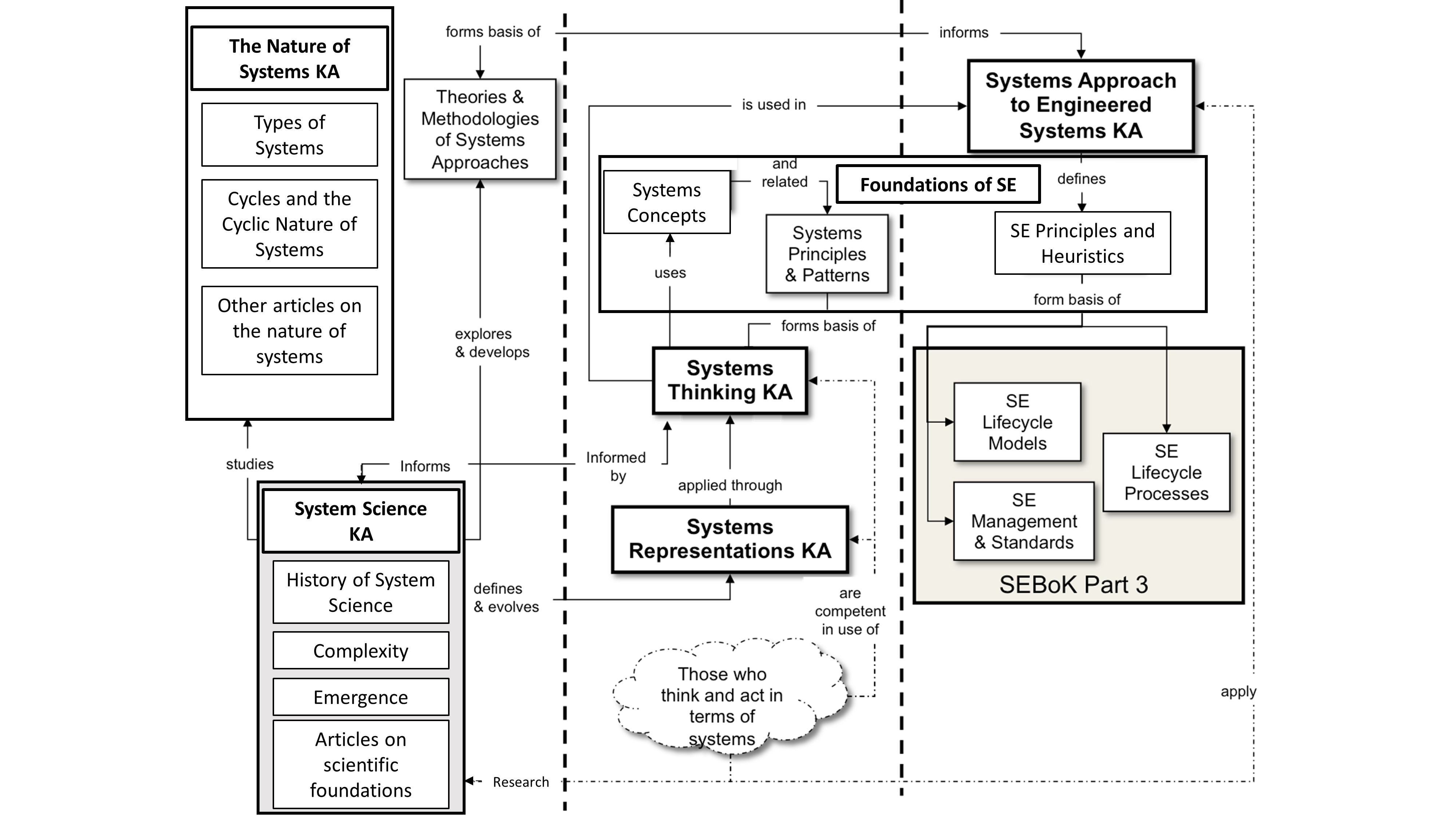
図中の英語
The six Knowledge Areas in Part 2 each highlight a different but complementary aspect of systems foundations:
Part 2 の6つの知識領域は、システムズの基礎について、それぞれ異なるが互いに補完し合う側面を強調している。
1. Systems Fundamentals, introduces essential definitions, concepts, principles, and heuristics. These provide systems engineers with a baseline vocabulary and the means to distinguish different kinds of systems, including product, service, enterprise, and system-of-systems,
1. Systems Fundamentals(システムズの基礎)は、本質的な定義、概念、原則、ヒューリスティクスを紹介する。これらは、システムズエンジニアに基礎となる語彙を提供するとともに、製品、サービス、エンタープライズ、システム・オブ・システムズを含む、異なる種類のシステムを区別する手段を与える。
2. The Nature of Systems, surveys the diversity of natural, engineered, and socio-technical systems, drawing attention to universal patterns that underpin systems science and form the basis of systems thinking and systems engineering.
2. The Nature of Systems(システムの本質)は、自然システム、エンジニアリング対象システム、社会技術システムの多様性を概観し、システム科学を下支えするとともにシステム思考とシステムズエンジニアリングの基礎を成す、普遍的なパターンに目を向ける。
3. Systems Science, presents influential theories and movements in systems research, including the chronological development of systems knowledge and the foundations that inform systems approaches.
3. Systems Science(システム科学)は、システムズの知識の年代を追った発展や、システムズアプローチに情報を与える基礎を含め、システム研究における影響力のある理論と運動を示す。
4. Systems Thinking, describes the perspectives, principles, and patterns that characterize a systemic worldview. It emphasizes the role of reflective practitioners who integrate research and practice in order to frame and address complex problems.
4. Systems Thinking(システム思考)は、システム的な世界観を特徴づける視点、原則、パターンを記述する。また、複雑な問題を捉えて対処するために研究と実践を統合する、省察的な実践者の役割を強調する。
5. Representing Systems with Models, considers the central role of models in both advancing systems theory and supporting engineering practice, from conceptual understanding to design and analysis..
5. Representing Systems with Models(モデルによるシステムの表現)は、概念的理解から設計・分析に至るまで、システム理論を前進させるうえでも、エンジニアリング実践を支えるうえでも、モデルが果たす中心的な役割を考察する。
6. Systems Approach Applied to Engineered Systems, defines a structured approach for problem and opportunity discovery, solution synthesis, analysis, implementation, and use. This knowledge area provides the most direct link between systems foundations and practical SE application.
6. Systems Approach Applied to Engineered Systems(エンジニアリング対象システムへのシステムズアプローチの適用)は、問題と機会の発見、解決策の合成、分析、実装、利用のための構造化されたアプローチを定義する。この知識領域は、システムズの基礎と SE の実践的な応用とを最も直接的に結びつけるものである。
Taken together, these Knowledge Areas form a “system of ideas” that connects research, understanding, and practice. They provide a shared foundation of systems knowledge that underpins a wide range of scientific, management, and engineering disciplines, and that can be applied across all types of domains.
これらの知識領域は全体として、研究、理解、実践を結びつける「考えのシステム(system of ideas)」を形成する。これらは、科学、マネジメント、エンジニアリングの幅広い分野を下支えし、あらゆる種類の領域にわたって適用できる、システムズの知識の共通の基礎を提供する。
IFSR. 2012. The Systems Praxis Framework, Developed as a Joint Project of INCOSE and ISSS. Vienna, Austria: International Federation for Systems Research (IFSR). Available at: https://systemspraxis.org/framework.pdf.
Sillitto, H.G., 2012. "Integrating systems science, systems thinking, and systems engineering: Understanding the differences and exploiting the synergies", Proceedings of the 22nd INCOSE International Symposium, Rome, Italy, 9-12 July, 2012.
Bertalanffy, L., von. 1968. General System Theory: Foundations, Development, Applications, rev. ed. New York, NY, USA: Braziller.
Checkland, P. B. 1999. Systems Thinking, Systems Practice. Chichester, UK: John Wiley & Sons.
INCOSE (2022). INCOSE Systems Engineering Vision 2025. San Diego, CA: International Council on Systems Engineering.
Blanchard, B., & Fabrycky, W. (2010). Systems Engineering and Analysis (5th ed.). Saddle River, NJ: Prentice Hall.
Lawson, H. (2010). A Journey Through the Systems Landscape. London: College Publications.
Meadows, D. (2008). Thinking in Systems. White River Junction, VT: Chelsea Green.
Mobus, G. (2022). System Science: Theory, Analysis, Modeling and Design. Springer.
Ostrom, E. (2009). “A General Framework for Analyzing Sustainability of Social-Ecological Systems.” PNAS, 104(51): 15181–15187.
Ostrom, E. (2009). "A General Framework for Analyzing Sustainability of Social-Ecological Systems." PNAS, 104(51): 15181–15187.
Senge, P.M. (1990). The Fifth Discipline: The Art & Practice of the Learning Organization. New York: Doubleday.
Troncale, L. (1985–2010). Selected works on Systems Isomorphies and Systems Processes.
Volk, T. (2017). Quarks to Culture: How We Came to Be. Columbia University Press.
Zwick, M. (2023). Elements and Relations: Aspects of a Scientific Metaphysics. Springer.