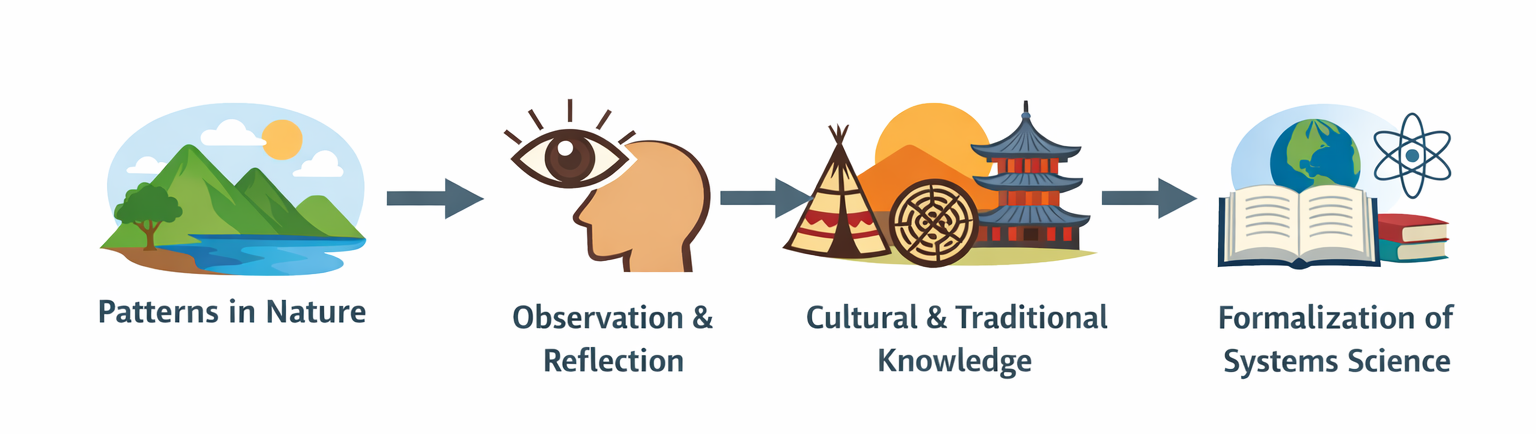
図1:自然のパターンからシステム科学の出現へ。(SEBoK original)
From Nature's Patterns to Systems Science
This article introduces the development of systems science by tracing its roots in the recognition of recurring patterns in nature and the gradual emergence of a formal scientific field devoted to understanding them. It serves as the opening article of the Systems Science Knowledge Area (KA), building conceptually on the preceding KA on Natural Systems and preparing the ground for the subsequent exploration of the historical development of systems science.
本記事は、システム科学の発展を、その起源である自然界の繰り返しパターンの認識にさかのぼり、それらを理解することに専心する体系立った科学分野が徐々に出現してきた過程をたどりながら紹介する。本記事は Systems Science 知識領域(Knowledge Area、KA)の冒頭の記事であり、概念的には先行する Natural Systems に関する KA を土台とし、続く記事でシステム科学の歴史的発展を探求するための地ならしとなる。
Acknowledgement
謝辞
This article reflects established knowledge from systems science and systems engineering, organized and collated for the SEBoK. Drafting support was provided by OpenAI’s ChatGPT, with all content reviewed and finalized by the author, who retains full responsibility.
本記事は、システム科学とシステムズエンジニアリングにおける確立された知識を、SEBoK のために整理・集約したものである。起草には OpenAI の ChatGPT による支援を受けた。すべての内容は著者がレビューして最終的な形に仕上げており、著者が全責任を負う。
Across many domains of experience and scientific inquiry, observers have long recognized that the world exhibits recurring forms of organization and behavior. Cycles of growth and decay, nested structures within living organisms, balancing dynamics in ecosystems, and patterns of stability and change in social systems all reveal a patterned structure to reality. These recurring features suggest that systems, whether biological, social, ecological, or technological, share common characteristics governing how they organize, persist, interact, and evolve.
経験と科学的探究の多くの領域で、観察者たちは、世界が組織化と振る舞いにおいて繰り返し現れる形態を示すことを長らく認識してきた。成長と衰退の周期、生物内部の入れ子構造、生態系において均衡を保つダイナミクス、社会システムにおける安定と変化のパターンは、いずれも現実がパターン化された構造を持つことを明らかにしている。こうした繰り返し現れる特徴は、生物的、社会的、生態的、技術的のいずれであれ、システムが、自らの組織化、存続、相互作用、進化のあり方を支配する共通の特性を共有していることを示唆する。
The recognition of such patterns eventually led researchers to ask whether general principles of organization might apply across different kinds of systems. The search for such principles ultimately contributed to the emergence of systems science as a formal interdisciplinary field.
こうしたパターンの認識は、やがて研究者たちに、組織化の一般原理が異なる種類のシステムにまたがって当てはまるのではないかという問いを抱かせた。そうした原理の探求は、最終的に、独立した学際分野としてのシステム科学の出現に寄与した。
Human engagement with systemic patterns can be understood as a progression from observation of natural organization to the development of formal scientific theories of systems. Early recognition of recurring patterns in nature inspired reflection across cultures and disciplines, which gradually evolved into structured scientific investigation.
システム的なパターンへの人間の関わりは、自然の組織化の観察から、システムに関する形式的な科学理論の発展へと至る進展として理解できる。自然界に繰り返し現れるパターンが早くから認識されたことで、文化や学問分野を越えた省察が促され、その省察が徐々に構造化された科学的探究へと発展していった。
図中の英語
Figure 1 illustrates this conceptual progression, from patterns observed in nature, through human observation and cultural interpretation, to the formalization of systems science.
図1はこの概念的な進展を示している。すなわち、自然の中で観察されるパターンから、人間による観察と文化的解釈を経て、システム科学の形式化に至る進展である。
While systems science emerged as a formal discipline primarily during the twentieth century, systemic insight itself has much deeper historical and cultural roots.
システム科学が確立した学問分野として出現したのは主に20世紀のことだが、システム的洞察そのものは、はるかに深い歴史的・文化的根源を持つ。
Many intellectual and cultural traditions have long recognized patterns of interdependence, relationality, and cyclic processes in the natural world. Ancient philosophical traditions in both Eastern and Western cultures often emphasized the interconnected nature of phenomena and the importance of balance, harmony, and dynamic change. Concepts such as cyclical time, nested order, and relational identity appear in early philosophical writings and cosmologies across many civilizations.
多くの知的・文化的伝統は、自然界における相互依存、関係性、循環的プロセスのパターンを長らく認識してきた。東洋と西洋の双方における古代哲学の伝統は、しばしば、現象が相互に結びついていることや、バランス、調和、動的な変化の重要性を強調した。循環する時間、入れ子状の秩序、関係的アイデンティティといった概念は、多くの文明の初期の哲学的著作や宇宙論に見られる。
Indigenous knowledge traditions around the world frequently emphasize relational understandings of humans, ecosystems, and the natural world, recognizing that living systems exist within webs of reciprocal relationships and dynamic environmental processes. Such perspectives often stress stewardship, adaptation, and the maintenance of balance within ecological systems.
世界各地の先住民の知識伝統は、人間、生態系、自然界についての関係的な理解をしばしば強調し、生命システムが相互的な関係の網と動的な環境プロセスの中に存在することを認識している。こうした視点は、しばしば生態系における管理責任(stewardship)、適応、バランスの維持を重視する。
These traditions do not constitute systems science in the modern academic sense. However, they reflect enduring human attempts to understand patterns of organization and interdependence in the world, demonstrating that systemic awareness is not limited to any single intellectual tradition.
これらの伝統は、現代の学術的な意味でのシステム科学にあたるものではない。しかし、それらは世界における組織化と相互依存のパターンを理解しようとする、人間の連綿と続く試みを反映しており、システム的な気づきが単一の知的伝統に限られないことを示している。
Modern systems science can therefore be understood not as the origin of systemic thinking, but as a formal scientific articulation of questions that humans have long explored across cultures and disciplines.
したがって、現代のシステム科学は、物事をシステムとして捉える思考の起源としてではなく、人間が文化や学問分野を越えて長らく探求してきた問いを形式的な科学として明示したものとして理解できる。
Systemic patterns are particularly evident in the natural world. Observations of natural phenomena reveal recurring structures and dynamics across many domains.
システム的なパターンは、自然界において特に顕著である。自然現象を観察すると、多くの領域にわたって繰り返し現れる構造とダイナミクスが明らかになる。
Examples include:
例として以下が挙げられる。
• feedback processes that regulate stability in biological and ecological systems
• フィードバックプロセス:生物的・生態的システムにおいて安定を調節する
• cyclic dynamics such as seasonal cycles, nutrient cycles, and biological rhythms
• 循環的ダイナミクス:季節の周期、栄養塩の循環、生物リズムなど
• hierarchical organization across multiple levels of structure
• 階層的組織化:構造の複数のレベルにまたがる
• flows of energy and information that sustain system activity
• エネルギーと情報の流れ:システムの活動を維持する
• self-organization, where order emerges spontaneously from interacting components
• 自己組織化:相互作用する構成要素から秩序が自発的に生じる
These patterns appear across many scientific disciplines. Feedback regulation is central to physiology and ecology. Cyclic processes appear in ecosystems, climate systems, and planetary dynamics. Hierarchical organization appears in biological organisms, ecosystems, and complex technological infrastructures.
これらのパターンは多くの科学分野に見られる。フィードバック調節は、生理学と生態学において中心的な位置を占める。循環的プロセスは、生態系、気候システム、惑星のダイナミクスに見られる。階層的組織化は、生物、生態系、複雑な技術インフラに見られる。
Modern studies of systemic patterns in nature have further highlighted the existence of recurring structural and dynamic patterns across multiple scales of organization, sometimes described as meta-patterns. These patterns include phenomena such as cycles, branching networks, gradients, nested structures, and feedback regulation that recur across biological, ecological, and physical systems (Volk 2017).
自然におけるシステム的パターンに関する現代の研究は、複数の組織化スケールにわたって繰り返し現れる構造的・動的パターンの存在をさらに浮き彫りにしてきた。これらはメタパターン(meta-patterns)と呼ばれることもある。こうしたパターンには、生物的、生態的、物理的システムにわたって繰り返し現れる、周期、分岐ネットワーク、勾配、入れ子構造、フィードバック調節といった現象が含まれる(Volk 2017)。
The widespread recurrence of these patterns suggests that similar organizing principles may operate across many domains of reality, raising the possibility of a more general science of systems.
これらのパターンが広く繰り返し現れることは、類似の組織化原理が現実の多くの領域にわたって働いている可能性を示唆するとともに、より一般的なシステムの科学の可能性を提起する。
During the nineteenth and early twentieth centuries, scientific progress was largely driven by reductionist approaches, which sought to understand complex phenomena by analyzing their individual components. This approach produced major advances in physics, chemistry, and biology.
19世紀から20世紀初頭にかけて、科学の進歩を主に牽引したのは還元主義的アプローチであった。これは、複雑な現象を、その個々の構成要素の分析によって理解しようとするものである。このアプローチは、物理学、化学、生物学に大きな進歩をもたらした。
However, certain phenomena resisted explanation through reduction alone. Complex systems such as organisms, ecosystems, societies, and large technological infrastructures exhibit behaviors that arise from interactions among components rather than from the properties of the components themselves.
しかし、ある種の現象は、還元だけでは説明しきれなかった。生物、生態系、社会、大規模な技術インフラといった複雑なシステムは、構成要素そのものの特性からではなく、構成要素間の相互作用から生じる振る舞いを示す。
Recognizing this challenge, scientists began exploring new ways of understanding such phenomena. Warren Weaver famously described these challenges as “problems of organized complexity”, referring to situations in which large numbers of interacting elements produce structured and dynamic behavior that cannot be explained through simple statistical or reductionist models (Weaver 1948).
この課題を認識した科学者たちは、そのような現象を理解する新たな方法を模索し始めた。Warren Weaver は、こうした課題を「組織化された複雑性の問題(problems of organized complexity)」と表現したことでよく知られる。これは、多数の相互作用する要素が、単純な統計的モデルや還元主義的モデルでは説明できない、構造化された動的な振る舞いを生み出す状況を指す(Weaver 1948)。
Understanding organized complexity required scientific approaches capable of studying systems as organized wholes rather than collections of isolated parts.
組織化された複雑性を理解するには、システムを孤立した部分の集合としてではなく、組織化された全体として研究できる科学的アプローチが必要であった。
Several influential developments during the twentieth century contributed to the emergence of systems science.
20世紀には、いくつかの影響力の大きな発展がシステム科学の出現に寄与した。
One early precursor was the work of Alexander Bogdanov, whose early twentieth-century framework of Tektology attempted to formulate a universal science of organization across natural and social systems. Although developed independently of later systems traditions, Bogdanov’s work anticipated many themes that would later appear in systems theory.
初期の先駆けの一つは Alexander Bogdanov の仕事であり、彼の20世紀初頭の「テクトロジー(Tektology)」という枠組みは、自然的システムと社会的システムにまたがる組織化の普遍科学を定式化しようとするものであった。Bogdanov の仕事は、それ以降のシステム論の諸伝統とは独立に発展したものの、後年システム理論に現れる多くのテーマを先取りしていた。
Later developments included General Systems Theory, developed by Ludwig von Bertalanffy, which sought to identify general principles governing the organization and behavior of open systems across biological, social, and technological domains (Bertalanffy 1968).
その後の発展としては、Ludwig von Bertalanffy が展開した一般システム理論(General Systems Theory)がある。これは、生物的、社会的、技術的領域にわたって開放系の組織化と振る舞いを支配する一般原理を特定しようとするものであった(Bertalanffy 1968)。
At the same time, cybernetics investigated mechanisms of communication, feedback, and control in both biological organisms and machines (Wiener 1948; Ashby 1956). Cybernetics demonstrated how feedback processes enable systems to regulate themselves and adapt to changing environments.
同時期に、サイバネティクス(cybernetics)は、生物と機械の双方におけるコミュニケーション、フィードバック、制御のメカニズムを探究した(Wiener 1948; Ashby 1956)。サイバネティクスは、フィードバックプロセスによってシステムが自らを調節し、変化する環境に適応できるようになる仕組みを示した。
Kenneth Boulding further expanded these ideas by proposing a hierarchical classification of systems, illustrating how increasing levels of complexity appear across natural and social systems (Boulding 1956).
Kenneth Boulding は、システムの階層的分類を提案してこれらの考えをさらに押し広げ、自然的システムと社会的システムにわたって、複雑性のレベルがどのように高まっていくかを示した(Boulding 1956)。
Together, these developments contributed to the formation of systems science as a field concerned with identifying general patterns of organization across many domains of reality.
これらの発展は相まって、現実の多くの領域にわたる組織化の一般パターンの特定に取り組む分野としての、システム科学の形成に寄与した。
Further developments deepened the scientific study of complex systems.
その後の発展は、複雑なシステムの科学的研究をさらに深めた。
Herbert Simon examined the hierarchical architecture of complex systems, arguing that many complex structures evolve through the gradual aggregation of stable subsystems (Simon 1962). Simon’s work helped explain why hierarchical organization is common in both natural and engineered systems.
Herbert Simon は複雑なシステムの階層的アーキテクチャを検討し、多くの複雑な構造は、安定したサブシステムが徐々に集積していくことを通じて進化すると論じた(Simon 1962)。Simon の仕事は、自然的システムとエンジニアード・システムの双方で階層的組織化が一般的に見られる理由の説明に役立った。
Research in thermodynamics and nonlinear systems also revealed how self-organization and emergent order can arise in systems far from equilibrium (Nicolis and Prigogine 1977). These discoveries contributed to the development of modern complexity science.
熱力学と非線形システムの研究もまた、平衡から遠く離れたシステムにおいて自己組織化と創発的秩序がどのように生じ得るかを明らかにした(Nicolis and Prigogine 1977)。これらの発見は、現代の複雑性科学の発展に寄与した。
Together, these developments expanded the scientific understanding of how complex systems form, behave, and evolve.
これらの発展は相まって、複雑なシステムがどのように形成され、振る舞い、進化するかについての科学的理解を広げた。
As interest in systemic phenomena grew, several complementary intellectual traditions emerged that contributed to the development of systems science. These traditions include:
システム的現象への関心が高まるにつれ、システム科学の発展に寄与するいくつかの相補的な知的伝統が現れた。それらの伝統には以下が含まれる。
• biological systems theory
• 生物学的システム理論
• cybernetics and control theory
• サイバネティクスと制御理論
• systems modeling and complexity science
• システムモデリングと複雑性科学
• systems analysis and interdisciplinary systems research
• システム分析と学際的システム研究
Although these traditions developed in different disciplinary contexts, they share a common focus on relationships, interactions, and organization within complex systems.
これらの伝統は異なる学問的コンテキストのもとで発展したが、複雑なシステムにおける関係、相互作用、組織化に焦点を当てる点で共通している。
Systems science gradually emerged from the convergence of these streams of inquiry. The field seeks to understand systemness itself, the underlying principles and patterns that characterize systems across natural, social, and engineered domains.
システム科学は、こうした探究の流れが収束する中から徐々に出現した。この分野が理解しようとするのはシステム性そのもの(systemness itself)、すなわち自然的、社会的、工学的に構成された領域にわたってシステムを特徴付ける根底的な原理とパターンである。
The next article in this Knowledge Area, History and Foundations of Systems Science, examines how these ideas developed into a coherent body of scientific thought and how the field has evolved through contributions from multiple disciplines and intellectual traditions.
この知識領域の次の記事 History and Foundations of Systems Science では、これらの考えがどのようにして首尾一貫した科学的思考の体系へと発展したか、そしてこの分野が複数の学問分野や知的伝統からの貢献を通じてどのように進化してきたかを検討する。
Ashby, W. R. 1956. An Introduction to Cybernetics. London, UK: Chapman & Hall.
Bertalanffy, L. von. 1968. General System Theory: Foundations, Development, Applications. New York, NY: Braziller.
Bogdanov, A. 1980. Essays in Tektology. Seaside, CA: Intersystems.
Boulding, K. E. 1956. “General Systems Theory—The Skeleton of Science.” Management Science 2(3), pp. 197–208.
Simon, H. A. 1962. “The Architecture of Complexity.” Proceedings of the American Philosophical Society.
Volk, T. 2017. Quarks to Culture: How We Came to Be. New York, NY: Columbia University Press.
Weaver, W. 1948. “Science and Complexity.” American Scientist 36, pp. 536–544.
Wiener, N. 1948. Cybernetics: Or Control and Communication in the Animal and the Machine. Cambridge, MA: MIT Press.
None.
Miller, J. G. 1978. Living Systems. New York, NY: McGraw-Hill.
Mobus, G. E., and M. C. Kalton. 2015. Principles of Systems Science. New York, NY: Springer.
Nicolis, G., and I. Prigogine. 1977. Self-Organization in Nonequilibrium Systems. New York, NY: Wiley.
Warfield, J. N. 2006. An Introduction to Systems Science. Singapore: World Scientific.