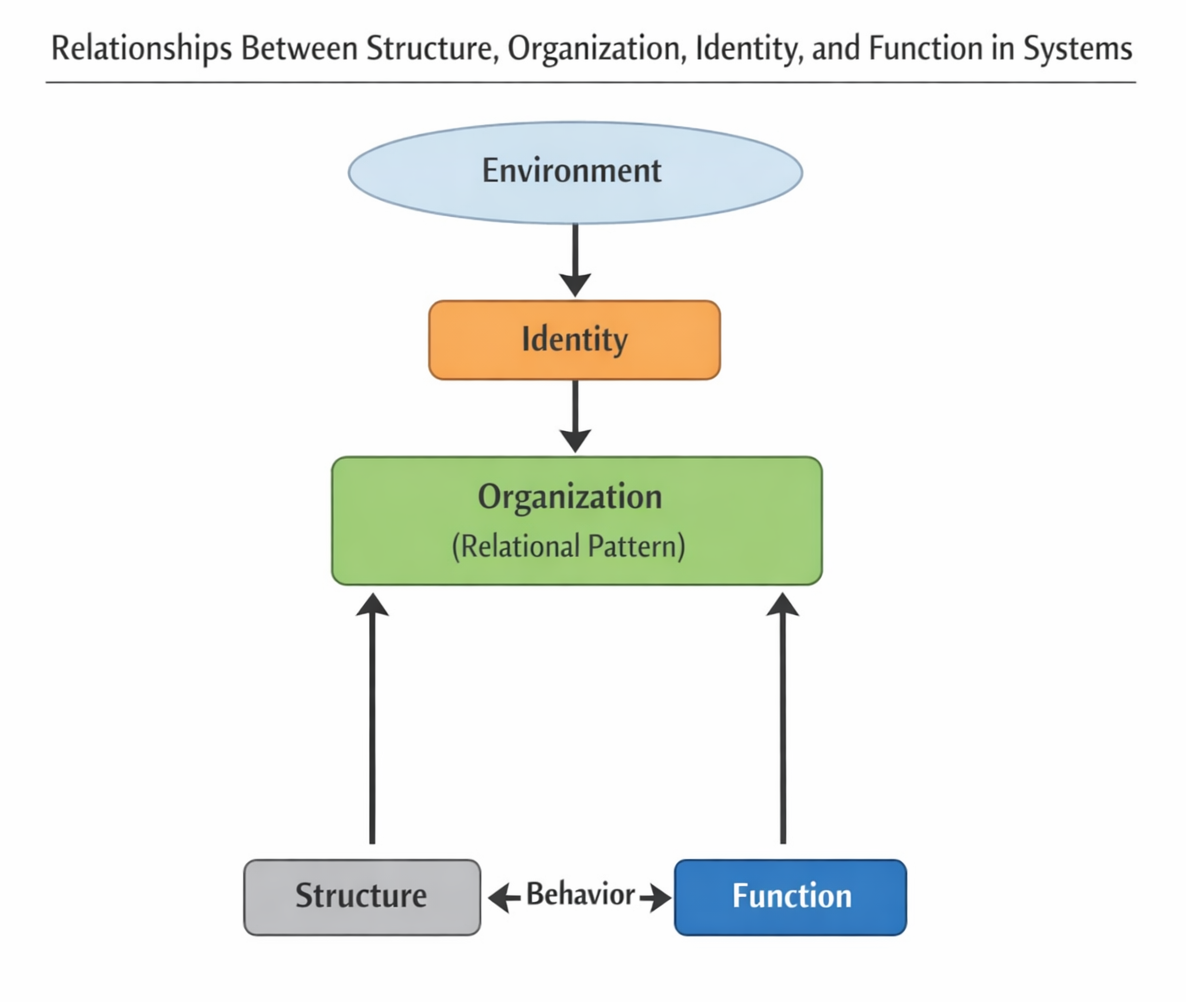
図1:システムにおける構造、アイデンティティ、機能の間の関係。(SEBoK original)
Structure, Identity, and Function in Systems
Systems can be understood by looking at three closely connected ideas: structure, identity, and function. Structure describes how a system is organized and how its parts relate to one another, while function reflects what the system does and the outcomes it produces. Identity helps explain what makes a system recognizable over time, even as it changes or adapts to new conditions. Together, these perspectives help explain how systems behave, evolve, and maintain continuity across natural, engineered, and socio-technical contexts.
システムは、構造、アイデンティティ、機能という密接に結びついた3つの考え方に着目することで理解できる。構造はシステムがどのように組織化され、その部分が互いにどう関係しているかを記述し、機能はシステムが何を行い、どのような成果を生み出すかを表す。アイデンティティは、システムが変化したり新しい条件に適応したりしても、時間を通じて認識可能であり続けるのはなぜかを説明するのに役立つ。これらの視点は合わせて、自然的、人工的、社会技術的なコンテキストにおいて、システムがどのように振る舞い、進化し、連続性を維持するかを説明する助けとなる。
Acknowledgement
謝辞
This article reflects established knowledge from systems science and systems engineering, organized and collated for the SEBoK. Drafting support was provided by OpenAI’s ChatGPT, with all content reviewed and finalized by the author, who retains full responsibility.
本記事は、システム科学とシステムズエンジニアリングにおける確立された知識を、SEBoK 向けに整理・集約したものである。起草には OpenAI の ChatGPT の支援を受け、すべての内容は著者がレビューして最終化したものであり、著者が全責任を負う。
Systems maintain coherence through relationships among their structure, identity, and function. These elements together determine how systems are organized, how they distinguish themselves from their environments, and how they perform activities that sustain their continued existence.
システムは、その構造、アイデンティティ、機能の間の関係を通じて一貫性を維持する。これらの要素は合わせて、システムがどのように組織化されるか、環境から自らをどのように区別するか、そして自らの存続を支える活動をどのように遂行するかを決定する。
In systems science, a system is generally understood as a set of interacting components that together form a coherent whole. The properties and behaviors of the whole arise not only from the characteristics of individual components but also from the relationships among those components. These relationships define the system’s structure and enable processes that support system function.
システム科学では一般に、システムは、相互作用し合いながら一体となって首尾一貫した全体を形成する構成要素の集合として理解される。全体の特性と振る舞いは、個々の構成要素の特徴だけでなく、それらの構成要素間の関係からも生じる。これらの関係がシステムの構造を定義し、システムの機能を支えるプロセスを可能にする。
Understanding the interplay between structure, identity, and function provides a foundation for analyzing both natural and engineered systems. It explains how systems persist over time, how they maintain coherence despite internal change, and how they perform the activities that characterize them as recognizable entities.
構造、アイデンティティ、機能の相互作用を理解することは、自然的システムとエンジニアード・システムの双方を分析するための基盤となる。それによって、システムが時間を通じてどのように存続するのか、内部の変化にもかかわらずどのように一貫性を維持するのか、そして認識可能な実体としてのシステムを特徴付ける活動をどのように遂行するのかが説明される。
The structure of a system refers to the arrangement of its components and the relationships among them. These relationships may involve physical connections, flows of energy or materials, exchanges of information, or other forms of interaction.
システムの構造(structure of a system)とは、その構成要素の配置と、構成要素間の関係を指す。これらの関係には、物理的な接続、エネルギーや物質の流れ、情報の交換、その他の形態の相互作用が含まれ得る。
Structure determines how components influence one another and how processes propagate throughout the system. In a biological organism, structural organization includes tissues, organs, and circulatory pathways that enable coordinated physiological processes. In an engineered system such as an aircraft, structural organization includes subsystems, interfaces, and communication links that allow components to operate together as an integrated whole.
構造は、構成要素が互いにどのように影響し合い、プロセスがシステム全体にどのように伝播するかを決定する。生物の場合、構造的組織化には、協調した生理学的プロセスを可能にする組織、器官、循環経路が含まれる。航空機のようなエンジニアード・システムの場合、構造的組織化には、構成要素が統合された全体として連携して動作することを可能にするサブシステム、インタフェース、通信リンクが含まれる。
Structure therefore represents more than a collection of parts. It reflects an organized pattern of relationships that constrains and enables system behavior.
したがって、構造は単なる部分の集まり以上のものである。それは、システムの振る舞いを制約し、かつ可能にする組織化された関係のパターン(organized pattern of relationships)を反映している。
General systems theory emphasized the importance of understanding such relational patterns rather than focusing solely on isolated components. As described by Ludwig von Bertalanffy, many important properties of systems arise from the organization of relationships among elements.
一般システム理論は、孤立した構成要素だけに焦点を当てるのではなく、こうした関係的パターンを理解することの重要性を強調した。Ludwig von Bertalanffy が述べたように、システムの重要な特性の多くは、要素間の関係の組織化から生じる。
Cybernetics similarly highlights the role of structure in shaping system behavior. W. Ross Ashby showed that the behavior of a system is constrained by its internal structure and the regulatory relationships among its components.
サイバネティクスも同様に、システムの振る舞いを形作るうえでの構造の役割を浮き彫りにしている。W. Ross Ashby は、システムの振る舞いがその内部構造と構成要素間の調節的関係によって制約されることを示した。
Closely related to structure is the concept of organization, which refers to the relationships that define a system as a particular kind of entity. Organization determines which relationships must remain intact for the system to maintain its identity.
構造と密接に関連するのが組織化(organization)の概念であり、これはシステムを特定の種類の実体として定義する関係を指す。組織化は、システムがアイデンティティを維持するために、どの関係が損なわれずに保たれていなければならないかを決定する。
Biologists Humberto Maturana and Francisco Varela distinguished between structure, which may change over time, and organization, which defines the essential relations that characterize a system.
生物学者の Humberto Maturana と Francisco Varela は、時間とともに変化し得る構造(structure)と、システムを特徴付ける本質的な関係を定義する組織化(organization)とを区別した。
For example, the components of a living organism continually change through metabolic processes and cellular turnover. Despite these structural changes, the organism maintains its identity because the organizational relationships that sustain life remain intact.
例えば、生物の構成要素は、代謝プロセスや細胞の入れ替わりによって絶えず変化している。こうした構造的変化にもかかわらず生物がアイデンティティを維持するのは、生命を維持する組織的関係が損なわれずに保たれているからである。
Similarly, engineered systems may undergo component replacement and modification throughout their lifecycle while preserving their identity as functioning systems.
同様に、エンジニアード・システムも、ライフサイクルを通じて構成要素の交換や変更を受けながら、機能するシステムとしてのアイデンティティを保持し得る。
System identity therefore depends not only on the presence of particular components but on the continuity of organizational relationships that sustain the system as a coherent whole.
したがって、システムのアイデンティティは、特定の構成要素が存在することだけでなく、システムを首尾一貫した全体として維持する組織的関係の連続性(continuity of organizational relationships)にも依存する。
Relational perspectives in systems science further emphasize that systemic properties arise from networks of relationships rather than isolated components. Robert Rosen argued that living systems must be understood primarily through the relationships that sustain their organization.
システム科学における関係的視点はさらに、システム的特性が孤立した構成要素からではなく、関係のネットワークから生じることを強調する。Robert Rosen は、生命システムは主として、その組織を維持する関係を通じて理解されなければならないと主張した。
Systems are typically distinguished from their environments by boundaries that define the scope of the system.
システムは通常、その範囲を定義する境界(boundaries)によって環境から区別される。
Boundaries identify which components and processes belong to the system and which lie outside it. These boundaries may be physical, functional, or conceptual.
境界は、どの構成要素とプロセスがシステムに属し、どれがシステムの外にあるかを特定する。これらの境界は、物理的なものも、機能的なものも、概念的なものもあり得る。
A biological membrane forms a physical boundary that separates an organism from its environment while regulating exchanges of materials and energy. In engineered systems, boundaries often correspond to defined interfaces that regulate interactions with external systems.
生体膜は、生物をその環境から隔てつつ、物質やエネルギーの交換を調節する物理的境界を形成する。エンジニアード・システムでは、境界はしばしば、外部システムとの相互作用を調節する、定義されたインタフェースに対応する。
Importantly, boundaries do not imply isolation. Most systems maintain their identity through regulated interaction with their environments, exchanging energy, materials, and information while preserving internal organization.
重要なのは、境界が孤立を意味するわけではないことである。ほとんどのシステムは、内部の組織化を保持しながらエネルギー、物質、情報を交換し、環境との調節された相互作用(regulated interaction with their environments)を通じてアイデンティティを維持している。
In systems thinking practice, boundaries are also recognized as analytical constructs used to define the scope of a system of interest (Ackoff 1999).
システム思考の実践においては、境界は、対象システム(system of interest)の範囲を定義するために用いられる分析上の構成物としても認識されている(Ackoff 1999)。
Structure, identity, and function are closely interconnected.
構造、アイデンティティ、機能は互いに密接に結びついている。
Structure provides the arrangement of components that enables processes to occur. These processes allow the system to perform functions that sustain its continued existence. At the same time, the organization of structural relationships maintains the identity of the system as a coherent whole.
構造は、プロセスが生じることを可能にする構成要素の配置を提供する。これらのプロセスによって、システムは自らの存続を支える機能を遂行できる。同時に、構造的関係の組織化は、首尾一貫した全体としてのシステムのアイデンティティを維持する。
Figure 1 illustrates these relationships.
図1にこれらの関係を示す。
図中の英語
System structure defines the arrangement of components and their relationships. These relationships sustain system identity by preserving organizational coherence. At the same time, structural organization enables functions and behaviors that allow the system to operate effectively within its environment.
システム構造は、構成要素の配置とその関係を定義する。これらの関係は、組織的一貫性を保持することでシステムのアイデンティティを維持する。同時に、構造的組織化は、システムがその環境の中で効果的に動作することを可能にする機能と振る舞いを可能にする。
Changes in system structure may alter system behavior, while disruptions to essential organizational relationships may threaten system identity.
システム構造が変化すればシステムの振る舞いが変わることがあり、本質的な組織的関係が乱されればシステムのアイデンティティが脅かされることがある。
Understanding these relationships is therefore central to understanding system behavior and persistence.
したがって、これらの関係を理解することは、システムの振る舞いと存続を理解するうえで中心となる。
Systems science applies to a wide range of systems across both the natural world and human society. Although these systems differ in their components and mechanisms, they share common systemic properties such as organization, boundaries, interactions, and functional processes.
システム科学は、自然界と人間社会の双方にわたる広範なシステムに適用される。これらのシステムは構成要素やメカニズムこそ異なるが、組織化、境界、相互作用、機能的プロセスといった共通のシステム的特性を共有している。
Several broad domains of systems can be identified.
システムについては、いくつかの大きな領域を特定できる。
*Physical systems include structures such as atoms, planetary systems, and engineered artifacts. Their structure arises from physical interactions among components, and their behavior reflects processes such as energy transfer and motion.
• 物理的システム(Physical systems):原子、惑星系、人工物などの構造を含む。その構造は構成要素間の物理的相互作用から生じ、その振る舞いはエネルギー伝達や運動といったプロセスを反映する。
*Living systems include cells, organisms, and ecosystems. These systems maintain identity through biological organization and metabolic processes that sustain life (Miller 1978).
• 生命システム(Living systems):細胞、生物、生態系を含む。これらのシステムは、生命を維持する生物学的組織化と代謝プロセスを通じてアイデンティティを維持する(Miller 1978)。
*Social systems include communities, institutions, and organizations. In these systems, structure arises from relationships among individuals and groups, while functions involve communication, coordination, governance, and collective action (Parsons 1951).
• 社会システム(Social systems):コミュニティ、制度、組織を含む。これらのシステムでは、構造は個人や集団の間の関係から生じ、機能にはコミュニケーション、調整、ガバナンス、集合的行動が関わる(Parsons 1951)。
*Conceptual systems include scientific theories, mathematical frameworks, classification systems, and engineering models. These systems consist primarily of concepts and relationships that organize knowledge and reasoning.
• 概念的システム(Conceptual systems):科学理論、数学的枠組み、分類システム、エンジニアリングモデルを含む。これらのシステムは主として、知識と推論を組織化する概念と関係から成る。
Despite their differences, all of these domains exhibit recognizable relationships among structure, identity, and function. Systems science therefore seeks principles that apply across these diverse contexts (Boulding 1956).
それぞれ違いはあるものの、これらの領域はいずれも、構造、アイデンティティ、機能の間に認識可能な関係を示す。したがって、システム科学は、こうした多様なコンテキストにわたって当てはまる原理を探究する(Boulding 1956)。
For a system to persist over time, its structural organization and functional processes must remain sufficiently coherent. This coherence allows the system to maintain identity despite internal change or environmental disturbance.
システムが時間を通じて存続するには、その構造的組織化と機能的プロセスが十分な一貫性を保ち続けなければならない。この一貫性により、システムは内部の変化や環境からの外乱にもかかわらずアイデンティティを維持できる。
Systems that lose essential relationships among components may experience degradation or collapse. Biological organisms may lose viability if regulatory processes fail, while engineered systems may fail when structural relationships among subsystems break down.
構成要素間の本質的な関係を失ったシステムは、劣化や崩壊に至ることがある。生物は調節プロセスが機能しなくなれば存続可能性を失うことがあり、エンジニアード・システムはサブシステム間の構造的関係が崩れれば故障することがある。
Maintaining coherence among structure, identity, and function is therefore central to system viability.
したがって、構造、アイデンティティ、機能の間の一貫性を維持することは、システムの存続可能性(viability)の中心となる。
Concepts such as regulation, feedback, and adaptation play important roles in maintaining this coherence across many kinds of systems (Ashby 1956; Meadows 2008).
調節、フィードバック、適応といった概念は、多くの種類のシステムにおいてこの一貫性を維持するうえで重要な役割を果たす(Ashby 1956; Meadows 2008)。
The relationship between structure, identity, and function is central to systems engineering practice.
構造、アイデンティティ、機能の関係は、システムズエンジニアリングの実践(systems engineering practice)の中心にある。
Engineers must design system architectures that establish appropriate relationships among components while enabling the system to perform required functions. System architecture frameworks, interface definitions, and model-based representations provide conceptual tools for managing system structure and ensuring coherent integration of subsystems.
エンジニアは、システムが要求される機能を遂行できるようにしながら、構成要素間に適切な関係を確立するシステムアーキテクチャを設計しなければならない。システムアーキテクチャの枠組み、インタフェース定義、モデルベースの表現は、システム構造を管理し、サブシステムの首尾一貫した統合を確実にするための概念的ツールを提供する。
Understanding how structural relationships influence system behavior helps systems engineers design systems that remain reliable and adaptable within complex operational environments.
構造的関係がシステムの振る舞いにどのように影響するかを理解することは、システムズエンジニアが、複雑な運用環境の中で信頼性と適応性を保ち続けるシステムを設計する助けとなる。
Conceptual models and system representations therefore play an important role in enabling engineers to reason about structure and function before systems are physically realized.
したがって、概念モデルとシステム表現は、システムが物理的に実現される前に、エンジニアが構造と機能について推論できるようにするうえで重要な役割を果たす。
Systems maintain coherence through relationships among their structure, organization, and function. Structural arrangements determine how components interact, organizational relationships sustain system identity, and these relationships together enable the system to perform functions within its environment.
システムは、その構造、組織化、機能の間の関係を通じて一貫性を維持する。構造的配置は構成要素がどのように相互作用するかを決定し、組織的関係はシステムのアイデンティティを維持し、これらの関係が一体となって、システムが環境の中で機能を遂行することを可能にする。
These relationships apply across many domains of systems, including physical, living, social, and conceptual systems. Understanding how structure and organization sustain systemic coherence provides an essential foundation for analyzing complex systems.
これらの関係は、物理的システム、生命システム、社会システム、概念的システムを含め、多くのシステム領域にわたって当てはまる。構造と組織化がどのようにシステム的一貫性を維持するかを理解することは、複雑なシステムを分析するための不可欠な基盤となる。
This foundation also prepares the ground for examining how complex behaviors arise from interactions among system components, which is explored further in the following article on Emergence and Complexity.
この基盤はまた、システム構成要素間の相互作用から複雑な振る舞いがどのように生じるかを検討するための下地ともなり、この点は後続の Emergence and Complexity に関する記事でさらに探求される。
Ackoff, R. L. (1999). Ackoff’s Best: His Classic Writings on Management. Wiley.
Ackoff, R. L. (1999). Ackoff's Best: His Classic Writings on Management. Wiley.
Ashby, W. R. (1956). An Introduction to Cybernetics. Chapman & Hall.
Bertalanffy, L. von. (1968). General System Theory: Foundations, Development, Applications. George Braziller.
Boulding, K. E. (1956). “General Systems Theory—The Skeleton of Science.” Management Science, 2(3).
Meadows, D. H. (2008). Thinking in Systems: A Primer. Chelsea Green.
Maturana, H. R., & Varela, F. J. (1980). Autopoiesis and Cognition: The Realization of the Living. D. Reidel.
Miller, J. G. (1978). Living Systems. McGraw-Hill.
Parsons, T. (1951). The Social System. Free Press.
Rosen, R. (1991). Life Itself: A Comprehensive Inquiry into the Nature, Origin, and Fabrication of Life. Columbia University Press.
Simon, H. A. (1962). “The Architecture of Complexity.” Proceedings of the American Philosophical Society, 106(6).
Troncale, L. R. (2006). “Towards a Science of Systems Processes.” Systems Research and Behavioral Science.
Weinberg, G. M. (1975). An Introduction to General Systems Thinking. Wiley.
None.
None.