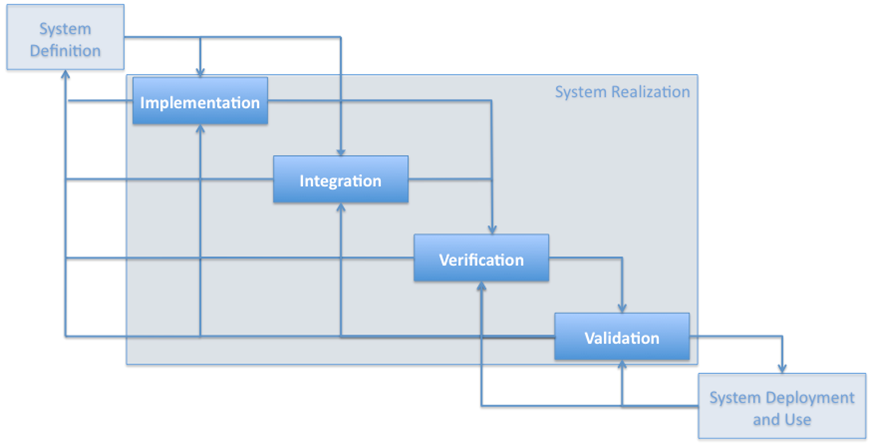
図3.システム実現。(SEBoK Original)
Applying Life Cycle Processes
The Generic Life Cycle Model describes a set of life cycle stages and their relationships. In defining this we described some of the technical and management activities critical to the success of each stage. While this association of activity to stage is important, we must also recognize the through life relationships between these activities to ensure we take a .
汎用ライフサイクルモデル(Generic Life Cycle Model)は、ライフサイクル(life cycle)の段階の集合とその関係を記述する。これを定義する中で、各段階の成功に不可欠な技術アクティビティと管理アクティビティの一部を記述した。アクティビティと段階のこうした結び付けは重要であるが、システムズアプローチ(systems approach)を確実に取るためには、これらのアクティビティの間にあるライフを通じた関係も認識しなければならない。
Systems Engineering technical and management activities are defined in a set of life cycle processes. These group together closely related activities and allow us to describe the relationships between them. In this topic, we discuss a number of views on the nature of the inter-relationships between process activities within a life cycle model.
システムズエンジニアリング(Systems Engineering)の技術アクティビティと管理アクティビティは、一連のライフサイクルプロセス(life cycle processes)の中で定義される。ライフサイクルプロセスは密接に関連するアクティビティをまとめ、アクティビティどうしの関係を記述できるようにする。本トピックでは、ライフサイクルモデル内のプロセスのアクティビティ間の相互関係の性質について、いくつかの見方を論じる。
In general, the technical and management activities are applied in accordance with the principles of concurrency, Recursion (glossary). These principles overlap to some extent and can be seen as related views of the same fundamental need to ensure we can take a holistic systems approach, while allowing for some structuring and sequence of our activities. The views presented below should be seen as examples of the ways in which different SE authors present these overlapping ideas.
一般に、技術アクティビティと管理アクティビティは、並行性(concurrency)、反復(iteration)、再帰(recursion)の原則に従って適用される。これらの原則はある程度重なり合っており、アクティビティに一定の構造と順序を持たせつつ、全体論的なシステムズアプローチを確実に取れるようにするという、同一の根本的なニーズに対する、互いに関連した見方と捉えることができる。以下に示す見方は、さまざまな SE の著者がこうした重なり合う考え方をどのように提示しているかの例と捉えるべきである。
A process is a series of actions or steps taken in order to achieve a particular end. Processes can be performed by humans or machines transforming inputs into outputs.
プロセス(process)とは、特定の目的を達成するために取られる一連の行動またはステップである。プロセスは、入力を出力に変換する人間や機械によって遂行できる。
In the SEBoK, processes are interpreted in several ways, including: technical, life cycle, business, or manufacturing flow processes. Many of the Part 3 sections are structured along technical processes (e.g. design, verification); however, Life Cycle Models also describes a number of high-level program life cycle sequence which call themselves processes (e.g. rational unified process (RUP), etc.).
SEBoK では、プロセスは技術的プロセス、ライフサイクルプロセス、ビジネスプロセス、製造フロープロセスなど、いくつかの意味で解釈される。Part 3 の節の多くは技術的プロセス(例えば、設計、検証)に沿って構成されている。しかし、「Life Cycle Models」も、自らをプロセスと称する上位レベルのプログラムライフサイクル系列を数多く記述している(例えば、ラショナル統一プロセス(RUP)など)。
Part 4: Applications of Systems Engineering and Part 5: Enabling Systems Engineering utilize processes that are related to services and business enterprise operations.
Part 4: Applications of Systems Engineering と Part 5: Enabling Systems Engineering は、サービスやビジネスエンタープライズの運用に関連するプロセスを用いる。
Systems Engineering life cycle processes define technical and management activities performed across one or more stages to provide the information needed to make life cycle decisions; and to enable realization, use and sustainment of a Life Cycle Model (glossary)|life cycle models and process activities can be used to describe how SE is applied to different system contexts.
システムズエンジニアリングのライフサイクルプロセスは、ライフサイクルにおける意思決定に必要な情報を提供し、また対象システム(System-of-Interest、SoI)をそのライフサイクルモデル全体を通じて必要に応じて実現・利用・維持できるようにするために、1つ以上の段階にわたって遂行される技術アクティビティと管理アクティビティを定義する。ライフサイクルモデルとプロセスのアクティビティの間のこの関係を用いて、SE がさまざまなシステムコンテキスト(system contexts)にどのように適用されるかを記述できる。
A requirement is something that is needed or wanted but may not be compulsory in all circumstances. Requirements may refer to product or process characteristics or constraints. Different understandings of requirements are dependent upon process state, level of abstraction, and type (e.g. functional, performance, constraint). An individual requirement may also have multiple interpretations over time.
要求(requirement)とは、必要とされるもの、あるいは望まれるものであるが、あらゆる状況で必須であるとは限らない。要求は、製品やプロセスの特性や制約を指すことがある。要求をどう理解するかは、プロセスの状態、抽象化のレベル、種類(例えば、機能、パフォーマンス、制約)によって異なる。個々の要求が、時間の経過とともに複数の解釈を持つこともある。
Requirements exist at multiple levels of enterprise or systems with multiple levels of abstraction. This ranges from the highest level of the enterprise capability or customer need to the lowest level of the system design. Thus, requirements need to be defined at the appropriate level of detail for the level of the entity to which they apply. See the articles System Concept Definition and System Requirements Definition for further detail on the transformation of needs and requirements from the enterprise to the lowest system element across concept definition and system definition.
要求は、エンタープライズやシステムの複数のレベルに、複数の抽象化レベルで存在する。その範囲は、エンタープライズの能力や顧客ニーズの最上位レベルから、システム設計の最下位レベルにまで及ぶ。したがって、要求は、適用対象となるエンティティのレベルにふさわしい詳細度で定義する必要がある。概念定義とシステム定義にわたる、エンタープライズから最下位のシステム要素へのニーズと要求の変換についての詳細は、「System Concept Definition」と「System Requirements Definition」の記事を参照のこと。
An architecture refers to the organizational structure of a system, whereby the system can be defined in different contexts. Architecting is the art or practice of designing the structures. See below for further discussions on the use of levels of Logical and Physical architecture models to define related system and system elements; and support the requirements activities.
アーキテクチャ(architecture)とは、システムの組織的構造を指し、それによってシステムをさまざまなコンテキストで定義できる。アーキテクティング(architecting)とは、その構造を設計する技法または実践である。論理アーキテクチャモデルと物理アーキテクチャモデルのレベルを用いて関連するシステムやシステム要素を定義すること、および要求事項に関するアクティビティを支援することについてのさらなる議論は、以下を参照のこと。
Architectures can apply for a system product, enterprise, or service. For example, Part 3 mostly considers product or service related architectures that systems engineers create, but enterprise architecture describes the structure of an organization. Part 5: Enabling Systems Engineering interprets enterprise architecture in a much broader manner than an IT system used across an organization, which is a specific instance of architecture.
アーキテクチャは、システム製品、エンタープライズ、サービスに適用できる。例えば、Part 3 は主として、システムズエンジニアが作り出す製品やサービスに関連するアーキテクチャを扱うが、エンタープライズアーキテクチャは組織の構造を記述するものである。Part 5: Enabling Systems Engineering は、エンタープライズアーキテクチャを、組織全体で用いられる IT システム(これはアーキテクチャの特定のインスタンスである)よりもはるかに広い意味で解釈している。
Frameworks are closely related to architectures, as they are ways of representing architectures. See Architecture Framework for definition and examples.
フレームワークはアーキテクチャを表現する方法であるため、アーキテクチャと密接に関連している。定義と例については、Architecture Framework を参照のこと。
A number of other life cycle processes are mentioned below, including Integration (glossary), Validation (glossary), deployment, operation, Disposal (glossary); they are discussed in detail in the System Realization and System Deployment and Use knowledge areas.
以下では、システム分析(System Analysis)、統合(Integration)、検証(Verification)、妥当性確認(Validation)、展開、運用、保守(Maintenance)、廃棄(Disposal)など、その他の数多くのライフサイクルプロセスにも言及する。これらについては、「System Realization」と「System Deployment and Use」の知識領域で詳しく論じる。
In the Generic Life Cycle Model, we have listed key activities critical to successful completion of each stage. This is a useful way to illustrate the goals of each stage and gives an indication of how processes align with these stages. This can be important when considering how to plan for resources, milestones, etc. However, it is important to observe that the execution of process activities is not compartmentalized to particular life cycle stages (Lawson 2010).
汎用ライフサイクルモデル(Generic Life Cycle Model)では、各段階を首尾よく完了するために不可欠な主要なアクティビティを列挙した。これは各ステージの目標を説明するのに有用な方法であり、プロセスがこれらの段階とどのように対応するかを示すものでもある。これは、リソースやマイルストーンなどをどう計画するかを考える際に重要となり得る。しかし、プロセスのアクティビティの実行は特定のライフサイクル段階に区切られているわけではない、という点を認識することが重要である(Lawson 2010)。
Figure 1 shows a simple illustration of the through life nature of technical and management processes. This figure builds directly on the "hump diagram" principles described in Systems Approach Applied to Engineered Systems.
図1は、技術的プロセスと管理プロセスのライフを通じた性質を簡単に図示したものである。この図は、「Systems Approach Applied to Engineered Systems」で記述された「ハンプ図(hump diagram)」の原則に直接基づいている。
Figure 1: Generic Relationships between life cycle stages and processes (modified from Lawson 2010)
図1:ライフサイクルの段階とプロセスの間の一般的な関係(Lawson 2010 から修正)
この図は原典のページに掲載されています。権利の都合により本サイトでは省略しています。原典で見る
The lines on this diagram represent the amount of activity for each process over the generic life cycle. The peaks (or humps) of activity represent the periods when a process activity becomes the main focus of a stage. The activity before and after these peaks may represent through life issues raised by a process focus, e.g. how likely maintenance constraints will be represented in the system requirements. These considerations help maintain a more holistic perspective in each stage, or they can represent forward planning to ensure the resources needed to complete future activities have been included in estimates and plans, e.g. all resources needed for verification are in place or available. Ensuring this hump diagram principle is implemented in a way which is achievable, affordable and appropriate to the situation is a critical driver for all life cycle models.
この図の線は、汎用ライフサイクルにわたる各プロセスの活動量を表す。活動のピーク(すなわちハンプ)は、そのプロセスのアクティビティが段階の主な焦点となる期間を表す。これらのピークの前後のアクティビティは、プロセスの焦点によって提起されるライフを通じた課題を表すことがある。例えば、保守上の制約がシステム要求事項にどの程度反映される見込みか、といった課題である。こうした考慮は、各段階でより全体論的な視点を保つのに役立つ。あるいは、将来のアクティビティを完了するのに必要なリソースが見積もりと計画に確実に織り込まれるようにするための、先を見越した計画を表すこともある。例えば、検証に必要なすべてのリソースが整っている、または利用可能であることなどである。このハンプ図の原則を、達成可能で、費用的に無理がなく、状況に適した方法で確実に実装することは、あらゆるライフサイクルモデルにとって重要な推進力である。
The concept of iteration applies to life cycle stages within a life cycle model, and also applies to processes. Figure 2 below gives an example of iteration in the life cycle processes associated with concept and system definition.
反復の概念は、ライフサイクルモデル内のライフサイクル段階に適用されるとともに、プロセスにも適用される。以下の図2は、概念定義とシステム定義に関連するライフサイクルプロセスにおける反復の例を示す。
Figure 2. Example of Iterations of Processes Related to System Definition (Faisandier 2012). Permission Granted by Sinergy'Com. All other rights are reserved by the copyright owner.
図2.システム定義に関連するプロセスの反復の例(Faisandier 2012)。Permission Granted by Sinergy'Com. All other rights are reserved by the copyright owner.
この図は原典のページに掲載されています。権利の都合により本サイトでは省略しています。原典で見る
There is generally a close coupling between the exploration of a problem or opportunity and the definition of one or more feasible solutions; see Systems Approach to Engineered Systems. Thus, the related processes in this example will normally be applied in an iterative way. The relationships between these processes are further discussed in the System Concept Definition KA.
問題や機会の探索と、1つ以上の実現可能なソリューションの定義との間には、一般に密接な結び付きがある。「Systems Approach to Engineered Systems」を参照のこと。したがって、この例における関連プロセスは、通常は反復的に適用される。これらのプロセス間の関係については、「System Concept Definition」KA でさらに論じる。
Figure 3 below gives an example of the iteration between the other life cycle processes.
以下の図3は、その他のライフサイクルプロセス間の反復の例を示す。
図中の英語
The iterations in this example relate to the overlaps in process outcomes shown in Figure 1. They either allow consideration of cross process issues to influence the system definition (e.g. considering likely integration or verification approaches might make us think about failure modes or add data collection or monitoring elements into the system) or they allow risk management and through life planning activities to identify the need for future activities.
この例における反復は、図1に示したプロセス成果の重なりに関係している。これらの反復により、プロセス横断的な課題への考慮がシステム定義に影響を及ぼすこと(例えば、想定される統合や検証のアプローチを考慮することで、故障モードの検討や、システムへのデータ収集・監視要素の追加につながることがある)か、あるいはリスクマネジメントとライフを通じた計画のアクティビティが将来のアクティビティの必要性を特定することのいずれかが可能になる。
The relationships between these processes are further discussed in system realization and system deployment and use.
これらのプロセス間の関係については、システム実現(system realization)とシステムの展開と利用(system deployment and use)でさらに論じる。
The comprehensive definition of a SoI is generally achieved using decomposition layers and system elements. Figure 4 presents a fundamental schema of a system breakdown structure.
SoI の包括的な定義は、一般に分解レイヤーとシステム要素(system elements)を用いて達成される。図4は、システム分解構造の基本的なスキーマを示す。
Figure 4. Hierarchical Decomposition of a System-of-Interest (Faisandier 2012). Permission Granted by Sinergy'Com. All other rights are reserved by the copyright owner.
図4.対象システムの階層的分解(Faisandier 2012)。Permission Granted by Sinergy'Com. All other rights are reserved by the copyright owner.
この図は原典のページに掲載されています。権利の都合により本サイトでは省略しています。原典で見る
In each decomposition layer and for each system, the System Definition processes are applied recursively because the notion of "system" is in itself recursive; the notions of SoI, system, and system element are based on the same concepts (see Part 2). Figure 5 shows an example of the recursion of life cycle processes.
各分解レイヤーにおいて、また各システムについて、システム定義プロセスは再帰的に適用される。「システム」という概念そのものが再帰的だからである。SoI、システム、システム要素という考え方は、同じ概念に基づいている(Part 2 を参照のこと)。図5は、ライフサイクルプロセスの再帰の例を示す。
Figure 5. Recursion of Processes on Layers (Faisandier 2012). Permission Granted by Sinergy'Com. All other rights are reserved by the copyright owner.
図5.レイヤーに対するプロセスの再帰(Faisandier 2012)。Permission Granted by Sinergy'Com. All other rights are reserved by the copyright owner.
この図は原典のページに掲載されています。権利の都合により本サイトでは省略しています。原典で見る
The sections above give different perspectives on how SE life cycle processes are related and how this shapes their application. Solution synthesis is described in Part 2 as a way of taking a systems approach to creating solutions. Synthesis is, in general, a mixture of top-down and bottom-up approaches as discussed below.
上記の各節は、SE ライフサイクルプロセスがどのように関連し合い、それがプロセスの適用をどのように形作るかについて、さまざまな視点を提供している。合成(synthesis)は、Part 2 において、ソリューションを創出するためにシステムズアプローチを取る方法として記述されている。合成は一般に、以下で論じるように、トップダウンアプローチとボトムアップアプローチが混ざり合ったものである。
In a top-down approach, concept definition activities are focused primarily on understanding the problem, the operational needs/requirements within the problem space, and the conditions that constrain the solution and bound the solution space. The concept definition activities determine the mission context, mission analysis, and the needs to be fulfilled in that context by a new or modified system (i.e. the SoI), and address stakeholder needs and requirements.
トップダウンアプローチでは、概念定義のアクティビティは主として、問題の理解、問題空間における運用上のニーズ/要求、そしてソリューションを制約しソリューション空間の境界を定める条件に焦点を当てる。概念定義のアクティビティでは、ミッションのコンテキスト、ミッション分析(mission analysis)、および新しいシステムや修正されたシステム(すなわち SoI)がそのコンテキストで満たすべきニーズを決定し、ステークホルダー(stakeholder)のニーズと要求事項に対処する。
The system definition activities consider functional, behavioral, temporal, and physical aspects of one or more solutions based on the results of concept definition. System analysis considers the advantages and disadvantages of the proposed system solutions both in terms of how they satisfy the needs established in concept definition, as well as the relative cost, time scales and other development issues. This may require further refinement of the concept definition to ensure all legacy relationships and stakeholders relevant to a particular solution architecture have been considered in the stakeholder requirements.
システム定義(system definition)のアクティビティでは、概念定義の結果に基づいて、1つ以上のソリューションの機能的、振る舞い的、時間的、物理的な側面を検討する。システム分析(System analysis)では、提案されたシステムソリューションの利点と欠点を、概念定義で確立されたニーズをどの程度満たすかという観点と、相対的なコスト、時間スケール、その他の開発上の課題という観点の両方から検討する。その際、特定のソリューションアーキテクチャに関係するすべての従来からの関係とステークホルダーがステークホルダー要求事項の中で考慮されていることを確実にするために、概念定義のさらなる洗練が必要になることがある。
The outcomes of this iteration between Concept Definition and System Definition define a required system solution and its associated problem context, which are used for System Realization, System Deployment and Use, and Product and Service Life Management of one or more solution implementations. In this approach, problem understanding and solution selection activities are completed in the front-end portion of system development and design and then maintained and refined as necessary throughout the life cycle of any resulting solution systems. Top-down activities can be sequential, iterative, recursive or evolutionary depending upon the life cycle model.
概念定義とシステム定義の間のこの反復の成果は、要求されるシステムソリューションとそれに関連する問題コンテキストを定義し、それらはシステム実現(System Realization)、システムの展開と利用(System Deployment and Use)、および1つ以上のソリューション実装の Product and Service Life Management に用いられる。このアプローチでは、問題理解とソリューション選択のアクティビティはシステム開発・設計の初期段階で完了し、その後、その結果として得られた解決側のシステムのライフサイクル全体を通じて、必要に応じて維持・洗練される。トップダウンのアクティビティは、ライフサイクルモデルに応じて、逐次的、反復的、再帰的、進化的のいずれにもなり得る。
In some situations, the concept definition activities determine the need to evolve existing capabilities or add new capabilities to an existing system. During the concept definition, the alternatives to address the needs are evaluated. Engineers are then led to reconsider the system definition in order to modify or adapt some structural, functional, behavioral, or temporal properties during the product or service life cycle for a changing context of use or for the purpose of improving existing solutions.
状況によっては、既存の能力を進化させる必要があるか、既存のシステムに新しい能力を追加する必要があるかを、概念定義のアクティビティで見極めることがある。概念定義の間に、ニーズに対処するための代替案が評価される。その後エンジニアは、製品(product)やサービス(service)のライフサイクルの間に、変化する利用のコンテキスト(context)に合わせて、あるいは既存のソリューションを改善する目的で、構造的、機能的、振る舞い的、時間的な特性のいくつかを変更または適応させるべく、システム定義を再検討するよう導かれる。
Reverse engineering is often necessary to enable system engineers to (re)characterize the properties of the system-of-interest (SoI) or its elements. This is an important step to ensure that system engineers understand the SoI before beginning modification. For more information on system definition, see the System Concept Definition article.
リバースエンジニアリング(Reverse engineering)は、システムズエンジニアが対象システム(system-of-interest、SoI)やその要素の特性を(再)特徴付けできるようにするために、しばしば必要となる。これは、システムズエンジニアが変更に着手する前に SoI を確実に理解しておくための重要なステップである。システム定義に関するさらなる情報については、「System Concept Definition」の記事を参照のこと。
A bottom-up approach is necessary for analysis purposes, or for (re)using existing elements in the design architecture. Changes in the context of use or a need for improvement can prompt this. In contrast, a top-down approach is generally used to define an initial design solution corresponding to a problem or a set of needs.
ボトムアップアプローチは、分析のため、あるいは設計アーキテクチャ(architecture)の中で既存の要素を(再)利用するために必要となる。利用のコンテキストの変化や改善の必要性が、そのきっかけとなることがある。対照的に、トップダウンアプローチは一般に、ある問題やニーズの集合に対応する初期の設計ソリューションを定義するために用いられる。
In most real problems, a combination of bottom-up and top-down approaches provides the right mixture of innovative solution thinking driven by need, and constrained and pragmatic thinking driven by what already exists. This is often referred to as a “middle-out” approach.
現実の問題のほとんどでは、ボトムアップアプローチとトップダウンアプローチを組み合わせることで、ニーズに駆動される革新的なソリューション思考と、既に存在するものに駆動される制約された実際的な思考との、適切な混合が得られる。これはしばしば「ミドルアウト(middle-out)」アプローチと呼ばれる。
As well as being the most pragmatic approach, synthesis has the potential to keep the life cycle focused on whole system issues, while allowing the exploration of the focused levels of detail needed to describe realizable solutions; see Synthesising System Solutions for more information.
合成は、最も実際的なアプローチであるだけでなく、ライフサイクルの焦点をシステム全体の課題に保ちつつ、実現可能なソリューションを記述するのに必要な、焦点を絞った詳細レベルの探索を可能にする潜在力を持つ。さらなる情報については、「Synthesising System Solutions」を参照のこと。
Faisandier, A. 2012. Systems Architecture and Design. Belberaud, France: Sinergy'Com.
Lawson, H. 2010. A Journey Through the Systems Landscape. London, UK: College Publications.
INCOSE. 2015. Systems Engineering Handbook: A Guide for System Life Cycle Processes and Activities, version 4.0. Hoboken, NJ, USA: John Wiley and Sons, Inc, ISBN: 978-1-118-99940-0.
None.