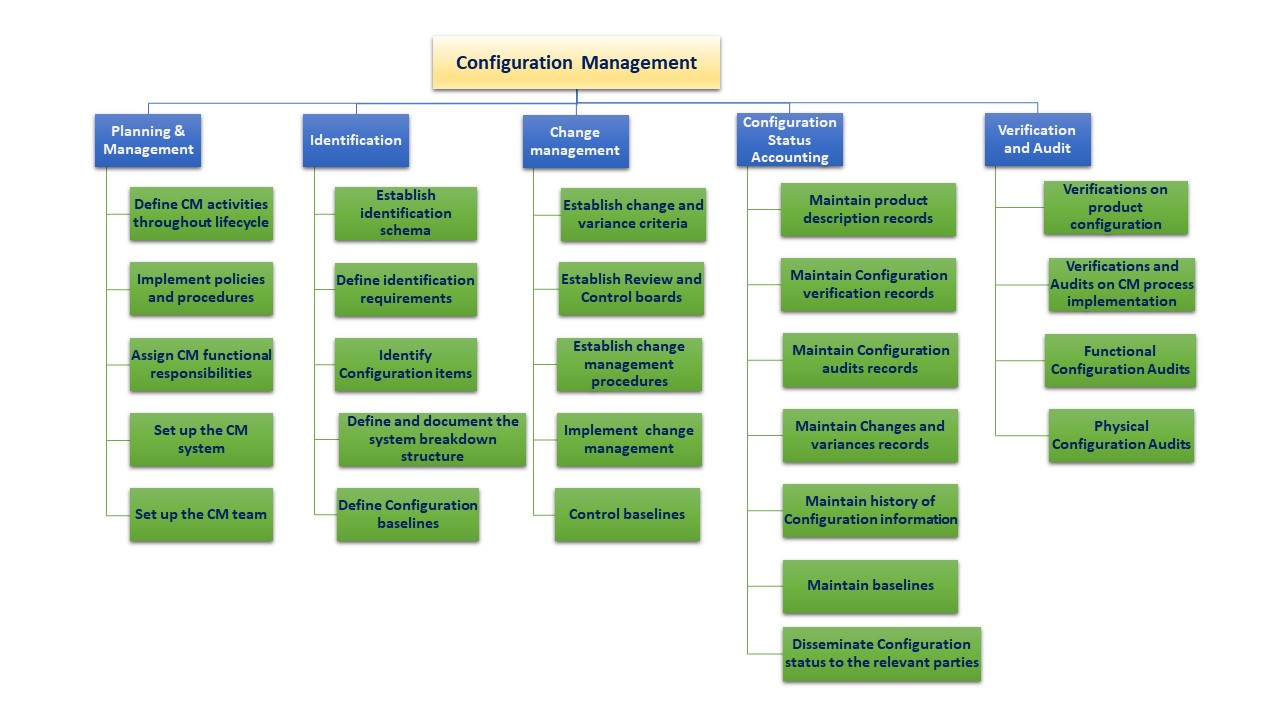
図1. 構成管理のアクティビティ。(SEBoK Original)
Configuration Management
Configuration management (CM) helps teams keep track of changes to a system over its life cycle—ensuring that what’s built matches what was planned, and that everyone stays aligned as updates occur. Simply put, CM is about maintaining a clear, accurate picture of a system as it evolves—tracking changes, managing versions, and avoiding confusion.
構成管理(configuration management、CM)は、チームがシステムのライフサイクルを通じて変更を追跡するのに役立つ。構築されるものが計画どおりであること、そして更新が行われる中で全員の足並みがそろい続けることを確実にする。簡単に言えば、CM とは、進化していくシステムについて明確で正確な全体像を維持すること、すなわち変更を追跡し、バージョンを管理し、混乱を避けることである。
As stated in ISO/IEC/IEEE 15288 (6.3.5.1): The purpose of the configuration management process is to manage system and system element configurations over their life cycle. The INCOSE SE Handbook describes CM as a key technical management process, supported by defined roles, resources, and controls. In this article, we may refer to a “system” or “product” depending on the application of the CM process.
ISO/IEC/IEEE 15288(6.3.5.1)に述べられているとおり、構成管理プロセスの目的は、システムおよびシステム要素の構成をそのライフサイクルにわたって管理することである。INCOSE SE Handbook は、CM を、定義された役割、リソース、管理手段に支えられた主要な技術管理プロセスとして記述している。本記事では、CM プロセスの適用に応じて「システム」と呼ぶ場合も「製品」と呼ぶ場合もある。
CM and main CM concepts are defined slightly differently according to the various standards. The objective of this article is to provide a general understanding of CM based on common and general principles, usually aligned with INCOSE SE Handbook, ISO 10007, and SAE EIA-649C standards. Before entering in the description of the CM process, it is important to define a few concepts (below).
CM および CM の主要な概念の定義は、規格によって若干異なる。本記事の目的は、通常 INCOSE SE Handbook、ISO 10007、SAE EIA-649C の各規格と整合する、共通かつ一般的な原則に基づいて、CM の全般的な理解を提供することである。CM プロセスの説明に入る前に、以下でいくつかの概念を定義しておくことが重要である。
CM applies to any kind of system; any product or process can be considered a system. Therefore, CM addresses hardware, software, services, systems, and systems of systems with equal relevance, or any combination of the above. CM is applicable regardless of the complexity of the system in question.
CM はあらゆる種類のシステムに適用され、どのような製品やプロセスもシステムとみなすことができる。したがって、CM はハードウェア、ソフトウェア、サービス、システム、システムオブシステムズのいずれにも、またそれらのどのような組み合わせにも、等しく関係する。CM は、対象システムの複雑さにかかわらず適用できる。
CM applies throughout the entire life cycle of the system. CM applies to all system life-cycle models and development approaches, with adequate tailoring.
CM はシステムのライフサイクル全体にわたって適用される。また、適切なテーラリングを行えば、あらゆるシステムライフサイクルモデルと開発アプローチに適用される。
In addition, to master the configuration of a system of interest, the configuration of the associated enabling systems should also be taken into account.
加えて、対象システム(system of interest)の構成を掌握するには、関連するイネーブリングシステムの構成も考慮に入れるべきである。
The configuration refers to the interrelated functional and physical characteristics outlined in configuration information, as defined by ISO 10007. The system and its individual elements, which fall under Configuration Management, are known as Configuration Items. Their functional and physical characteristics constitute their configuration information.
ISO 10007 の定義によれば、構成(configuration)とは、構成情報に示された、相互に関連する機能的特性および物理的特性を指す。構成管理の対象となるシステムとその個々の要素は、構成品目(Configuration Items)と呼ばれる。それらの機能的特性と物理的特性が、その構成情報をなす。
Configuration information encompasses the comprehensive data necessary to describe and document Configuration Items throughout the entire system life cycle. This includes artifacts produced during the execution of the technical processes, such as requirement specifications, architecture descriptions, design descriptions, and user documentation, as referenced in ISO/IEC/IEEE 15289.
構成情報は、システムのライフサイクル全体を通じて構成品目を記述し文書化するのに必要な、包括的なデータを含む。これには、ISO/IEC/IEEE 15289 で参照されているように、要求仕様、アーキテクチャ記述、設計記述、利用者文書など、技術プロセスの実行中に作成される成果物が含まれる。
Configuration information is understood as structured and contextualized data related to the system and its artifacts. While data serves as the raw input, information represents the processed output that adds context, relevance, and purpose. The collective set of configuration information associated with a system encapsulates all pertinent elements needed to document its characteristics.
構成情報とは、システムとその成果物に関連する、構造化され文脈を与えられたデータであると理解される。データが生の入力であるのに対し、情報は、文脈、関連性、目的を付け加えた、処理済みの出力である。システムに関連する構成情報の集合全体には、その特性を文書化するのに必要な関連要素が全て包含される。
The objectives of Configuration Management (CM) are to provide means to guarantee consistency between the system and its configuration information, ensure the integrity and traceability of this information and its changes over time, and facilitate reproducibility. These three objectives collectively enable the capabilities to define, realize, transition, operate, maintain, and dispose of the system.
構成管理(CM)の目的は、システムとその構成情報との一貫性を保証する手段を提供すること、この情報とその変更の完全性とトレーサビリティを経時的に確保すること、そして再現性を容易にすることである。これら3つの目的が一体となることで、システムの定義、実現、移行、運用、保守、廃棄を行う能力が得られる。
Configuration Management (CM) and Information Management (IM) processes are interconnected; however, CM focuses on the relevance of information related to the system and its evolution over time, while IM concentrates on the management of the information itself. This includes its generation, collection, validation, transformation, dissemination, and disposal, overseeing the entire life cycle of the information.
構成管理(CM)と情報管理(IM)のプロセスは相互に結び付いている。ただし、CM がシステムとその経時的な進化に関わる情報の関連性に焦点を当てるのに対し、IM は情報そのものの管理に注力する。これには情報の生成、収集、妥当性確認、変換、普及、廃棄が含まれ、IM は情報のライフサイクル全体を監督する。
CM is concerned with the significance and applicability of information in relation to the specific system elements with which it is associated, referred to as configuration information. While all information can be managed, only configuration information is subject to configuration management.
CM は、情報が関連付けられている特定のシステム要素との関係において、その情報が持つ意義と適用可能性を扱う。このような情報を構成情報と呼ぶ。あらゆる情報は管理の対象となり得るが、構成管理の対象となるのは構成情報だけである。
The CM and IM processes are complementary and closely aligned with the objective of ensuring traceability.
CM と IM のプロセスは互いに補完し合うものであり、トレーサビリティの確保という目的に密接に整合している。
To ensure the CM process activities, a dedicated Configuration Management system to enable and support CM.
CM プロセスのアクティビティを確実に行うための、CM を可能にし支援する専用の構成管理システム。
The Configuration Management process relies on appropriate processes, resources, and controls, to establish and maintain an authoritative source of truth on system configuration.
構成管理プロセスは、適切なプロセス、リソース、管理手段に依拠して、システム構成の正本となる情報源を確立し維持する。
The CM process consists of activities that are widely used in key standards and references, including ISO/IEC/IEEE 15288, SAE EIA 649, and ISO 10007. The names of these activities may differ through various norms and standards, and in this article, the terms used are:
CM プロセスは、ISO/IEC/IEEE 15288、SAE EIA 649、ISO 10007 をはじめとする主要な規格や参考文献で広く用いられているアクティビティから成る。これらのアクティビティの名称は規範や規格によって異なることがあるが、本記事では次の用語を用いる。
• Configuration Management Planning and Management
• 構成管理の計画と管理
• Configuration Identification
• 構成識別
• Configuration Change Management
• 構成変更管理
• Configuration Status Accounting
• 構成状況の記録・報告
• Configuration Verification and Audit.
• 構成検証と監査
The benefits of using the CM process are maximized when all five activities are planned and executed. These activities are not strictly sequential; rather, they are interrelated and may be applied concurrently and iteratively as needed throughout the system life cycle.
CM プロセスを用いる利益は、5つのアクティビティ全てを計画し実行したときに最大となる。これらのアクティビティは厳密に順を追って行うものではなく、相互に関連しており、システムのライフサイクルを通じて必要に応じて並行的かつ反復的に適用されることがある。
図中の英語
This first activity involves defining the scope and organization of CM tasks. It is considered good practice to formalize the results of this activity in a dedicated CM plan that guides implementation throughout the life cycle.
この最初のアクティビティは、CM タスクの範囲と体制を定義することである。このアクティビティの結果を専用の CM 計画として正式に文書化し、ライフサイクルを通じた実施の指針とすることは、好事例とされている。
In terms of organization, the roles in charge of leading the Configuration Management activities on the project need to be defined early in the system life cycle. These roles constitute the CM team. This team is organized according to the size and complexity of the product to be managed and to the organizational rules of the organization. It should at least have a Configuration Manager, who oversees the CM plan.
体制の面では、プロジェクトにおける構成管理アクティビティを主導する役割を、システムのライフサイクルの早い段階で定義する必要がある。これらの役割が CM チームを構成する。このチームは、管理対象となる製品の規模と複雑さ、および当該組織の組織規則に応じて編成される。チームには、少なくとも CM 計画を監督する構成管理者(Configuration Manager)を置くべきである。
CM Planning and Management defines the CM scope relevant for the system and for being able to maintain the consistency between the system and its configuration information: CM activities need to be adjusted to the type of system (hardware, software, service or combination of the above), the system life cycle, and to the system complexity, as well to the type of configuration information to be managed and to their criticality.
CM の計画と管理では、システムに関連し、かつシステムとその構成情報との一貫性を維持できるようにするための CM の範囲を定義する。CM アクティビティは、システムの種類(ハードウェア、ソフトウェア、サービス、またはそれらの組み合わせ)、システムのライフサイクル、システムの複雑さ、さらに管理対象となる構成情報の種類とその重要度に合わせて調整する必要がある。
The activities depend also on the stages of the life cycle that need to be addressed as defined per contract: if all the stages of the life cycle must be managed from conception until retirement, the CM plan covers all these stages.
アクティビティは、契約で定められた、対応すべきライフサイクル段階にも左右される。構想から廃止までライフサイクルの全段階を管理しなければならない場合、CM 計画はそれら全ての段階を対象とする。
The CM plan should address the definition of the CM tasks, their organization, their schedule, the responsibilities of the various stakeholders of the system, and the tools to support the CM. CM activities involve most of the stakeholders of the system.
CM 計画では、CM タスクの定義、その体制、そのスケジュール、システムのさまざまなステークホルダーの責任、CM を支援するツールを取り上げるべきである。CM アクティビティには、システムのステークホルダーの大半が関与する。
The CM plan should also be developed in consideration of the organizational context and culture. It must adhere to or incorporate applicable policies, procedures, and standards and it must accommodate acquisition, subcontracting and partnership situations, as well as any specific requirements agreements.
CM 計画は、組織の文脈と文化も考慮して策定すべきである。適用される方針、手順、規格に準拠するか、それらを取り込まなければならず、また、取得、下請け、パートナーシップの各状況や、特定の要求事項に関する合意にも対応しなければならない。
Except very specific use cases, CM planning and management should address the remaining activities as described hereafter.
ごく特殊なユースケースを除き、CM の計画と管理では、以下に述べる残りのアクティビティを取り上げるべきである。
Additional considerations about the Planning and Management of CM activities are provided in “CM implementation.
CM アクティビティの計画と管理に関する追加の考慮事項は、「CM implementation」に示されている。
This activity overarches the following task:
このアクティビティは、次のタスクを包含する。
• Identify which elements of the system and which information should be under configuration management
• システムのどの要素とどの情報を構成管理の下に置くべきかを特定する
• Identify where configuration management is needed among the elements of the system: these elements are called “Configuration Items”, the information related to these elements are their configuration information
• システムの要素のうち、どれに構成管理が必要かを特定する。これらの要素は「構成品目」と呼ばれ、これらの要素に関連する情報がその構成情報となる
• Define the identification rules for Configuration items and configuration information to apply to ensure the unicity, the rules to make these identifiers evolve, and the associated labelling constraints
• 一意性を確保するために適用する、構成品目と構成情報の識別規則、それらの識別子を進化させる規則、および関連するラベル付けの制約を定義する
• Structure the items and their information: this structure reflects the relationships between system items
• 品目とその情報を構造化する。この構造はシステム品目間の関係を反映する
• Define the rules for validating and releasing the items and the information under configuration management
• 構成管理の下にある品目と情報の妥当性確認とリリースに関する規則を定義する
• Define the baselines to be established at dedicated milestones of the system life cycle.
• システムのライフサイクルの所定のマイルストーンで確立するベースラインを定義する
Note 1: a baseline specifies how a system is viewed for the purposes of management, control, and evaluation; each baseline is fixed at a specific point in time in the system life cycle and represents the current approved configuration; it serves as a basis for defining changes, and generally can only be changed through formal change procedures. See CM baselines for more details about typical CM baselines.''
注1:ベースラインは、管理、構成変更管理、評価のためにシステムをどのように捉えるかを規定する。各ベースラインはシステムのライフサイクルの特定の時点で固定され、現在承認されている構成を表す。ベースラインは変更を定義する際の基礎となり、一般に正式な変更手続きを通じてのみ変更できる。典型的な CM ベースラインの詳細については CM baselines を参照。
Note 2: depending on the practices and methods, the term “configuration item” may be used to designate anything that should be managed in the configuration management system, which leads to include the system elements and its information in the generic term “configuration items”.
注2:実践や手法によっては、「構成品目」という用語が、構成管理システムで管理すべきあらゆるものを指すのに用いられることがある。その場合、システム要素とその情報が「構成品目」という総称に含まれることになる。
A disciplined Configuration Change Management process is critical for engineering systems.
統制のとれた構成変更管理プロセスは、システムのエンジニアリングにおいて極めて重要である。
It encompasses the analysis, justification, evaluation, coordination and disposition of changes to the system and variances to the system (non-compliance to its requirements).
これは、システムへの変更、およびシステムに対する逸脱(要求事項への不適合)の分析、正当化、評価、調整、処置を包含する。
This activity aims to control the evolution of the system, of its elements and of its configuration information throughout the life cycle.
このアクティビティは、ライフサイクルを通じて、システム、その要素、その構成情報の進化を管理することを目的とする。
To ensure the missions of the activity, boards are defined to monitor and make key decisions regarding changes and variances process.
このアクティビティの使命を果たすため、変更と逸脱のプロセスを監視し、それに関する主要な意思決定を行うボードが設けられる。
These boards are commonly called "Configuration Control Boards (CCBs)" but may also be referred to as "Configuration Steering Boards" or "Change Control Boards (CCBs)". They can also be split into Change Review boards and Change Implementation boards, when separately addressing the decisions about agreeing to the changes and variances and the stage where changes are implemented.
これらのボードは一般に「構成変更管理ボード(Configuration Control Boards、CCB)」と呼ばれるが、「構成ステアリングボード」や「変更管理ボード(Change Control Boards、CCB)」と呼ばれることもある。また、変更と逸脱への合意に関する決定と、変更を実施する段階とを分けて扱う場合には、変更レビューボードと変更実施ボードに分けることもできる。
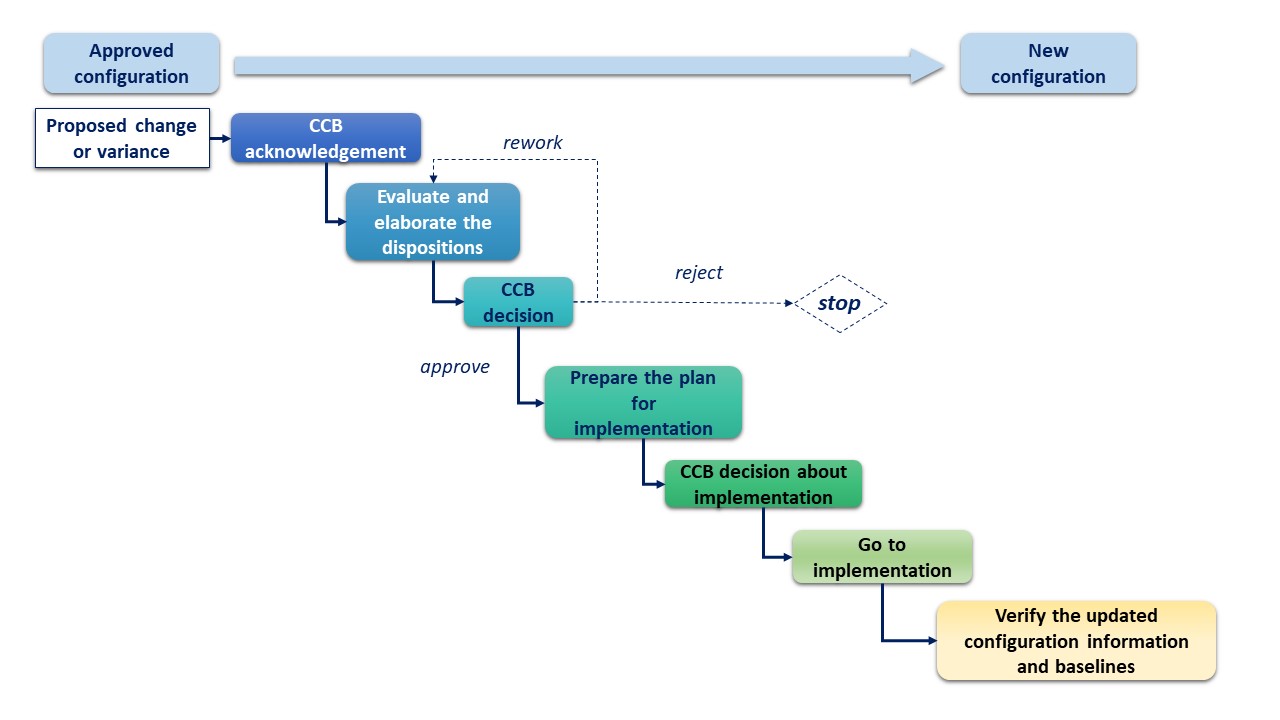
図中の英語
A Configuration Control Board (CCB) typically includes:
構成変更管理ボード(CCB)には通常、次のメンバーが含まれる。
• a CCB Chair,
• CCB の議長
• a Configuration Manager,
• 構成管理者
• the product or organization systems engineer,
• 製品または組織のシステムズエンジニア
• domain-specific subject-matter experts (SMEs) such as for software or mechanical engineering, product support, and cyber resiliency,
• ソフトウェアや機械工学、製品支援、サイバーレジリエンスなどの領域固有の主題専門家(subject-matter experts、SME)
• procurement and contracting specialists.
• 調達と契約の専門家
The CCB dealing with the CM of a dedicated system or product (product CCB) may invite periodic participation from specialized or outside SMEs, including representation from vendors and subcontractors; this however must be carefully managed to ensure that information-access restrictions (especially for competition-sensitive information) is not compromised.
特定のシステムまたは製品の CM を扱う CCB(製品 CCB)では、ベンダや下請け業者の代表者を含め、専門の SME や外部の SME に定期的な参加を求めることがある。ただしその際は、情報アクセスの制限(特に競争上機微な情報に関する制限)が損なわれないよう、慎重に管理しなければならない。
Organizational CCBs may be organized at a wider level and address several systems, products, or product lines and they typically include information technology (IT) and cyber resiliency SMEs who may not be needed on product-focused CCBs.
組織の CCB は、より広い範囲で編成され、複数のシステム、製品、製品ラインを扱うことがある。組織の CCB には通常、製品に焦点を当てた CCB では必要とされない場合がある、情報技術(information technology、IT)とサイバーレジリエンスの SME が含まれる。
More advanced considerations about the change management and the related boards are provided in CM implementation.
変更管理と関連するボードについてのより高度な考慮事項は、CM implementation に示されている。
This activity covers all the reporting tasks that aim to provide dedicated reporting about the configuration information and the CM activities. The reports can address a wide range of content, for various purposes: internal reports for the organization and for the internal stakeholders, external reports as part of the deliveries planned in the contract, certificates and conformity reports, etc.
このアクティビティは、構成情報と CM アクティビティについて専用の報告を提供することを目的とした、あらゆる報告タスクを対象とする。報告はさまざまな目的のために幅広い内容を扱うことができ、組織や内部ステークホルダー向けの内部報告、契約で計画された納入物の一部としての外部報告、証明書や適合性報告などがある。
Configuration Management is involved in the management and control of artifacts produced and modified throughout the system life cycle. It is therefore linked to system analysis, system detailed design definition, system realization, system deployment and use, system operation and product and service life management.
構成管理は、システムのライフサイクルを通じて作成・変更される成果物の管理に関わる。したがって、システム分析、システム詳細設計の定義、システム実現、システムの展開と使用、システム運用、製品・サービスライフ管理と結び付いている。
CM must also work in conjunction with other technical management processes. These include project planning, project assessment and control, decision management, risk management, information management, and measurement.
CM は、他の技術管理プロセスとも連携して機能しなければならない。これには、プロジェクト計画、プロジェクト評価と管理、意思決定管理、リスクマネジメント、情報管理、測定が含まれる。
This includes CM application to the artifacts of all the other management processes (plans, analyses, reports, statuses, etc.).
これには、他の全ての管理プロセスの成果物(計画、分析、報告、状況など)に CM を適用することが含まれる。
Refer to CM implementation for detailed considerations about the practical implementation of CM according to context.
状況に応じた CM の実践的な実施に関する詳細な考慮事項については、CM implementation を参照。
Key pitfalls and good practices related to systems engineering CM are described in the next two sections.
システムズエンジニアリングにおける CM に関連する主な落とし穴と好事例を、次の2つの節で述べる。
Some of the key pitfalls encountered in planning and performing CM are in Table 1.
CM の計画と実施で遭遇する主な落とし穴のいくつかを、表1に示す。
表1. 構成管理の落とし穴。(SEBoK Original)
| + Table 1. Configuration Management Pitfalls. (SEBoK Original) |
| Name |
|---|
| Description |
| Shallow Visibility |
| Poor Tailoring |
| Limited CM Perspective |
| Insufficient CM Awareness |
| Lack of CM Plan |
| Insufficient CM Checks |
| 名称 | 説明 |
|---|---|
| 可視性の浅さ | 変更管理プロセスに、影響を受ける全ての専門分野を関与させていないこと。 |
| テーラリングの不備 | プロジェクトの規模やサブシステムの数などに合わせた CM のテーラリングが不十分であること。 |
| CM の視点の限定 | COTS ベンダや下請け業者を含む、貢献する全ての組織の CM プロセスを考慮し統合していないこと。 |
| CM の認識の不足 | 影響を受ける全ての専門分野の認識と訓練が不十分であること。 |
| CM 計画の欠如 | CM アクティビティを組織化せず、適切なリソースと手段を提供していないこと。 |
| CM チェックの不足 | CM の実施を定期的に検証していないこと。 |
Some good practices gathered from the references are provided in Table 2 below.
参考文献から集めた好事例のいくつかを、以下の表2に示す。
表2. 構成管理の好事例。(SEBoK Original)
| + Table 2. Configuration Management Good Practices. (SEBoK Original) |
| Name |
|---|
| Description |
| Cross-Functional CM |
| Full Lifecycle Perspective |
| CM Planning |
| Requirements Traceability |
| CCB Hierarchy |
| Consistent Identification |
| CM Automation |
| 名称 | 説明 |
|---|---|
| 機能横断的な CM | 適宜、ソフトウェア、ハードウェア、ファームウェア、データ、その他の種類の品目について、機能横断的なコミュニケーションと CM プロセスを実施する。 |
| ライフサイクル全体の視点 | ライフサイクル全体を通じて統合された CM を計画する。明示的に計画しなくてもプログラムの一部として行われるだろうと想定しないこと。 |
| CM の計画 | プロセスは、プロジェクトの早い段階で、単一の包括的な CM 計画に文書化される。その計画は(システム)CM 計画であるべきである。選定し使用するツールを含める。 |
| 要求事項のトレーサビリティ | CM アクティビティの開始時から要求事項のトレーサビリティを確保する。 |
| CCB の階層 | プログラム要素に見合った構成変更管理ボードの階層を用いる。 |
| 一貫した識別 | ソフトウェア CI とハードウェア CI で一貫した識別方式を用いる。 |
| CM の自動化 | 構成状況の記録・報告は、可能な限り自動化すべきである。 |
ISO/IEC/IEEE 15288:2023, Second Edition. Systems and software engineering — System life cycle processes - International Organization for Standardisation / International Electrotechnical Commissions / Institute of Electrical and Electronics Engineers. ISO/IEC/IEEE 15288:2023
INCOSE. 2023. Systems Engineering Handbook: A Guide for System Life Cycle Processes and Activities, version 5.0. Hoboken, NJ, USA: John Wiley and Sons, Inc, ISBN: 978-1-119-81429-0.
ISO 10007, Third Edition. Quality Management Systems – Guidelines for Configuration Management. International Organization for Standardization (ISO), ISO 10007:2017
Blanchard, B.S. and W J. Fabrycky. 2005. Systems Engineering and Analysis, 4th ed. Prentice-hall international series in industrial and systems engineering. Englewood Cliffs, NJ, USA: Prentice-Hall.
IEEE SWEBOK Version 4 2024. Guide to the Software Engineering Body of Knowledge (SWEBOK). Los Alamitos, CA, USA: IEEE Computer Society. Available at: https://www.computer.org/education/bodies-of-knowledge/software-engineering
SEI. 2010. Capability Maturity Model Integrated (CMMI) for Development, version 1.3. Pittsburgh, PA, USA: Software Engineering Institute (SEI)/Carnegie Mellon University (CMU).
ISO/IEC/IEEE 15288:2023, Second Edition. Systems and software engineering — System life cycle processes - International Organization for Standardisation / International Electrotechnical Commissions / Institute of Electrical and Electronics Engineers. ISO/IEC/IEEE 15288:2023
INCOSE. 2023. Systems Engineering Handbook: A Guide for System Life Cycle Processes and Activities, version 5.0. Hoboken, NJ, USA: John Wiley and Sons, Inc, ISBN: 978-1-119-81429-0.
ISO 10007, Third Edition. Quality Management Systems – Guidelines for Configuration Management. International Organization for Standardization (ISO), ISO 10007:2017
ANSI/GEIA. 2019. Configuration Management Standard Implementation Guide. Arlington, VA, USA: American National Standards Institute/Government Electronics & Information Technology Association, EIA649C.
GEIA. 2022. Data Management. Arlington, VA, USA: Government Electronics & Information Technology Association. GEIA-859B.
ISO/IEC/IEEE 16236:2019. Systems and Software Engineering - Life Cycle Processes - Project Management. International Organization for Standardisation / International Electrotechnical Commissions / Institute of Electrical and Electronics Engineers - ISO/IEC/IEEE 16326:2019 (Edition 2)
ISO/IEC/IEEE 15289:2019. Systems and software engineering — Content of life-cycle information items. International Organization for Standardisation / International Electrotechnical Commissions / Institute of Electrical and Electronics Engineers - ISO/IEC/IEEE 15289:2019 (Edition 4)
ISO/IEC/IEEE 24748-1:2024. Systems and software engineering — Life cycle management - Part 1: Guidelines for life cycle management. International Organization for Standardisation / International Electrotechnical Commissions / Institute of Electrical and Electronics Engineers - ISO/IEC/IEEE 24748-1:2024 (Edition 2)
ISO/IEC/IEEE 24748-2 Systems and software engineering — Life Cycle Management – Part 2: Guidelines for the Application of ISO/IEC/IEEE 15288
ISO/IEC/IEEE 24748-2:2024. Systems and software engineering — Life cycle management - Part 2: Guidelines for the application of ISO/IEC/IEEE 15288 (system life cycle processes) - International Organization for Standardisation / International Electrotechnical Commissions / Institute of Electrical and Electronics Engineers - ISO/IEC/IEEE 24748-2:2024 (Edition 2)
ECSS-M-ST-40C Rev.1. 2009. Space project management - Configuration and information management. Noordwijk, The Netherlands: European Cooperation for Space Standardization (ECSS)
ANSI/EEIA. 2020. Configuration Management Requirements for Defense Contracts EIA649_1A. Arlington, VA, USA: Government Electronics & Information Technology Association - EIA649_1A
ISO/IEC/IEEE 24748-8:2019 - Systems and software engineering — Life cycle management Part 8: Technical reviews and audits on defense programs - International Organization for Standardisation / International Electrotechnical Commissions / Institute of Electrical and Electronics Engineers - ISO/IEC/IEEE 24748-8:2019 (Edition 1)