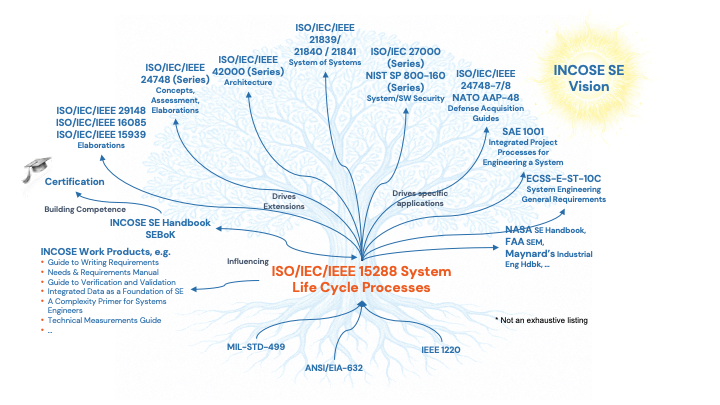
図2. システムズエンジニアリング標準の概要(SEBoK original)
Evolution of Systems Engineering Standards
As stated in the article Why Standards, the development of a standard is performed to establish “rules, guidelines, or characteristics for activities or their results”. As the discipline of Systems Engineering evolved, so did the need to standardize the knowledge and practices. This article discusses the journey to develop relevant, useful standards for systems and systems engineering.
記事 Why Standards で述べられているように、標準は「活動またはその結果に対する規則、ガイドライン、または特性」を確立するために策定される。システムズエンジニアリング(Systems Engineering)という分野が進化するにつれて、その知識と実践を標準化する必要性も高まっていった。本記事では、システムおよびシステムズエンジニアリングにとって関連性のある有用な標準を策定してきた歩みについて論じる。
Systems engineering standards have evolved as the SE discipline has matured and evolved. These references have continued to incorporate the lessons learned and changes in approaches and methods to ensure they reflect current, proven practices. Along this evolution path, there has been collaboration to help align the references across the industry associations and standards development organizations (more is discussed on this in Harmonization of Systems Engineering Standards). Figure 1 provides a graphical view of the evolution of a subset of the key SE related standards.
システムズエンジニアリング標準は、SE という分野の成熟と進化に伴って進化してきた。これらの参考文献は、得られた教訓や、アプローチと手法の変化を継続的に取り込み、現在の実証済みの実践を確実に反映するようにしてきた。この進化の過程では、業界団体や標準化団体の間で参考文献の整合を図るための協働が行われてきた(これについては Harmonization of Systems Engineering Standards で詳しく論じている)。図1は、主要な SE 関連標準のうちの一部について、その進化を図示したものである。
Figure 1. Evolution of Key SE Standards and References (Roedler, adapted from Roedler 2023). Reprinted with permission of Garry Roedler. All other rights are reserved by the copyright owner.
図1. 主要な SE 標準と参考文献の進化(Roedler、Roedler 2023 から翻案)。Garry Roedler の許可を得て転載。その他のすべての権利は著作権者が留保する。
この図は原典のページに掲載されています。権利の都合により本サイトでは省略しています。原典で見る
Until the early 1990's, MIL-STD-499 (initially released in 1969) and subsequent revisions were the first and only SE standards developed. In 1994, it transitioned to an industry standard, EIA/IS 632. Around the same time, INCOSE started development of its Systems Engineering Handbook (SEH). Figure 1 shows the ongoing evolution of these standards, as well as the publication of ISO/IEC 15288, which later also became a joint standard with the IEEE. With the dramatic uptake of 15288, the latest revision of ANSI/EIA 632 was fully aligned with 15288 with a scope change and published as SAE 1001. Finally, the SEBoK, started its development in 2009 and was first published in 2012, as a broader reference that serves as a guide to the SE Body of Knowledge. The folowing paragraphs provide a little more detail about the evolution of some of the SE standards.
1990年代初頭までは、MIL-STD-499(1969年に最初に発行)とその後の改訂版が、策定された最初にして唯一の SE 標準であった。1994年には、これが業界標準である EIA/IS 632 へと移行した。ほぼ同時期に、INCOSE はシステムズエンジニアリングハンドブック(Systems Engineering Handbook、SEH)の策定に着手した。図1はこれらの標準の継続的な進化を示すとともに、後に IEEE との共同標準にもなった ISO/IEC 15288 の発行も示している。15288 の劇的な普及に伴い、ANSI/EIA 632 の最新改訂版は範囲を変更して 15288 と完全に整合させたうえで、SAE 1001 として発行された。最後に SEBoK は、SE の知識体系へのガイドとして機能する、より広範な参考文献として2009年に策定が始まり、2012年に初めて発行された。以下の段落では、いくつかの SE 標準の進化について、もう少し詳しく述べる。
The U.S. Air Force published MIL-STD-499 (“System Engineering Management”) in 1969 to guide program managers and contractors on systems engineering planning, processes, tailoring, documentation, and technical oversight. In 1974, the standard was updated to MIL-STD-499A (“Engineering Management”), which broadened its guidance. A draft MIL-STD-499B was developed later to further modernize SE concepts, but it was never formally released. Over time, due to defense acquisition reform and policy changes, many U.S. military standards, including 499A, were deprecated or withdrawn. Thus, the MIL-STD lineage provided an early, structured, contract-oriented, and fairly prescriptive basis for systems engineering, especially in defense domains.
米空軍は1969年に MIL-STD-499(「System Engineering Management」)を発行し、システムズエンジニアリングの計画、プロセス、テーラリング、文書化、技術的監督について、プログラムマネージャと請負業者に指針を示した。1974年には、この標準が MIL-STD-499A(「Engineering Management」)に更新され、指針の範囲が広げられた。その後、SE の概念をさらに現代化するために MIL-STD-499B の草案が策定されたが、正式に発行されることはなかった。やがて、防衛取得改革や政策変更により、499A を含む多くの米軍標準が非推奨となったり撤回されたりした。このように MIL-STD の系譜は、特に防衛分野において、構造化され、契約志向で、かなり規範的な、システムズエンジニアリングの初期の基盤をもたらした。
After U.S. defense policy shifted away from mandating military standards, standards development responsibility increasingly moved to industry and voluntary bodies.
米国の防衛政策が軍標準の義務付けから離れるにつれて、標準策定の責任はますます産業界と任意団体へ移っていった。
In 1994, the EIA (Electronic Industries Association), with the help of INCOSE and the DoD community, produced an interim standard EIA/IS-632 which closely mirrored MIL-STD-499B to describe a systems engineering process more suitable for commercial and defense applications alike.
1994年、EIA(Electronic Industries Association)は INCOSE と DoD コミュニティの協力を得て、商業用途と防衛用途のいずれにもより適したシステムズエンジニアリングプロセスを記述するために、MIL-STD-499B を密接に反映した暫定標準 EIA/IS-632 を作成した。
That interim standard was developed into the full ANSI/EIA-632 (“Processes for Engineering a System”). ANSI/EIA-632 defined 13 processes across categories (technical, management, acquisition, supply), focusing on lifecycle engineering of systems rather than prescribing methods. It was intended to support enterprise-level systems as well as product development.
この暫定標準は、正式な ANSI/EIA-632(「Processes for Engineering a System」)へと発展した。ANSI/EIA-632 は、(技術、管理、取得、供給)の各カテゴリにわたる13のプロセスを定義し、手法を規定するのではなく、システムのライフサイクル(life cycle)エンジニアリングに焦点を当てた。同標準は、製品開発だけでなく、エンタープライズレベルのシステムも支援することを意図していた。
Independently, IEEE developed a systems engineering standard, IEEE 1220 (“Application and Management of the Systems Engineering Process”), first published in 1995 as a trial-use standard to specify application and management of systems engineering processes in engineering organizations. Later versions (e.g. IEEE 1220-2005) were revised to better align with ISO/IEC 15288, with a slightly narrower or more development-focused scope. In effect, IEEE 1220 can be viewed as an application of ANSI/EIA-632 concepts within the electrical/electronic and systems engineering domains, refined for industry use.
これとは独立に、IEEE はシステムズエンジニアリング標準である IEEE 1220(「Application and Management of the Systems Engineering Process」)を策定し、エンジニアリング組織におけるシステムズエンジニアリングプロセスの適用と管理を規定する試用標準として、1995年に初めて発行した。その後の版(例:IEEE 1220-2005)は、ISO/IEC 15288 との整合を高めるよう改訂され、範囲はやや狭く、あるいはより開発に焦点を当てたものとなった。実質的に、IEEE 1220 は、電気/電子およびシステムズエンジニアリングの分野に ANSI/EIA-632 の概念を適用し、産業界での使用に向けて洗練させたものとみなすことができる。
In 2007, a joint project between the IEEE, ISO/IEC, and INCOSE worked to move the SE management content of IEEE 1220-2005 into the new ISO/IEC/IEEE 26702 standard (“Management of Systems Engineering Processes”) and ensured that the process content was adequately included in ISO/IEC/IEEE 15288:2008.
2007年、IEEE、ISO/IEC、INCOSE の共同プロジェクトは、IEEE 1220-2005 の SE 管理に関する内容を新しい ISO/IEC/IEEE 26702 標準(「Management of Systems Engineering Processes」)へ移す作業を進めるとともに、プロセスの内容が ISO/IEC/IEEE 15288:2008 に適切に含まれることを確実にした。
These two parallel paths (ANSI/EIA-632 as a broad, enterprise-level systems process standard, and IEEE 1220 as a complementary development-oriented standard) contributed to the discourse on how to specify SE processes more generically, flexibly, and applicable across domains.
これら2つの並行する道筋(広範なエンタープライズレベルのシステムプロセス標準としての ANSI/EIA-632 と、補完的な開発志向の標準としての IEEE 1220)は、SE プロセスをより汎用的かつ柔軟に、分野を越えて適用できる形で規定するにはどうすればよいかという議論に寄与した。
In the mid-1990s, there was growing recognition of the need for a common, internationally accepted, life-cycle process standard for systems engineering that integrates hardware, software, and human/system concerns. ISO/IEC JTC1/SC7 (the software/systems engineering committee) initiated work (from about 1994 onward) to define such a standard, leveraging contributions from IEEE, INCOSE, EIA, and ISO national bodies. The goal was to provide a process framework, common vocabulary, life-cycle management approach, and enable alignment across systems and software standards.
1990年代半ばには、ハードウェア、ソフトウェア、および人間/システムの関心事を統合する、システムズエンジニアリングのための共通かつ国際的に受け入れられたライフサイクルプロセス標準の必要性が、ますます認識されるようになっていた。ISO/IEC JTC1/SC7(ソフトウェア/システムエンジニアリングの委員会)は、IEEE、INCOSE、EIA、ISO の国内団体の寄与を活用しながら、そのような標準を定める作業を(1994年頃から)開始した。その目標は、プロセスの枠組み、共通の語彙、ライフサイクル管理のアプローチを提供するとともに、システム標準とソフトウェア標準の間の整合を可能にすることであった。
The first edition of ISO/IEC 15288 was published on 1 November 2002. In 2004, IEEE adopted it as IEEE 15288, fostering dual branding and further adoption. Subsequent revisions were published: 2008 (aligned with 12207), 2015 (joint ISO/IEC/IEEE version), and 2023 (latest). The standard today defines 30 processes (grouped into Organizational Project-Enabling Processes, Agreement Processes, Technical Management Processes, and Technical Processes) with purpose, outcomes, activities, and tasks for each process. The expectation within the standards community is that ISO/IEC/IEEE 15288 will continue to be the most relevant SE standard. And many other standards and references have adopted its process framework or been developed to elaborate on specific processes, focus on specific applications, or provide a technical basis for systems concepts. More information about the evolving standards taxonomy is provided in the article Systems Engineering Related Standards Landscape. Also, more information on the harmonization of the SE standards is provided in the article Harmonization of Systems Engineering Standards.
ISO/IEC 15288 の初版は2002年11月1日に発行された。2004年には IEEE がこれを IEEE 15288 として採用し、二重ブランド化とさらなる普及を後押しした。その後、2008年(12207 と整合)、2015年(ISO/IEC/IEEE 共同版)、2023年(最新版)に改訂版が発行された。現在、この標準は30のプロセス(組織のプロジェクトイネーブリングプロセス、合意プロセス、技術管理プロセス、技術プロセスに分類)を定義し、プロセスごとに目的、成果、アクティビティ、タスクを示している。標準化コミュニティでは、ISO/IEC/IEEE 15288 が今後も最も関連性の高い SE 標準であり続けると期待されている。そして、他の多くの標準や参考文献は、そのプロセスの枠組みを採用してきた。また、特定のプロセスを詳述するため、特定の適用に焦点を当てるため、あるいはシステム概念の技術的基盤を提供するために策定されたものも多い。進化する標準の分類体系についての詳しい情報は、Systems Engineering Related Standards Landscape の記事にある。また、SE 標準の整合化についての詳しい情報は、Harmonization of Systems Engineering Standards の記事にある。
Figure 2 provides a view of the SE standards evolution and harmonization depicting a tree whose roots are the standards from which ISO/IEC/IEEE 15288 originated. ISO/IEC/IEEE 15288 is the trunk of the tree and the branches reflect development or revisions of other works as a result of harmonization with ISO/IEC/IEEE 15288. More information on the details of the harmonization efforts is provided in SEBoK article Harmonization of Systems Engineering Standards. Also, the article Systems Engineering Related Standards Landscape provides a large listing of the SE standards and references that are in use today.
図2は、SE 標準の進化と整合化を木として描いたものである。根は ISO/IEC/IEEE 15288 の起源となった標準、幹は ISO/IEC/IEEE 15288 そのもの、枝は ISO/IEC/IEEE 15288 との整合化の結果としての他の著作物の策定や改訂を表している。整合化の取り組みの詳細は、SEBoK の記事 Harmonization of Systems Engineering Standards に示されている。また、Systems Engineering Related Standards Landscape の記事には、今日使用されている SE 標準と参考文献が幅広く列挙されている。
図中の英語
Roedler, G. 2023. "SE Standards and Guidance – Revisions and Trends." International Council on Systems Engineering, Boston, MA, USA.
Roedler, G. 2015. "Evolution of SE Standards and Practices – ISO/IEC/IEEE 15288 Based Harmonization." National Defense Industrial Association (NDIA) Conference, Springfield, VA, USA.
ANSI/EIA. 1998. Processes for Engineering a System. Warrendale, PA, USA: SAE International. ANSI/EIA 632.
IEEE. 2005. Application and Management of the Systems Engineering Process. Piscataway, NJ, USA: Institute of Electrical and Electronics Engineers (IEEE). IEEE 1220-2005
INCOSE. 2023. INCOSE Systems Engineering Handbook 5th Edition. International Council on Systems Engineering. Hoboken, NJ, USA: John Wiley & Sons. INCOSE SE Handbook.
ISO/IEC. 2007. Management of Systems Engineering Processes. Geneva, Switzerland: International Organization for Standardization (ISO)/International Electrotechnical Commission (IEC). ISO/IEC 26702:2007.
ISO/IEC/IEEE. 2023. Systems and Software Engineering -- System Life Cycle Processes. Geneva, Switzerland: International Organisation for Standardisation / International Electrotechnical Commissions / Institute of Electrical and Electronics Engineers. ISO/IEC/IEEE 15288:2023.
ISO/IEC/IEEE. 2026. Systems and Software Engineering -- Life Cycle Management – Part 4: Systems engineering management planning. Geneva, Switzerland: International Organisation for Standardisation / International Electrotechnical Commissions / Institute of Electrical and Electronics Engineers. ISO/IEC/IEEE 24748-4:2026.
SAE. 2018. Integrated Project Processes for Engineering a System. Warrendale, PA, USA: SAE International. SAE 1001.
US DoD. 1974. Military standard: System engineering management (MIL-STD-499A). Washington, DC: Department of Defense. MIL-STD 499A.
Roedler, G. 2023. " SE Standards and Guidance – Revisions and Trends." International Council on Systems Engineering, Boston, MA, USA.
Roedler, G. 2015. "Evolution of SE Standards and Practices – ISO/IEC/IEEE 15288 Based Harmonization." National Defense Industrial Association (NDIA) Conference, Springfield, VA, USA.
Roedler, G; Shaw, B.; Davis, D. 2015. "Extending Industry Standards to Meet the Systems Engineering Needs of Defense Programs." Defense Standardization Program Journal, Arlington, VA. March 2015.
ANSI/EIA. 1998. Processes for Engineering a System. Warrendale, PA, USA: SAE International. ANSI/EIA 632.
IEEE. 2005. Application and Management of the Systems Engineering Process. Piscataway, NJ, USA: Institute of Electrical and Electronics Engineers (IEEE). IEEE 1220-2005
INCOSE. 2023. INCOSE Systems Engineering Handbook 5th Edition. International Council on Systems Engineering. Hoboken, NJ, USA: John Wiley & Sons. INCOSE SE Handbook.
ISO/IEC. 2007. Management of Systems Engineering Processes. Geneva, Switzerland: International Organization for Standardization (ISO)/International Electrotechnical Commission (IEC). ISO/IEC 26702:2007.
ISO/IEC/IEEE. 2026. Systems and Software Engineering -- Software Life Cycle Processes. Geneva, Switzerland: International Organisation for Standardisation / International Electrotechnical Commissions / Institute of Electrical and Electronics Engineers. ISO/IEC/IEEE 12207: 2026.
ISO/IEC/IEEE. 2023. Systems and Software Engineering -- System Life Cycle Processes. Geneva, Switzerland: International Organisation for Standardisation / International Electrotechnical Commissions / Institute of Electrical and Electronics Engineers. ISO/IEC/IEEE 15288: 2023.
ISO/IEC/IEEE. 2024. "Systems and Software Engineering -- Life Cycle Management – Part 1: Guidelines for life cycle management,". Geneva, Switzerland: International Organization for Standardization (ISO)/International Electrotechnical Commission (IEC)/ Institute of Electrical and Electronics Engineers (IEEE). ISO/IEC/IEEE 24748-1:2024.
ISO/IEC/IEEE. 2024. Systems and Software Engineering -- Life Cycle Management – Part 2: Guidelines for the application of ISO/IEC/IEEE 15288 (system life cycle processes). Geneva, Switzerland: International Organisation for Standardisation / International Electrotechnical Commissions / Institute of Electrical and Electronics Engineers. ISO/IEC/IEEE 24748-2:2024.
ISO/IEC/IEEE. 2026. Systems and Software Engineering -- Life Cycle Management – Part 4: Systems engineering management planning. Geneva, Switzerland: International Organisation for Standardisation / International Electrotechnical Commissions / Institute of Electrical and Electronics Engineers. ISO/IEC/IEEE 24748-4:2026.
ISO/IEC/IEEE. 2017. Systems and Software Engineering - Vocabulary (SEVocab). Geneva, Switzerland: International Organization for Standardization (ISO)/International Electrotechnical Commission (IEC)/Institute of Electrical and Electronics Engineers (IEEE). ISO/IEC/IEEE 24765:2017.
SAE. 2018. Integrated Project Processes for Engineering a System. Warrendale, PA, USA: SAE International. SAE 1001.
US DoD. 1974. Military standard: System engineering management (MIL-STD-499A). Washington, DC: Department of Defense. MIL-STD 499A.
None.