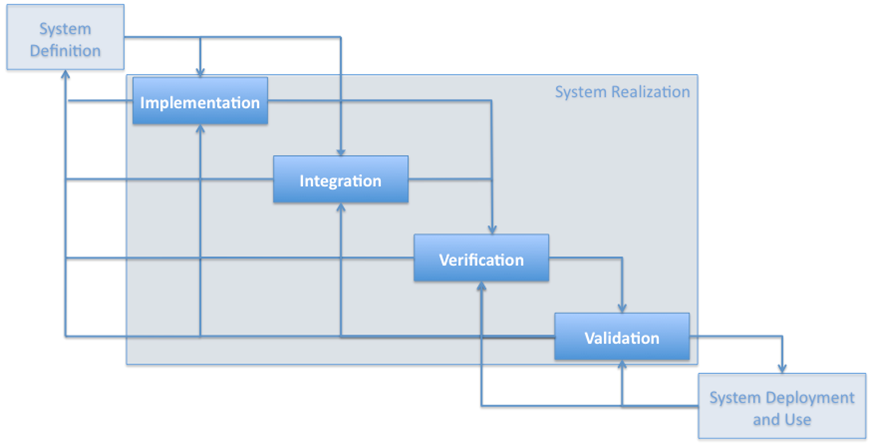
図1. システム実現。(SEBoK Original)
System Realization
System realization activities are conducted to create and test versions of a system as specified by system definition. The activities are grouped and described as generic processes that are performed iteratively and/or concurrently depending on the selected Implementation (glossary)|system implementation), integrate disparate system elements (system integration), and ensure that the system meets both the needs of stakeholders (system validation) and aligns with the system requirements and architecture (system verification).
システム実現(System realization)のアクティビティは、システム定義(system definition)で規定されたとおりにシステムのバージョンを作成し、テストするために実施される。これらのアクティビティは汎用プロセスとしてまとめて記述され、選択されたライフサイクルモデル(Life Cycle Model)に応じて反復的に、および/または並行して実施される。これらのアクティビティには、システムを構築するために必要なアクティビティ(システム実装(system implementation))、異種のシステム要素を統合するためのアクティビティ(システム統合(system integration))、そしてシステムがステークホルダーのニーズを満たすこと(システム妥当性確認(system validation))と、システム要求事項およびアーキテクチャに整合すること(システム検証(system verification))を保証するために必要なアクティビティが含まれる。
These activities are not sequential, but are performed concurrently, iteratively and recursively depending on the selected life cycle model. Figure 1 (see "Overview", below), also shows how these processes fit within the context of and System Deployment and Use KAs. See also Applying Life Cycle Processes for further discussion of the relationships between process and life cycle model.
これらのアクティビティは逐次的に行われるのではなく、選択されたライフサイクルモデルに応じて、並行的、反復的、再帰的に実施される。図1(下記「概要」を参照)には、これらのプロセスがシステム定義 KA およびシステムの配備と使用 KA の文脈の中でどのように位置づけられるかも示されている。プロセスとライフサイクルモデルとの関係については Applying Life Cycle Processes でさらに詳しく論じているので、そちらも参照のこと。
Essentially, the outputs of system definition are used during system implementation to create system elements and during system integration to provide plans and criteria for combining these elements. The requirements are used to verify and validate system elements, systems, and the overall system-of-interest (SoI). These activities provide feedback into the system design, particularly when problems or challenges are identified.
本質的には、システム定義の出力は、システム実装においてはシステム要素を作成するために用いられ、システム統合においてはそれらの要素を組み合わせるための計画と基準を提供するために用いられる。要求事項は、システム要素、システム、そして全体としての対象システム(System-of-Interest、SoI)の検証と妥当性確認に用いられる。これらのアクティビティは、とりわけ問題や課題が特定された場合に、システム設計へのフィードバックをもたらす。
Finally, when the system is considered, verified, and validated, it will then become an input to system deployment and use. It is important to understand that there is overlap in these activities; they do not have to occur in sequence as demonstrated in Figure 1. Every life cycle model includes realization activities, principally, verification and validation activities. The way these activities are performed is dependent upon the life cycle model in use. (For additional information on life cycles, see the Life Cycle Models KA.)
最後に、システムについての検討、検証、妥当性確認が済むと、そのシステムはシステムの配備と使用への入力となる。これらの活動には重なりがあることを理解しておくことが重要である。図1に示すように、これらの活動は必ずしも順番に行われる必要はない。どのライフサイクルモデルにも実現活動、主として検証と妥当性確認の活動が含まれる。これらの活動の実施方法は、使用中のライフサイクルモデルに依存する。(ライフサイクルの詳細については、ライフサイクルモデル KA を参照のこと。)
図中の英語
The realization processes are performed to ensure that the system will be ready for transition and has the appropriate structure and behavior to enable the desired operation and functionality throughout the system’s life span. Both DAU and NASA include transition in realization, in addition to implementation, integration, verification, and validation (Prosnik 2010; NASA December 2007, 1-360).
実現プロセスは、システムが移行に向けて準備の整った状態となり、かつシステムの寿命全体にわたって所期の運用と機能を可能にする適切な構造と振る舞いを備えることを保証するために実施される。DAU と NASA はいずれも、実装、統合、検証、妥当性確認に加えて、移行も実現に含めている(Prosnik 2010; NASA December 2007, 1-360)。
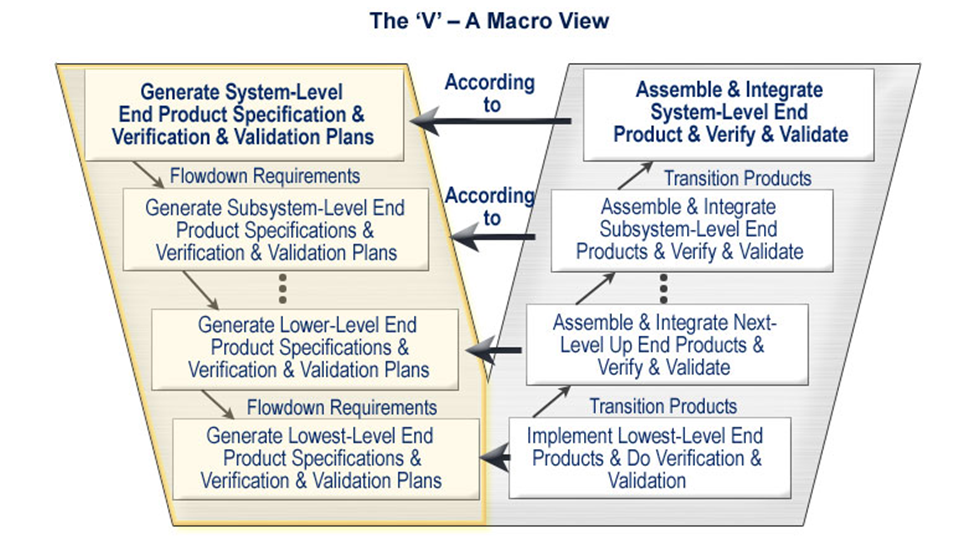
Figure 2 illustrates a macro view of generic outputs from realization activities when using a Vee life cycle model. The left side of the Vee represents various design activities 'going down' the system.
図2は、Vee ライフサイクルモデルを用いた場合に実現アクティビティから得られる汎用的な出力を、マクロな視点から示している。Vee の左側は、システムを「下っていく」さまざまな設計アクティビティを表している。
図中の英語
The left side of the Vee model demonstrates the development of system elements specifications and design descriptions. In this stage, verification and validation plans are developed, which are later used to determine whether realized system elements (products, services, or enterprises) are compliant with specifications and stakeholder needs and requirements. Also, during this stage initial specifications become flow-down requirements for lower-level system models. In terms of time frame, these activities take place early in the system’s life cycle. These activities are discussed further in the System Definition KA. However, it is important to understand that some of the system realization activities are initiated at the same time as system definition activities; this is the case with integration, verification and validation planning in particular.
Vee モデルの左側は、システム要素の仕様と設計記述の開発を示している。この段階で検証と妥当性確認の計画が策定され、それらは後に、実現されたシステム要素(製品(products)、サービス(services)、またはエンタープライズ(enterprises))が仕様およびステークホルダーのニーズと要求事項(stakeholder needs and requirements)に適合しているかどうかを判断するために用いられる。また、この段階では、初期の仕様が下位レベルのシステムモデルに対するフローダウン要求事項となる。時間軸で見ると、これらのアクティビティはシステムのライフサイクルの初期に行われる。これらのアクティビティについてはシステム定義 KA でさらに論じる。ただし、システム実現アクティビティの一部はシステム定義アクティビティと同時に開始されることを理解しておくことが重要である。とりわけ統合、検証、妥当性確認の計画がこれに当たる。
The right side of the Vee model, as illustrated in Figure 2, shows the system elements (products, services, or enterprises) are assembled according to the system model described on the left side of the Vee (integration). Verification and validation activities determine how well the realized system fulfills the stakeholder requirements, the system requirements, and design properties. These activities should follow the plans developed on the left side of the Vee. Integration can be done continuously, incrementally and/or iteratively, supported by verification and validation (V&V) efforts. For example, integration typically starts at the bottom of the Vee and continues upwards to the top of the Vee.
図2に示すように、Vee モデルの右側は、Vee の左側で記述されたシステムモデルに従ってシステム要素(製品、サービス、またはエンタープライズ)が組み立てられること(統合)を示している。検証と妥当性確認のアクティビティは、実現されたシステムがステークホルダー要求事項、システム要求事項、および設計特性(design properties)をどの程度満たしているかを判断する。これらのアクティビティは、Vee の左側で策定された計画に従って行うべきである。統合は、検証と妥当性確認(V&V)の取り組みに支えられながら、継続的、漸進的、および/または反復的に行うことができる。例えば、統合は典型的には Vee の底部から始まり、Vee の頂部に向かって上向きに続く。
The U.S. Defense Acquisition University (DAU) provides an overview of what occurs during system realization:
米国国防取得大学(U.S. Defense Acquisition University、DAU)は、システム実現の際に何が行われるかを次のように概説している。
<blockquote>Once the products of all system models have been fully defined, Bottom-Up End Product Realization can be initiated. This begins by applying the Implementation Process to buy, build, code or reuse end products. These implemented end products are verified against their design descriptions and specifications, validated against Stakeholder Requirements and then transitioned to the next higher system model for integration. End products from the Integration Process are successively integrated upward, verified and validated, transitioned to the next acquisition phase or transitioned ultimately as the End Product to the user. (Prosnik 2010)</blockquote>
「すべてのシステムモデルの製品が完全に定義されたら、ボトムアップの最終製品実現を開始できる。まず、実装プロセスを適用して、最終製品を購入、構築、コード化、または再利用する。こうして実装された最終製品は、その設計記述と仕様に対して検証され、ステークホルダー要求事項に対して妥当性確認されたうえで、統合のために1つ上のシステムモデルへ移行される。統合プロセスから得られた最終製品は、順次上位へと統合され、検証および妥当性確認を経て、次の取得フェーズへ移行されるか、最終的には最終製品としてユーザーへ移行される。」(Prosnik 2010)
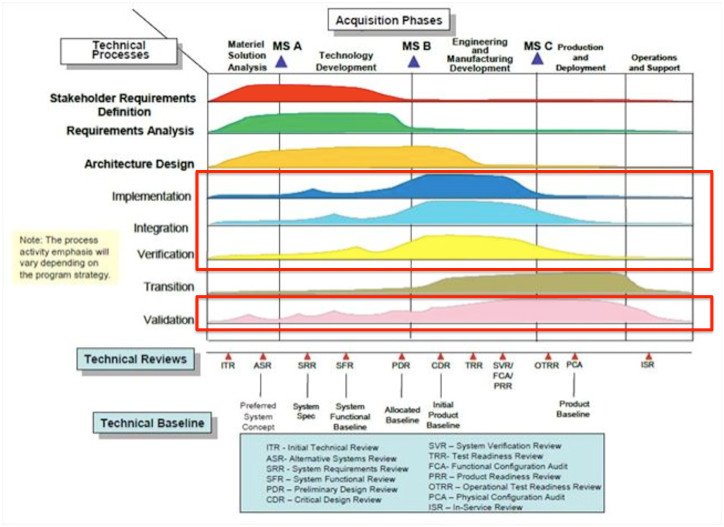
While the systems engineering (SE) technical processes are life cycle processes, the processes are concurrent, and the emphasis of the respective processes depends on the phase and maturity of the design. Figure 3 portrays (from left to right) a notional emphasis of the respective processes throughout the systems acquisition life cycle from the perspective of the U.S. Department of Defense (DoD). It is important to note that from this perspective, these processes do not follow a linear progression; instead, they are concurrent, with the amount of activity in a given area changing over the system’s life cycle. The red boxes indicate the topics that will be discussed as part of realization.
システムズエンジニアリング(systems engineering、SE)の技術プロセスはライフサイクルプロセスであるが、これらのプロセスは並行して進み、各プロセスの重点は設計のフェーズと成熟度に依存する。図3は、米国国防総省(U.S. Department of Defense、DoD)の観点から、システム取得ライフサイクル全体にわたる各プロセスの概念的な重点を(左から右へ)描いたものである。この観点では、これらのプロセスは直線的に進行するのではなく並行して進み、特定の領域におけるアクティビティ量はシステムのライフサイクルを通じて変化するという点に留意することが重要である。赤いボックスは、実現の一部として論じるトピックを示している。
図中の英語
DAU. 2010. Defense Acquisition Guidebook (DAG). Ft. Belvoir, VA, USA: Defense Acquisition University (DAU)/U.S. Department of Defense (DoD). February 19, 2010.
DAU. 2010. "Defense Acquisition Guidebook (DAG)". Ft. Belvoir, VA, USA: Defense Acquisition University (DAU)/U.S. Department of Defense (DoD). February 19, 2010.
Prosnik, G. 2010. Materials from "Systems 101: Fundamentals of Systems Engineering Planning, Research, Development, and Engineering". DAU distance learning program. eds. J. Snoderly, B. Zimmerman. Ft. Belvoir, VA, USA: Defense Acquisition University (DAU)/U.S. Department of Defense (DoD).
INCOSE. 2023.Systems Engineering Handbook: A Guide for System Life Cycle Processes and Activities, version 5.0. Hoboken, NJ, USA: John Wiley and Sons, Inc, ISBN: 978-1-119-81429-0.
INCOSE. 2023."Systems Engineering Handbook: A Guide for System Life Cycle Processes and Activities", version 5.0. Hoboken, NJ, USA: John Wiley and Sons, Inc, ISBN: 978-1-119-81429-0.
ISO/IEC/IEEE. 2023.Systems and Software Engineering - System Life Cycle Processes.Geneva, Switzerland: International Organization for Standardization (ISO)/International Electrotechnical Commission (IEC), Institute of Electrical and Electronics Engineers. ISO/IEC/IEEE 15288:2023.
ISO/IEC/IEEE. 2023."Systems and Software Engineering - System Life Cycle Processes."Geneva, Switzerland: International Organization for Standardization (ISO)/International Electrotechnical Commission (IEC), Institute of Electrical and Electronics Engineers. ISO/IEC/IEEE 15288:2023.
Martin, J.N. 1997. Systems Engineering Guidebook: A process for developing systems and products, 1st ed. Boca Raton, FL, USA: CRC Press.
Martin, J.N. 1997. "Systems Engineering Guidebook: A process for developing systems and products," 1st ed. Boca Raton, FL, USA: CRC Press.
NASA. 2007. Systems Engineering Handbook. Washington, D.C.: National Aeronautics and Space Administration (NASA), NASA/SP-2007-6105.
NASA. 2007. "Systems Engineering Handbook." Washington, D.C.: National Aeronautics and Space Administration (NASA), NASA/SP-2007-6105.
DAU. 2010. Defense Acquisition Guidebook (DAG). Ft. Belvoir, VA, USA: Defense Acquisition University (DAU)/U.S. Department of Defense (DoD). February 19, 2010.
DAU. 2010. "Defense Acquisition Guidebook (DAG)". Ft. Belvoir, VA, USA: Defense Acquisition University (DAU)/U.S. Department of Defense (DoD). February 19, 2010.
DAU. Your Acquisition Policy and Discretionary Best Practices Guide. In Defense Acquisition University (DAU)/U.S. Department of Defense (DoD) [database online]. Ft Belvoir, VA, USA. Available at: https://dag.dau.mil/Pages/Default.aspx (accessed 2010).
DAU. "Your Acquisition Policy and Discretionary Best Practices Guide." In Defense Acquisition University (DAU)/U.S. Department of Defense (DoD) [database online]. Ft Belvoir, VA, USA. Available at: https://dag.dau.mil/Pages/Default.aspx (accessed 2010).
ECSS. 2009. Systems Engineering General Requirements. Noordwijk, Netherlands: Requirements and Standards Division, European Cooperation for Space Standardization (ECSS), 6 March 2009. ECSS-E-ST-10C.
ECSS. 2009. "Systems Engineering General Requirements". Noordwijk, Netherlands: Requirements and Standards Division, European Cooperation for Space Standardization (ECSS), 6 March 2009. ECSS-E-ST-10C.
IEEE. 2012. "Standard for System and Software Verification and Validation". Institute of Electrical and Electronics Engineers. IEEE-1012.