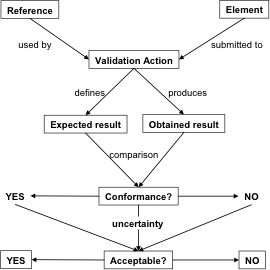
図1. 妥当性確認アクションの定義と使用。(SEBoK Original)
System Validation
System Validation is a set of actions used to check the compliance of any element (a system element, a system, a document, a service, a task, a system requirement, etc.) with its purpose and functions. These actions are planned and carried out throughout the life cycle of the system. Validation is a generic term that needs to be instantiated within the context it occurs. When understood as a process, validation is a transverse activity to every life cycle stage of the system. Particularly during the development cycle of the system, the validation process is performed in parallel with the system definition and system realization processes and applies to any activity and product resulting from this activity. The validation process is not limited to a phase at the end of system development, but generally occurs at the end of a set of life cycle tasks or activities, and always at the end of each milestone of a development project. It may be performed on an iterative basis on every produced engineering element during development and may begin with the validation of the expressed stakeholder needs and requirements. When the validation process is applied to the system when completely integrated, it is often called final validation. It is important to remember that while system validation is separate from verification, the activities are complementary and intended to be performed in conjunction.
システム妥当性確認(System Validation)は、あらゆる要素(システム要素(system element)、システム(system)、文書、サービス(service)、タスク、システム要求事項(system requirement)など)が、その目的と機能に適合しているかをチェックするために用いられる一連のアクションである。これらのアクションは、システムのライフサイクル全体を通じて計画され、実施される。妥当性確認は汎用的な用語であり、用いられるコンテキストに即して具体化する必要がある。プロセスとして捉えた場合、妥当性確認はシステムのすべてのライフサイクル段階にまたがる横断的なアクティビティである。特にシステムの開発サイクルにおいては、妥当性確認プロセスはシステム定義およびシステム実現(system realization)のプロセスと並行して実施され、あらゆるアクティビティと、それぞれから生じる製品に適用される。妥当性確認プロセスは、システム開発の最後にあるフェーズに限定されるものではなく、一般にライフサイクル(life cycle)の一連のタスクやアクティビティの終わりに行われ、開発プロジェクトの各マイルストーン(milestone)の終わりには必ず行われる。開発中に生成されるすべてのエンジニアリング要素に対して反復的に実施されることがあり、表明されたステークホルダーのニーズと要求事項(stakeholder needs and requirements)の妥当性確認から始まることもある。妥当性確認プロセスを完全に統合されたシステムに適用する場合、それはしばしば 最終妥当性確認(final validation)と呼ばれる。システム妥当性確認は検証(verification)とは別個のものであるが、その活動は相互に補完的であり、併せて実施されることが意図されている点を忘れてはならない。
Validation is the confirmation, through the provision of objective evidence, that the requirements for a specific intended use or application have been fulfilled. With a note added in ISO 9000:2005: validation is the set of activities that ensure and provide confidence that a system is able to accomplish its intended use, goals, and objectives (i.e., meet stakeholder requirements) in the intended operational environment (ISO 2005).
妥当性確認(Validation)とは、客観的な証拠を提示することによって、特定の意図された使用または適用に対する要求事項が満たされていることを確認することである。ISO 9000:2005 で追加された注記によれば、妥当性確認とは、システムが意図された運用環境において、その意図された使用、目標、目的を達成できること(すなわち、ステークホルダー要求事項を満たすこと)を保証し、その信頼を与える一連のアクティビティである(ISO 2005)。
The purpose of validation, as a generic action, is to establish the compliance of any activity output as compared to inputs of the activity. It is used to provide information and evidence that the transformation of inputs produced the expected and right result. Validation is based on tangible evidence; i.e., it is based on information whose veracity can be demonstrated by factual results obtained from techniques or methods such as inspection, measurement, test, analysis, calculation, etc. Thus, to validate a system (product, service, or enterprise) consists of demonstrating that it satisfies its system requirements and eventually the stakeholder’s requirements depending on contractual practices. From a global standpoint, the purpose of validating a system is to acquire confidence in the system’s ability to achieve its intended mission, or use, under specific operational conditions.
一般的なアクションとしての妥当性確認の目的は、あらゆるアクティビティの出力が、そのアクティビティの入力に照らして適合していることを確立することである。これは、入力の変換によって期待どおりの 正しい 結果が生み出されたという情報と証拠を提供するために用いられる。妥当性確認は具体的な証拠に基づく。すなわち、検査、測定、試験、分析、計算などの技法や方法から得られた事実に基づく結果によって、真実性を実証できる情報に基づく。したがって、システム(製品(product)、サービス(service)、エンタープライズ(enterprise))を妥当性確認するとは、そのシステムがシステム要求事項を満たし、契約上の慣行によっては最終的にステークホルダーの要求事項も満たすことを実証することである。全体的な観点から見ると、システムを妥当性確認する目的は、特定の運用条件の下で、システムが意図されたミッションを達成する、または意図された用途を果たす能力に対する信頼を得ることである。
The primary goal of systems engineering (SE) is to develop a solution that meets the needs and requirements of stakeholders. Validation is the process by which engineers ensure that the system will meet these needs and requirements.
システムズエンジニアリング(Systems Engineering、SE)の第一の目標は、ステークホルダーのニーズと要求事項を満たすソリューションを開発することである。妥当性確認は、システムがこれらのニーズと要求事項を満たすことをエンジニアが確実にするためのプロセスである。
A validation action is defined and then performed (see Figure 1, below).
妥当性確認アクション(validation action)は、まず定義され、その後実施される(下の図1を参照)。
図中の英語
A validation action applied to an engineering element includes the following:
エンジニアリング要素に適用される妥当性確認アクションには、以下が含まれる。
• Identification of the element on which the validation action will be performed.
• 妥当性確認アクションを実施する対象要素の特定。
• Identification of the reference that defines the expected result of the validation action.
• 妥当性確認アクションの期待される結果を定義する参照基準の特定。
Performing the validation action includes the following:
妥当性確認アクションの実施には、以下が含まれる。
• Obtaining a result by performing the validation action onto the submitted element.
• 提出された要素に対して妥当性確認アクションを実施し、結果を得ること。
• Comparing the obtained result with the expected result.
• 得られた結果を期待される結果と比較すること。
• Deducing the degree of compliance of the element.
• 比較結果から要素の適合度を導き出すこと。
• Deciding on the acceptability of this compliance, because sometimes the result of the comparison may require a value judgment to decide whether to accept the obtained result as compared to the relevance of the context of use.
• この適合を許容できるかどうかを判断すること。比較の結果によっては、使用コンテキストとの関連性に照らして、得られた結果を受け入れるかどうかを決めるために価値判断が必要になる場合があるためである。
Note: If there is uncertainty about compliance, the cause could come from ambiguity in the requirements.
注:適合について不確実性がある場合、その原因は要求事項の曖昧さにあることがある。
Any engineering element can be validated using a specific reference for comparison, such as stakeholder requirements, system requirements, functions, system elements, documents, etc. Examples are provided in Table 1 below:
あらゆるエンジニアリング要素は、ステークホルダー要求事項、システム要求事項、機能、システム要素、文書など、比較のための特定の参照基準を用いて妥当性確認できる。例を下の表1に示す。
表1. 妥当性確認される項目の例。(SEBoK Original)
| +Table 1. Examples of Validated Items (SEBoK Original) |
| Items |
|---|
| Explanation for Validation |
| Document |
| To validate a document is to make sure its content is compliant with the inputs of the task that produced the document. |
| Stakeholder Requirement and System Requirement |
| To validate a stakeholder requirement is to make sure its content is justified and relevant to stakeholders' expectations, complete and expressed in the language of the customer or end user. To validate a system requirement is to make sure its content translates correctly and/or accurately a stakeholder requirement to the language of the supplier. |
| Design |
| To validate the design of a system (logical and physical architectures) is to demonstrate that it satisfies its system requirements. |
| System |
| To validate a system (product, service, or enterprise) is to demonstrate that the product, service, or enterprise satisfies its system requirements and/or its stakeholder requirements. |
| Activity |
| To validate an activity or a task is to make sure its outputs are compliant with its inputs. |
| Process |
| To validate a process is to make sure its outcomes are compliant with its purpose. |
| 項目 | 妥当性確認のための説明 |
|---|---|
| 文書(Document) | 文書を妥当性確認するとは、その内容が、当該文書を生成したタスクの入力に適合していることを確かめることである。 |
| ステークホルダー要求事項とシステム要求事項(Stakeholder Requirement and System Requirement) | ステークホルダー要求事項を妥当性確認するとは、その内容が正当であり、ステークホルダーの期待に関連し、完全であり、顧客またはエンドユーザーの言語で表明されていることを確かめることである。システム要求事項を妥当性確認するとは、その内容がステークホルダー要求事項を供給者の言語へ正しく、かつ/または正確に翻訳していることを確かめることである。 |
| 設計(Design) | システムの設計(論理アーキテクチャと物理アーキテクチャ)を妥当性確認するとは、その設計がシステム要求事項を満たすことを実証することである。 |
| システム(System) | システム(製品、サービス、またはエンタープライズ)を妥当性確認するとは、その製品、サービス、またはエンタープライズが、システム要求事項および/またはステークホルダー要求事項を満たすことを実証することである。 |
| アクティビティ(Activity) | アクティビティまたはタスクを妥当性確認するとは、その出力がその入力に適合していることを確かめることである。 |
| プロセス(Process) | プロセスを妥当性確認するとは、その成果がその目的に適合していることを確かめることである。 |
The Verification versus Validation section of the System Verification article gives fundamental differences between the two concepts and associated processes. The Table 2 provides information to help understand these differences.
System Verification の記事の Verification versus Validation の節では、2つの概念と関連するプロセスの根本的な違いが示されている。表2は、これらの違いを理解するのに役立つ情報を示す。
表2. 検証と妥当性確認の違い(コンテキストにより異なる場合がある)。(SEBoK Original)
| +Table 2. Verification and Validation Differences (may vary with context). (SEBoK Original) |
| Point of View |
|---|
| Verification |
| Validation |
| Purpose of the Activity |
| Detect, identify faults/defects (supplier oriented) |
| Acquire confidence (end user oriented) |
| Idea behind the Term |
| Based on truth (objective/unbiased) |
| Based on value judgement (more subjective) |
| Level of Concern |
| Detail and local |
| Global in the context of use |
| Vision |
| Glass box (how it runs inside) |
| Black box (application of inputs provides the expected effect) |
| Basic Method |
| Fine-tooth comb |
| Traceability matrix |
| System (Product, Service, Enterprise) |
| "Done Right" (respects the state of the art); focus on (physical) characteristics |
| "Does Right" (produces the expected effect); focus on services, functions |
| Baseline Reference for Comparison (Product, Service, Enterprise) |
| System design |
| System requirements (and stakeholder requirements) |
| Order of Performance |
| First |
| Second |
| Organization of Activity |
| Verification actions are defined and/or performed by development/designer team |
| Validation actions are defined and/or performed by experts and external members to development/designer team |
| 観点 | 検証 | 妥当性確認 |
|---|---|---|
| アクティビティの目的 | 故障/欠陥を検出し特定する(供給者指向) | 信頼を得る(エンドユーザー指向) |
| 用語の背後にある考え方 | 真実に基づく(客観的/公平) | 価値判断に基づく(より主観的) |
| 関心のレベル | 詳細かつ局所的 | 使用コンテキストにおける全体 |
| 視点 | ガラスボックス(内部でどのように動作するか) | ブラックボックス(入力を与えると期待される効果が得られる) |
| 基本的な方法 | 細部まで丹念に点検する | トレーサビリティマトリクス |
| システム(製品、サービス、エンタープライズ) | 「正しく作られた(Done Right)」(最先端の水準を尊重する)。(物理的)特性に焦点を当てる | 「正しいことをする(Does Right)」(期待される効果を生み出す)。サービス、機能に焦点を当てる |
| 比較のためのベースライン参照基準(製品、サービス、エンタープライズ) | システム設計 | システム要求事項(およびステークホルダー要求事項) |
| 実施の順序 | 先 | 後 |
| アクティビティの組織化 | 検証アクションは開発/設計者チームによって定義され、かつ/または実施される | 妥当性確認アクションは、開発/設計者チームの外部の専門家とメンバーによって定義され、かつ/または実施される |
System validation concerns the global system seen as a whole and is based on the totality of requirements (system requirements, stakeholders’ requirements, etc.), but it is obtained gradually throughout the development stage in three non-exclusive ways:
システム妥当性確認は、全体として捉えたグローバルなシステムに関わるものであり、要求事項全体(システム要求事項、ステークホルダーの要求事項など)に基づくが、開発段階を通じて、相互に排他的でない3つの方法によって段階的に得られる。
• accumulating the results of verification actions and validation actions provided by the application of corresponding processes to every engineering element;
• すべてのエンジニアリング要素に対応するプロセスを適用することで得られる、検証アクションと妥当性確認アクションの結果を蓄積すること。
• performing final validation actions to the complete, integrated system in an industrial environment (as close as possible to the operational environment); and
• 産業環境(運用環境にできるだけ近い環境)において、完全で統合されたシステムに対して最終妥当性確認アクションを実施すること。
• performing operational validation actions on the complete system in its operational environment (context of use).
• その運用環境(使用コンテキスト)において、完全なシステムに対して運用妥当性確認アクションを実施すること。
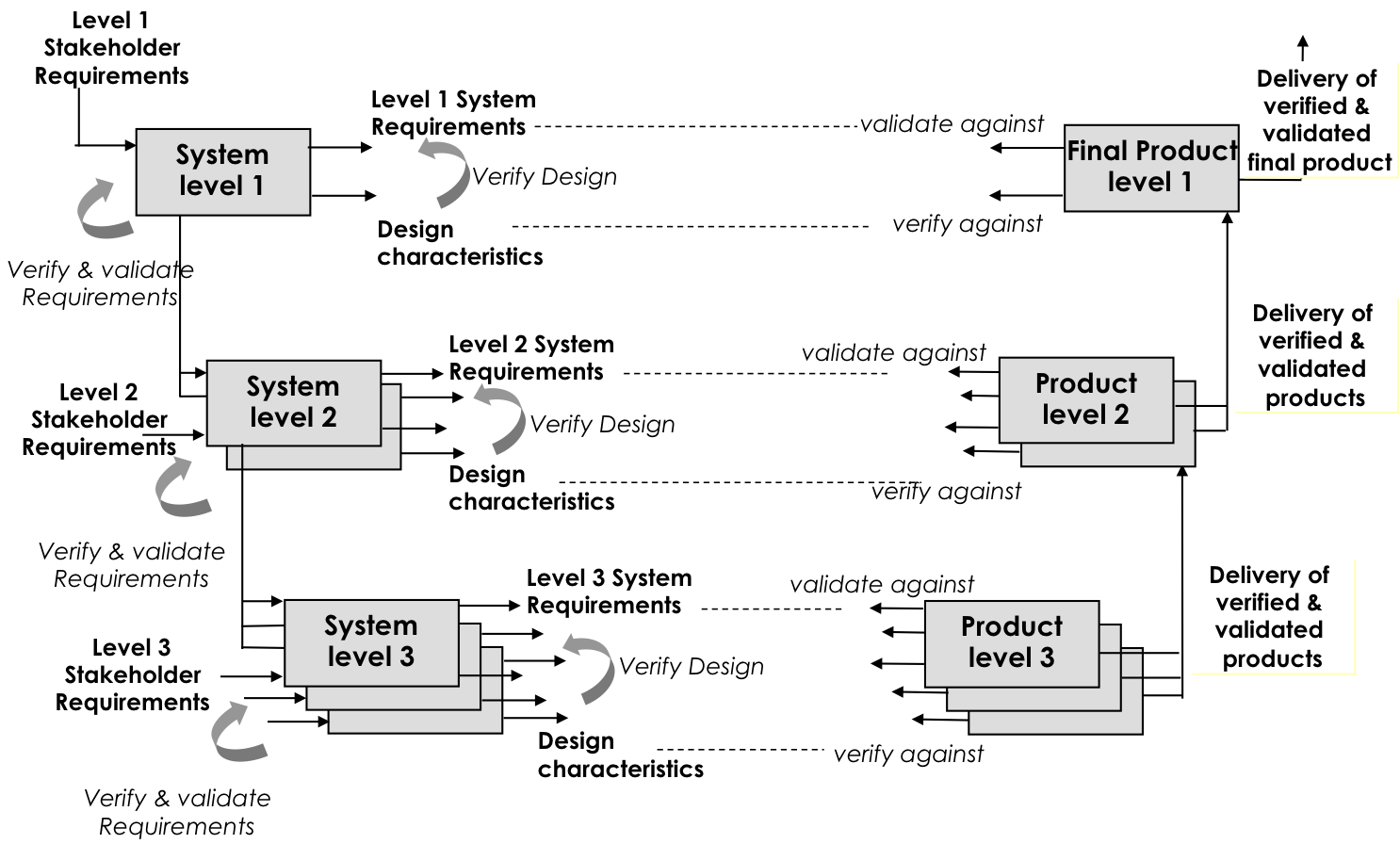
It is impossible to carry out only a single global validation on a complete, integrated complex system. The sources of faults/defects could be important, and it would be impossible to determine the causes of non-conformance manifested during this global check. Generally, the system-of-interest (SoI) has been decomposed during design in a set of layers of systems. Thus, every system and system element is verified, validated, and possibly corrected before being integrated into the parent system of the higher level, as shown in Figure 2.
完全で統合された複雑なシステムに対して、単一の全体的な妥当性確認だけを実施することは不可能である。故障/欠陥の発生源が大きくなる可能性があり、この全体チェックの間に現れた不適合の原因を特定することができなくなる。一般に、対象システム(System-of-Interest、SoI)は設計の間にシステムの層の集合へ分解されている。したがって、図2に示すように、すべてのシステムとシステム要素は、上位レベルの親システムへ統合される前に、検証され、妥当性確認され、場合によっては修正される。
図中の英語
As necessary, systems and system elements are partially integrated in subsets in order to limit the number of properties to be verified within a single step. For each level, it is necessary to perform a set of final validation actions to ensure that features stated at preceding levels are not damaged. Moreover, a compliant result obtained in a given environment can turn into a non-compliant result if the environment changes. Thus, as long as the system is not completely integrated and/or doesn't operate in the real operational environment, no result should be regarded as definitive.
必要に応じて、システムとシステム要素は、単一のステップで検証すべき特性の数を抑えるために、サブセットとして部分的に統合される。各レベルでは、先行するレベルで表明された特徴が損なわれていないことを確かめるために、一連の最終妥当性確認アクションを実施する必要がある。さらに、ある環境で得られた適合という結果は、環境が変われば不適合という結果に変わりうる。したがって、システムが完全には統合されていないか、実際の運用環境で動作していないか、そのいずれかに該当する限り、どの結果も確定的と見なすべきではない。
Inside each level of system decomposition, verification actions and validation actions are performed during system definition and system realization. This is represented in Figure 3 for the upper levels, and in Figure 4 for the lower levels. Stakeholder requirements definition and operational validation make the link between the two levels of the system decomposition.
システム分解の各レベルの内部では、検証アクションと妥当性確認アクションがシステム定義およびシステム実現(system realization)のそれぞれにおいて実施される。これを、上位レベルについては図3に、下位レベルについては図4に示す。ステークホルダー要求の定義と運用妥当性確認が、システム分解の2つのレベルを結びつける。

図中の英語
Operational validation of system element requirements and products makes the link between the two lower levels of the decomposition. See Figure 4 below.
システム要素要求事項および製品を対象とする運用妥当性確認が、分解の下位2レベルを結びつける。下の図4を参照。

図中の英語
Note: The last level of system decomposition is dedicated to the realization of system elements and the vocabulary and number of activities may be different from what is seen in Figure 4.
注:システム分解の最後のレベルはシステム要素の実現(realization of system elements)に充てられており、用語やアクティビティの数は図4に示すものとは異なる場合がある。
The difference between verification and validation is especially useful for elaborating on the integration strategy, the verification strategy, and the validation strategy. In fact, the efficiency of system realization is gained by optimizing the three strategies together to form what is often called the verification and validation strategy. This optimization consists of defining and performing the minimum number of verification and validation actions but detecting the maximum number of errors/faults/defects and achieving the maximum level of confidence in the system. The optimization takes into account the risks potentially generated if some verification actions or validation actions are excluded.
検証と妥当性確認の違いは、統合戦略、検証戦略、妥当性確認戦略を練り上げるうえで特に有用である。実際、システム実現の効率は、これら3つの戦略を合わせて最適化し、しばしば検証・妥当性確認戦略と呼ばれるものを形成することで得られる。この最適化とは、検証アクションと妥当性確認アクションを最小限の数だけ定義・実施しつつ、エラー/故障/欠陥の最大の数を検出し、システムに対する信頼を最大限のレベルまで高めることである。この最適化では、一部の検証アクションや妥当性確認アクションを除外した場合に生じうるリスクを考慮に入れる。
The purpose of the validation process is to provide objective evidence that the services provided by a system in use comply with stakeholder requirements and achieve its intended use in its intended operational environment (ISO/IEC/IEEE 15288 2015). The validation process performs a comparative assessment and confirms that the stakeholder requirements are correctly defined. Where variance is identified, it is recorded to guide future corrective actions. System validation is ratified by stakeholders (ISO/IEC/IEEE 15288 2015).
妥当性確認プロセスの目的は、使用中のシステムが提供するサービスがステークホルダー要求事項に適合し、意図された運用環境においてその意図された使用を達成するという客観的な証拠を提供することである(ISO/IEC/IEEE 15288 2015)。妥当性確認プロセスは比較評価を行い、ステークホルダー要求事項が正しく定義されていることを確認する。差異が特定された場合は、将来の是正アクションの指針とするためにそれを記録する。システム妥当性確認は、ステークホルダーによって正式に承認される(ISO/IEC/IEEE 15288 2015)。
The validation process demonstrates that the realized end product satisfies its stakeholders' (customers' or other interested parties') expectations within the intended operational environments with validation performed by anticipated operators and/or users (NASA 2007, 1-360). Each system element, system, and the complete SoI are compared against their own applicable requirements (system requirements and stakeholder requirements). This means that the validation process is instantiated as many times as necessary during the global development of the system.
妥当性確認プロセスは、実現された最終製品が、意図された運用環境において、想定される運用者および/または利用者が実施する妥当性確認によって、そのステークホルダー(顧客または他の利害関係者)の期待を満たすことを実証する(NASA 2007, 1-360)。各システム要素、システム、そして完全な SoI は、それぞれに適用される要求事項(システム要求事項とステークホルダー要求事項)と比較される。これは、システム全体の開発の間に、妥当性確認プロセスが必要に応じて何度でもインスタンス化されることを意味する。
In order to ensure that validation is feasible, the implementation of requirements must be verifiable onto a defined element. It is essential to ensure that requirements are properly written, i.e., quantifiable, measurable, unambiguous, etc. In addition, verification/validation requirements are often written in conjunction with stakeholder and system requirements and provide a method for demonstrating the implementation of each system requirement or stakeholder requirement.
妥当性確認を実施可能にするためには、要求事項の実装が、定義された要素に対して検証可能でなければならない。要求事項が適切に書かれていること、すなわち定量化可能で、測定可能で、曖昧さがないことなどを確保することが不可欠である。さらに、検証/妥当性確認の要求事項は、ステークホルダー要求事項やシステム要求事項と併せて書かれることが多く、各システム要求事項またはステークホルダー要求事項の実装を実証するための方法を提供する。
Generic inputs are references of requirements applicable to the submitted element. If the element is a system, inputs are system requirements and stakeholder requirements.
一般的な入力(Generic inputs)とは、提出された要素に適用される要求事項の参照である。要素がシステムの場合、入力はシステム要求事項とステークホルダー要求事項である。
Generic outputs are the validation plan that includes validation strategy, selected validation actions, validation procedures, validation tools, validated elements or systems, validation reports, issue/trouble reports, and change requests on requirements or on the system.
一般的な出力(Generic outputs)とは、妥当性確認戦略、選択された妥当性確認アクション、妥当性確認手順、妥当性確認ツール、妥当性確認済みの要素またはシステム、妥当性確認報告書、課題/トラブル報告書、要求事項またはシステムに対する変更要求を含む妥当性確認計画である。
Major activities and tasks performed during this process include the following:
このプロセスで実施される主要なアクティビティとタスクには、以下が含まれる。
• Establish a validation strategy (often drafted in a validation plan). This activity is carried out concurrently to system definition activities:
• 妥当性確認戦略を確立する(多くの場合、妥当性確認計画の中で起草される)。このアクティビティは、システム定義のアクティビティと並行して実施される。
** Identify the validation scope that is represented by (system and/or stakeholder) requirements; normally, every requirement should be checked as the number of validation actions can be high. ** Identify constraints according to their origin (technical feasibility, management constraints as cost, time, availability of validation means or qualified personnel, and contractual constraints that are critical to the mission) that limit or increase potential validation actions. ** Define appropriate verification/validation techniques to be applied, such as inspection, analysis, simulation, review, testing, etc., depending on the best step of the project to perform every validation action according to constraints. ** Consider a trade-off of what should be validated (scope) while taking into account all constraints or limits and deduce what can be validated objectively; selection of validation actions would be made according to the type of system, objectives of the project, acceptable risks, and constraints. ** Optimize the validation strategy to define the most appropriate validation technique for every validation action, define necessary validation means (tools, test-benches, personnel, location, and facilities) according to the selected validation technique, schedule the execution of validation actions in the project steps or milestones, and define the configuration of elements submitted to validation actions (this is primarily about testing on physical elements).
- (システムおよび/またはステークホルダー)要求事項によって表される妥当性確認の範囲を特定する。通常、妥当性確認アクションの数が多くなりうるため、すべての要求事項をチェックすべきである。 - 潜在的な妥当性確認アクションを制限または増加させる制約を、その起源(技術的な実現可能性、コスト・時間・妥当性確認手段や資格を持つ人員の可用性といったマネジメント上の制約、ミッションにとって決定的な契約上の制約)に応じて特定する。 - 制約を踏まえ、プロジェクトの最適なステップで各妥当性確認アクションを実施できるよう、検査、分析、シミュレーション、レビュー、試験など、適用すべき適切な検証/妥当性確認の技法を定義する。 - すべての制約や限界を考慮しながら、何を妥当性確認すべきか(範囲)についてトレードオフを検討し、客観的に妥当性確認できるものを推定する。妥当性確認アクションは、システムの種類、プロジェクトの目的、許容可能なリスク、制約に応じて選択される。 - 妥当性確認戦略を最適化する。各妥当性確認アクションに最も適切な妥当性確認技法を定義し、選択した妥当性確認技法に応じて必要な妥当性確認手段(ツール、テストベンチ、人員、場所、施設)を定義し、妥当性確認アクションの実行をプロジェクトのステップやマイルストーンに割り当ててスケジュールし、妥当性確認アクションに提出される要素の構成を定義する(これは主として物理的要素に対する試験に関わる)。
• Perform validation actions, including the following tasks:
• 妥当性確認アクションを実施する。これには以下のタスクが含まれる。
** Detail each validation action. In particular, note the expected results, the validation technique to be applied, and the corresponding means necessary (equipment, resources, and qualified personnel). ** Acquire validation means used during the system definition steps (qualified personnel, modeling tools, mocks-up, simulators, and facilities), then those means used during integration and final and operational steps (qualified personnel, validation tools, measuring equipment, facilities, validation procedures, etc.). ** Carry out validation procedures at the right time, in the expected environment, with the expected means, tools, and techniques. **Capture and record results obtained when performing validation actions using validation procedures and means.
- 各妥当性確認アクションを詳細化する。特に、期待される結果、適用すべき妥当性確認技法、必要となる対応する手段(機器、資源、資格を持つ人員)を明記する。 - システム定義のステップで使用する妥当性確認手段(資格を持つ人員、モデリングツール、モックアップ、シミュレータ、施設)を獲得し、続いて統合および最終・運用のステップで使用する手段(資格を持つ人員、妥当性確認ツール、測定機器、施設、妥当性確認手順など)を獲得する。 - 適切な時期に、想定される環境で、想定される手段、ツール、技法を用いて、妥当性確認手順を実行する。 - 妥当性確認手順と手段を用いて妥当性確認アクションを実施した際に得られた結果を取得し、記録する。
• Analyze the obtained results and compare them to the expected results. Decide if they comply acceptably. Record whether the decision and status are compliant or not, and generate validation reports and potential issue/trouble reports, as well as change requests on (system or stakeholder) requirements as necessary.
• 得られた結果を分析し、期待される結果と比較する。許容できる程度に適合しているかどうかを判断する。判断とステータスが適合か不適合かを記録し、妥当性確認報告書と潜在的な課題/トラブル報告書を作成するとともに、必要に応じて(システムまたはステークホルダー)要求事項に対する変更要求を作成する。
• Control the process using following tasks:
• 以下のタスクによってプロセスを管理する。
** Update the validation plan according to the progress of the project; in particular, planned validation actions can be redefined because of unexpected events. ** Coordinate validation activities with the project manager regarding the schedule, acquisition of means, personnel, and resources. Coordinate with the designers for issue/trouble/non-conformance reports. Coordinate with the configuration manager for versions of physical elements, design baselines, etc.
- プロジェクトの進捗に応じて妥当性確認計画を更新する。特に、計画された妥当性確認アクションは、予期しない事象によって再定義されることがある。 - スケジュール、手段の獲得、人員、資源についてはプロジェクトマネージャと妥当性確認アクティビティを調整する。課題/トラブル/不適合の報告書については設計者と調整する。物理的要素のバージョン、設計ベースラインなどについては構成管理者と調整する。
This process may create several artifacts, such as:
This process utilizes the ontology elements of Table 3.
このプロセスでは、以下のような成果物が作成されることがある。
このプロセスでは、表3のオントロジー要素を用いる。
表3. 妥当性確認の中で扱われる主要なオントロジー要素。(SEBoK Original)
| +Table 3. Main Ontology Elements as Handled within Validation. (SEBoK Original) |
| Element |
|---|
| Definition |
| Validation Action |
| A validation action describes what must be validated (the element as reference), on which element, the expected result, the verification technique to apply, on which level of decomposition. |
| Validation Procedure |
| A validation procedure groups a set of validation actions performed together (as a scenario of tests) in a given validation configuration. |
| Validation Tool |
| A validation tool is a device or physical tool used to perform validation procedures (test bench, simulator, cap/stub, launcher, etc.). |
| Validation Configuration |
| A validation configuration groups the physical elements necessary to perform a validation procedure. |
| Risk |
| An event having a probability of occurrence and a gravity degree on its consequence onto the system mission or on other characteristics (used for technical risk engineering). |
| Rationale |
| An argument that provides the justification for the selection of an engineering element. |
| 要素 | 定義 | 属性(例) |
|---|---|---|
| 妥当性確認アクション(Validation Action) | 妥当性確認アクションは、何を妥当性確認しなければならないか(参照としての要素)、どの要素に対して行うか、期待される結果、適用すべき検証技法、分解のどのレベルで行うかを記述する。 | 識別子、名前、説明 |
| 妥当性確認手順(Validation Procedure) | 妥当性確認手順は、ある妥当性確認の構成において(試験のシナリオとして)まとめて実施される一連の妥当性確認アクションをグループ化したものである。 | 識別子、名前、説明、期間、時間の単位 |
| 妥当性確認ツール(Validation Tool) | 妥当性確認ツールは、妥当性確認手順を実施するために使用される装置または物理的ツールである(テストベンチ、シミュレータ、キャップ/スタブ、ランチャなど)。 | 識別子、名前、説明 |
| 妥当性確認の構成(Validation Configuration) | 妥当性確認の構成は、妥当性確認手順の実施に必要な物理的要素をグループ化したものである。 | 識別子、名前、説明 |
| リスク(Risk) | 発生確率と、システムミッションまたは他の特性に及ぼす影響の重大度とを持つ事象である(技術的リスクエンジニアリングに用いられる)。 | 識別子、名前、説明、ステータス |
| 根拠(Rationale) | エンジニアリング要素の選択を正当化する論拠である。 | 識別子、名前、説明(根拠、妥当性確認アクションや妥当性確認手順を定義する理由、妥当性確認ツールを使用する理由など) |
The validation techniques are the same as those used for verification, but their purposes are different; verification is used to detect faults/defects, whereas validation is used to prove the satisfaction of (system and/or stakeholder) requirements.
妥当性確認の技法は検証に用いられるものと同じであるが、目的が異なる。検証は故障/欠陥を検出するために用いられるのに対し、妥当性確認は(システムおよび/またはステークホルダー)要求事項が満たされていることを証明するために用いられる。
The validation traceability matrix is introduced in the stakeholder requirements definition topic. It may also be extended and used to record data, such as a validation actions list, selected validation techniques to validate implementation of every engineering element ( stakeholder and system requirements in particular), expected results, and obtained results when validation actions have been performed. The use of such a matrix enables the development team to ensure that selected stakeholder and system requirements have been checked, or to evaluate the percentage of validation actions completed.
妥当性確認トレーサビリティマトリクス(validation traceability matrix)は、ステークホルダー要求の定義のトピックで導入されている。このマトリクスは拡張して、妥当性確認アクションの一覧、すべてのエンジニアリング要素(特にステークホルダー要求事項とシステム要求事項)の実装を妥当性確認するために選択された妥当性確認技法、期待される結果、妥当性確認アクションを実施した際に得られた結果などのデータの記録に用いることもできる。このようなマトリクスを用いることで、開発チームは、選択されたステークホルダー要求事項とシステム要求事項がチェックされたことを保証したり、完了した妥当性確認アクションの割合を評価したりできる。
Key pitfalls and good practices related to system validation are described in the next two sections.
システム妥当性確認に関連する主要な落とし穴と優れた実践を、次の2つの節で述べる。
Some of the key pitfalls encountered in planning and performing system validation are provided in Table 4.
システム妥当性確認の計画と実施において遭遇する主要な落とし穴のいくつかを表4に示す。
表4. システム妥当性確認における主要な落とし穴。(SEBoK Original)
| +Table 4. Major Pitfalls with System Validation. (SEBoK Original) |
| Pitfall |
|---|
| Description |
| Start validation at the end of the project |
| A common mistake is to wait until the system has been entirely integrated and tested (design is qualified) to perform any sort of validation. Validation should occur as early as possible in the [product] life cycle (Martin 1997). |
| Use only testing |
| Use only testing as a validation technique. Testing requires checking products and services only when they are implemented. Consider other techniques earlier during design; analysis and inspections are cost effective and allow discovering early potential errors, faults, or failures. |
| Stop validation when funding is diminished |
| Stop the performance of validation actions when budget and/or time are consumed. Prefer using criteria such as coverage rates to end validation activity. |
| 落とし穴 | 説明 |
|---|---|
| プロジェクトの終わりに妥当性確認を開始する | よくある間違いは、システムが完全に統合され試験される(設計が適格とされる)まで、いかなる種類の妥当性確認も実施せずに待つことである。妥当性確認は、[製品]ライフサイクルのできるだけ早い段階で行うべきである(Martin 1997)。 |
| 試験だけを用いる | 妥当性確認の技法として試験だけを用いる。試験では、製品とサービスが実装されて初めてそれらをチェックすることになる。設計のより早い段階で他の技法を検討すること。分析と検査は費用対効果が高く、潜在的なエラー、故障、失敗を早期に発見できる。 |
| 資金が減少したら妥当性確認を止める | 予算および/または時間を使い果たした時点で、妥当性確認アクションの実施を止める。妥当性確認アクティビティの終了には、カバレッジ率のような基準を用いることが望ましい。 |
Some good practices gathered from the references are provided in Table 5.
参考文献から集められた優れた実践のいくつかを表5に示す。
表5. システム妥当性確認における実証済みの実践。(SEBoK Original)
| +Table 5. Proven Practices with System Validation. (SEBoK Original) |
| Practice |
|---|
| Description |
| Start Validation Plan Early |
| It is recommended to start the drafting of the validation plan as soon as the first requirements applicable to the system are known. If the writer of the requirements immediately puts the question to know how to validate whether the future system will answer the requirements, it is possible to: |
| Verifiable Requirements |
| According to Buede, a requirement is verifiable if a "finite, cost-effective process has been defined to check that the requirement has been attained." (Buede 2009) Generally, this means that each requirement should be quantitative, measurable, unambiguous, understandable, and testable. It is generally much easier and more cost-effective to ensure that requirements meet these criteria while they are being written. Requirement adjustments made after implementation and/or integration are generally much more costly and may have wide-reaching redesign implications. There are several resources which provide guidance on creating appropriate requirements - see the system definition knowledge area, stakeholder requirements, and system requirements topics for additional information. |
| Document Validation Actions |
| It is important to document both the validation actions performed and the results obtained. This provides accountability regarding the extent to which system, system elements, and subsystems fulfill system requirements and stakeholders' requirements. These data can be used to investigate why the system, system elements, or subsystems do not match the requirements and to detect potential faults/defects. When requirements are met, these data may be reported to organization parties. For example, in a safety critical system, it may be necessary to report the results of safety demonstration to a certification organization. Validation results may be reported to the acquirer for contractual aspects or to internal company for business purpose. |
| Involve Users with Validation |
| Validation will often involve going back directly to the users to have them perform some sort of acceptance test under their own local conditions. |
| Involve |
| Often the end users and other relevant stakeholders are involved in the validation process. |
| 実践 | 説明 |
|---|---|
| 妥当性確認計画を早期に開始する | システムに適用される最初の要求事項が判明したらすぐに、妥当性確認計画の起草を開始することが推奨される。要求事項の作成者が、将来のシステムが要求事項に応えるかどうかをどのように妥当性確認するかという問いを直ちに自らに投げかければ、以下が可能になる。検証不可能な要求事項を検出すること。必要となる妥当性確認手段(テストベンチ、シミュレータなど)をあらかじめ見通し、費用を見積もり、必要に応じて設計に着手すること。コスト超過とスケジュール遅延を回避すること。 |
| 検証可能な要求事項 | Buede によれば、要求事項は、「要求事項が達成されたことをチェックするための有限で費用対効果の高いプロセスが定義されている」場合に検証可能である(Buede 2009)。一般に、これは各要求事項が定量的で、測定可能で、曖昧でなく、理解可能で、試験可能であるべきことを意味する。要求事項がこれらの基準を満たすことは、要求事項を書いている段階で確保する方が、一般にはるかに容易で費用対効果も高い。実装および/または統合の後に行われる要求事項の調整は、一般にはるかにコストがかかり、広範囲に及ぶ再設計の影響を持つことがある。適切な要求事項を作成するための指針を提供する資料はいくつかある。追加情報については、システム定義の知識領域、ステークホルダー要求事項、システム要求事項のトピックを参照。 |
| 妥当性確認アクションを文書化する | 実施した妥当性確認アクションと得られた結果の両方を文書化することが重要である。これにより、システム、システム要素、サブシステムがシステム要求事項とステークホルダーの要求事項をどの程度満たしているかについての説明責任が提供される。これらのデータは、システム、システム要素、サブシステムが要求事項に合致しない理由を調査したり、潜在的な故障/欠陥を検出したりするために使用できる。要求事項が満たされた場合、これらのデータは組織の関係者に報告されることがある。例えば、安全上重要なシステムでは、安全実証の結果を認証機関に報告する必要がある場合がある。妥当性確認の結果は、契約上の観点から取得者に、あるいは事業上の目的で社内に報告されることがある。 |
| 利用者を妥当性確認に関与させる | 妥当性確認では、利用者のもとへ直接戻り、利用者自身の現地の条件の下で何らかの受入試験を実施してもらうことがしばしばある。 |
| 関与させる | エンドユーザーと他の関連するステークホルダーが妥当性確認プロセスに関与することがしばしばある。 |
The following are elements that should be considered when practicing any of the activities discussed as a part of system realization:
以下は、システム実現の一部として論じられるいずれのアクティビティを実施する際にも考慮すべき要素である。
• Confusing verification and validation is a common issue. Validation demonstrates that the product, service, and/or enterprise as provided, fulfills its intended use, whereas verification addresses whether a local work product properly reflects its specified requirements. Validation actions use the same techniques as the verification actions (e.g., test, analysis, inspection, demonstration, or simulation).
• 検証と妥当性確認の混同はよくある問題である。妥当性確認は、提供される製品、サービス、および/またはエンタープライズがその意図された使用を果たすことを実証するのに対し、検証は、局所的な作業成果物がその指定された要求事項を適切に反映しているかどうかを扱う。妥当性確認アクションでは、検証アクションと同じ技法(例えば、試験、分析、検査、実証、シミュレーション)を用いる。
• State who the witnesses will be (for the purpose of collecting the evidence of success), what general steps will be followed, and what special resources are needed, such as instrumentation, special test equipment or facilities, simulators, specific data gathering, or rigorous analysis of demonstration results.
• (成功の証拠を収集する目的で)誰が立会者となるか、どのような一般的なステップに従うか、計装、特殊な試験装置や施設、シミュレータ、特定のデータ収集、実証結果の厳密な分析など、どのような特殊な資源が必要かを明記する。
• Identify the test facility, test equipment, any unique resource needs and environmental conditions, required qualifications and test personnel, general steps that will be followed, specific data to be collected, criteria for repeatability of collected data, and methods for analyzing the results.
• 試験施設、試験装置、固有の資源ニーズと環境条件、必要な資格と試験人員、従うべき一般的なステップ、収集すべき特定のデータ、収集データの繰返し性の基準、結果の分析方法を特定する。
Buede, D. M. 2009. The engineering design of systems: Models and methods. 2nd ed. Hoboken, NJ: John Wiley & Sons Inc.
INCOSE. 2012. INCOSE Systems Engineering Handbook, version 3.2.2. San Diego, CA, USA: International Council on Systems Engineering (INCOSE), INCOSE-TP-2003-002-03.2.2.
ISO/IEC/IEEE. 2015.Systems and Software Engineering - System Life Cycle Processes. Geneva, Switzerland: International Organization for Standardization (ISO)/International Electrotechnical Commission (IEC), Institute of Electrical and Electronics Engineers. ISO/IEC/IEEE 15288:2015.
NASA. 2007. Systems Engineering Handbook. Washington, D.C.: National Aeronautics and Space Administration (NASA), NASA/SP-2007-6105, December 2007.
INCOSE. 2012. Systems Engineering Handbook, version 3.2.2. San Diego, CA, USA: International Council on Systems Engineering (INCOSE), INCOSE-TP-2003-002-03.2.2.
ISO/IEC/IEEE. 2015.Systems and software engineering - system life cycle processes. Geneva, Switzerland: International Organization for Standardization (ISO)/International Electrotechnical Commission (IEC), Institute of Electrical and Electronics Engineers. ISO/IEC 15288:2015.
NASA. 2007. Systems Engineering Handbook. Washington, D.C.: National Aeronautics and Space Administration (NASA), NASA/SP-2007-6105, December 2007.
Buede, D.M. 2009. The engineering design of systems: Models and methods. 2nd ed. Hoboken, NJ: John Wiley & Sons Inc.
DAU. February 19, 2010. Defense Acquisition Guidebook (DAG). Ft. Belvoir, VA, USA: Defense Acquisition University (DAU)/U.S. Department of Defense.
ECSS. 2009. Systems engineering general requirements. Noordwijk, Netherlands: Requirements and Standards Division, European Cooperation for Space Standardization (ECSS), ECSS-E-ST-10C. 6 March 2009.
MITRE. 2011. "Verification and Validation." Systems Engineering Guide. Accessed 11 March 2012 at https://mitre.org/work/systems_engineering/guide/se_lifecycle_building_blocks/test_evaluation/verification_validation.html.
SAE International. 1996. Certification considerations for highly-integrated or complex aircraft systems. Warrendale, PA, USA: SAE International, ARP475.
SEI. 2007. Capability maturity model integrated (CMMI) for development, version 1.2, measurement and analysis process area. Pittsburg, PA, USA: Software Engineering Institute (SEI)/Carnegie Mellon University (CMU).