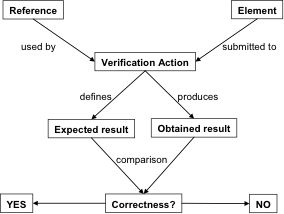
図1. 検証アクションの定義と使用。(SEBoK Original)
System Verification
System Verification is a set of actions used to check the correctness of any element, such as a system element, a system, a document, a service, a task, a requirement, etc. These types of actions are planned and carried out throughout the life cycle of the system. Verification is a generic term that needs to be instantiated within the context it occurs. As a process, verification is a transverse activity to every life cycle stage of the system. In particular, during the development cycle of the system, the verification process is performed in parallel with the system definition and system realization processes and applies to any activity and any product resulting from the activity. The activities of every life cycle process and those of the verification process can work together. For example, the integration process frequently uses the verification process. It is important to remember that verification, while separate from validation, is intended to be performed in conjunction with validation.
システム検証(System Verification)は、システム要素(system element)、システム(system)、文書、サービス(service)、タスク、要求事項(requirement)など、あらゆる要素の『正確さ(correctness)』をチェックするために用いられるアクションの集合である。こうしたアクションは、システムのライフサイクル(life cycle)全体を通じて計画され、実施される。検証は汎用的な用語であり、それが行われるコンテキストに即して具体化する必要がある。プロセスとしての検証は、システムのすべてのライフサイクル段階にまたがる横断的なアクティビティである。特にシステムの開発サイクルにおいては、検証プロセスはシステム定義(system definition)プロセスおよびシステム実現(system realization)プロセスと並行して実施され、あらゆるアクティビティと、そのアクティビティから生じるあらゆる製品に適用される。すべてのライフサイクルプロセスのアクティビティと検証プロセスのアクティビティは、互いに連携できる。例えば、統合(integration)プロセスは検証プロセスを頻繁に用いる。検証は妥当性確認(validation)とは別個のものであるが、妥当性確認と併せて実施することが意図されている点を忘れてはならない。
Verification is the confirmation, through the provision of objective evidence, that specified requirements have been fulfilled. With a note added in ISO/IEC/IEEE 15288, the scope of verification includes a set of activities that compares a system or system element against the requirements, architecture and design characteristics, and other properties to be verified (ISO/IEC/IEEE 2015). This may include, but is not limited to, specified requirements, design description, and the system itself.
検証(Verification)とは、客観的証拠を提示することによって、指定された要求事項が満たされていることを確認することである。ISO/IEC/IEEE 15288 に追加された注記によれば、検証の範囲には、システムまたはシステム要素を、要求事項、アーキテクチャおよび設計の特性、ならびに検証すべきその他の特性と比較する一連のアクティビティが含まれる(ISO/IEC/IEEE 2015)。これには、指定された要求事項、設計記述、およびシステム自体が含まれ得るが、これらに限定されない。
The purpose of verification, as a generic action, is to identify the faults/defects introduced at the time of any transformation of inputs into outputs. Verification is used to provide information and evidence that the transformation was made according to the selected and appropriate methods, techniques, standards, or rules.
汎用的なアクションとしての検証の目的は、入力から出力へのあらゆる変換の時点で混入した障害/欠陥を特定することである。検証は、その変換が、選択された適切な手法、技法、標準、または規則に従って行われたことを示す情報と証拠を提供するために用いられる。
Verification is based on tangible evidence; i.e., it is based on information whose veracity can be demonstrated by factual results obtained from techniques such as inspection, measurement, testing, analysis, calculation, etc. Thus, the process of verifying a system (product, service, enterprise, or system of systems (SoS)) consists of comparing the realized characteristics or properties of the product, service, or enterprise against its expected design properties.
検証は具体的な証拠に基づく。すなわち、検査、測定、テスト、分析、計算などの技法から得られた事実としての結果によって、その真実性を実証できる情報に基づく。したがって、システム(製品(product)、サービス(service)、エンタープライズ(enterprise)、またはシステムオブシステムズ(system of systems、SoS))を検証するプロセスは、製品、サービス、またはエンタープライズの実現された特性または性質を、期待される設計特性と比較するものである。
In the context of human realization, any human thought is susceptible to error. This is also the case with any engineering activity. Studies in human reliability have shown that people trained to perform a specific operation make around 1-3 errors per hour in best case scenarios. In any activity, or resulting outcome of an activity, the search for potential errors should not be neglected, regardless of whether or not one thinks they will happen or that they should not happen; the consequences of errors can cause extremely significant failures or threats.
人間による実現というコンテキストでは、人間の思考はどれも誤りを犯しやすい。これはどのエンジニアリングアクティビティにも当てはまる。人間信頼性に関する研究によれば、特定の操作を行うよう訓練された人は、最良の場合でも1時間あたり1-3件程度の誤りを犯す。あらゆるアクティビティと、そのアクティビティがもたらす結果について、誤りが起こると考えるかどうか、あるいは起こるべきではないと考えるかどうかにかかわらず、潜在的な誤りの探索を怠るべきではない。誤りの結果として、極めて重大な故障や脅威が生じ得る。
A verification action is defined, and then performed, as shown in Figure 1.
検証アクションは、図1に示すように、まず定義され、次に実施される。
図中の英語
The definition of a verification action applied to an engineering element includes the following:
エンジニアリング要素に適用する検証アクションの定義には、次の事項が含まれる。
• Identification of the element on which the verification action will be performed
• 検証アクションを実施する対象要素の特定
• Identification of the reference to define the expected result of the verification action (see examples of reference in Table 1)
• 検証アクションの期待される結果を定義するための参照の特定(参照の例は表1を参照)
The performance of a verification action includes the following:
検証アクションの実施には、次の事項が含まれる。
• Obtaining a result by performing the verification action onto the submitted element
• 供された要素に対して検証アクションを実施し、結果を得ること
• Comparing the obtained result with the expected result
• 得られた結果を期待される結果と比較すること
• Deducing the degree of correctness of the element
• その要素の正確さの程度を導き出すこと
Any engineering element can be verified using a specific reference for comparison: stakeholder requirement, system requirement, function, system element, document, etc. Examples are provided in Table 1.
あらゆるエンジニアリング要素は、比較のための特定の参照を用いて検証できる。ステークホルダー要求事項、システム要求事項、機能、システム要素、文書などである。例を表1に示す。
表1. 検証される項目の例。(SEBoK Original)
| +Table 1. Examples of Verified Items. (SEBoK Original) |
| Items |
|---|
| Explanation for Verification |
| Document |
| To verify a document is to check the application of drafting rules. |
| Stakeholder Requirement and System Requirement |
| To verify a stakeholder requirement or a system requirement is to check the application of syntactic and grammatical rules, characteristics defined in the stakeholder requirements definition process, and the system requirements definition process such as necessity, implementation free, unambiguous, consistent, complete, singular, feasible, traceable, and verifiable. |
| Design |
| To verify the design of a system is to check its logical and physical architecture elements against the characteristics of the outcomes of the design processes. |
| System |
| To verify a system (product, service, or enterprise) is to check its realized characteristics or properties against its expected design characteristics. |
| Aggregate |
| To verify an aggregate for integration is to check every interface and interaction between implemented elements. |
| Verification Procedure |
| To verify a verification procedure is to check the application of a predefined template and drafting rules. |
| 項目 | 検証のための説明 |
|---|---|
| 文書 | 文書の検証とは、起草規則の適用状況をチェックすることである。 |
| ステークホルダー要求事項とシステム要求事項 | ステークホルダー要求事項またはシステム要求事項の検証とは、構文規則および文法規則の適用状況、ならびにステークホルダー要求定義プロセスおよびシステム要求定義プロセスで定義された特性(必要性、実装フリー、曖昧でないこと、一貫性、完全性、単一であること、実現可能性、追跡可能性、検証可能性など)をチェックすることである。 |
| 設計 | システムの設計の検証とは、その論理的および物理的なアーキテクチャ要素を、設計プロセスの成果物の特性に照らしてチェックすることである。 |
| システム | システム(製品、サービス、またはエンタープライズ)の検証とは、その実現された特性または性質を、期待される設計特性に照らしてチェックすることである。 |
| 集合体 | 統合のための集合体の検証とは、実装された要素間のすべてのインタフェースと相互作用をチェックすることである。 |
| 検証手順 | 検証手順の検証とは、事前に定義されたテンプレートと起草規則の適用状況をチェックすることである。 |
The term verification is often associated with the term validation and understood as a single concept of V&V. Validation is used to ensure that one is working the right problem, whereas verification is used to ensure that one has solved the problem right (Martin 1997). From an actual and etymological meaning, the term verification comes from the Latin verus, which means truth, and facere, which means to make/perform. Thus, verification means to prove that something is true or correct (a property, a characteristic, etc.). The term validation comes from the Latin valere, which means to become strong, and has the same etymological root as the word value. Thus, validation means to prove that something has the right features to produce the expected effects. (Adapted from "Verification and Validation in plain English" (Lake INCOSE 1999).)
『検証(verification)』という用語は、『妥当性確認(validation)』という用語と結び付けられ、『V&V』という単一の概念として理解されることが多い。妥当性確認は『正しい問題に取り組んでいる(one is working the right problem)』ことを保証するために用いられ、検証は『問題を正しく解いた(one has solved the problem right)』ことを保証するために用いられる(Martin 1997)。実際の意味と語源の両面からみると、検証(verification)という用語は、ラテン語の『verus(真実)』と『facere(作る/実施する)』に由来する。したがって検証とは、何か(特性、特徴など)が『真実』であること、または正しいことを証明するという意味である。妥当性確認(validation)という用語は、ラテン語の『valere(強くなる)』に由来し、『value(価値)』という語と同じ語源を持つ。したがって妥当性確認とは、何かが期待される効果を生み出すための正しい特徴を備えていることを証明するという意味である。("Verification and Validation in plain English"(Lake INCOSE 1999)より翻案。)
The main differences between the verification process and the validation process concern the references used to check the correctness of an element, and the acceptability of the effective correctness.
検証プロセスと妥当性確認プロセスの主な違いは、要素の正確さをチェックするために用いる参照と、実効的な正確さの受容可能性にある。
• Within verification, comparison between the expected result and the obtained result is generally binary, whereas within validation, the result of the comparison may require a judgment of value regarding whether or not to accept the obtained result compared to a threshold or limit.
• 検証では、期待される結果と得られた結果の比較は一般に二値的であるのに対し、妥当性確認では、比較の結果について、閾値または限界と比較して得られた結果を受け入れるかどうかの価値判断が必要となる場合がある。
• Verification relates more to one element, whereas validation relates more to a set of elements and considers this set as a whole.
• 検証はどちらかといえば1つの要素に関わるのに対し、妥当性確認はどちらかといえば要素の集合に関わり、その集合を全体として捉える。
• Validation presupposes that verification actions have already been performed.
• 妥当性確認は、検証アクションがすでに実施されていることを前提とする。
• The techniques used to define and perform the verification actions and those for validation actions are very similar.
• 検証アクションの定義と実施に用いる技法と、妥当性確認アクションに用いる技法は、非常によく似ている。
There is sometimes a misconception that verification occurs after integration and before validation. In most cases, it is more appropriate to begin verification activities during development or implementation and to continue them into deployment and use.
検証は統合の後、妥当性確認の前に行われるという誤解が見られることがある。ほとんどの場合、検証アクティビティは開発中または実装(implementation)中に開始し、配備と使用へと継続するほうが適切である。
Once the system elements have been realized, they are integrated to form the complete system. Integration consists of assembling and performing verification actions as stated in the integration process. A final validation activity generally occurs when the system is integrated, but a certain number of validation actions are also performed parallel to the system integration in order to reduce the number of verification actions and validation actions while controlling the risks that could be generated if some checks are excluded. Integration, verification, and validation are intimately processed together due to the necessity of optimizing the strategy of verification and validation, as well as the strategy of integration.
システム要素が実現されると、それらは統合されて完全なシステムとなる。統合は、統合プロセスで述べたとおり、組み立てと検証アクションの実施からなる。最終的な妥当性確認活動は一般にシステムが統合された時点で行われるが、一定数の妥当性確認アクションもシステム統合と並行して実施される。これは、検証アクションと妥当性確認アクションの数を減らしつつ、一部のチェックを除外した場合に生じ得るリスクを管理するためである。統合、検証、妥当性確認は、検証と妥当性確認の戦略、および統合の戦略を最適化する必要があるため、密接に一体として扱われる。
The purpose of the verification process is to confirm that the system fulfills the specified design requirements. This process provides the information required to effect the remedial actions that correct non-conformances in the realized system or the processes that act on it - see ISO/IEC/IEEE 15288 (ISO/IEC/IEEE 2015).
Each system element and the complete system itself should be compared against its own design references (specified requirements). As stated by Dennis Buede, verification is the matching of [configuration items], components, sub-systems, and the system to corresponding requirements to ensure that each has been built right (Buede 2009). This means that the verification process is instantiated as many times as necessary during the global development of the system. Because of the generic nature of a process, the verification process can be applied to any engineering element that has conducted to the definition and realization of the system elements and the system itself.
Facing the huge number of potential verification actions that may be generated by the normal approach, it is necessary to optimize the verification strategy. This strategy is based on the balance between what must be verified and constraints, such as time, cost, and feasibility of testing, which naturally limit the number of verification actions and the risks one accepts when excluding some verification actions.
Several approaches exist that may be used for defining the verification process. The International Council on Systems Engineering (INCOSE) dictates that two main steps are necessary for verification: planning and performing verification actions (INCOSE 2012). NASA has a slightly more detailed approach that includes five main steps: prepare verification, perform verification, analyze outcomes, produce a report, and capture work products (NASA December 2007, 1-360, p. 102). Any approach may be used, provided that it is appropriate to the scope of the system, the constraints of the project, includes the activities of the process listed below in some way, and is appropriately coordinated with other activities.
Generic inputs are baseline references of the submitted element. If the element is a system, inputs are the logical and physical architecture elements as described in a system design document, the design description of internal interfaces to the system and interfaces requirements external to the system, and by extension, the system requirements. Generic outputs define the verification plan that includes verification strategy, selected verification actions, verification procedures, verification tools, the verified element or system, verification reports, issue/trouble reports, and change requests on design.
検証プロセスの目的は、システムが指定された設計要求事項を満たしていることを確認することである。このプロセスは、実現されたシステム、またはそれに作用するプロセスにおける不適合を正すための是正措置を講じるのに必要な情報を提供する。ISO/IEC/IEEE 15288(ISO/IEC/IEEE 2015)を参照のこと。
各システム要素と完全なシステム自体は、それぞれ自身の設計参照(指定された要求事項)と比較されるべきである。Dennis Buede が述べるように、『検証とは、[構成品目]、コンポーネント、サブシステム、およびシステムを、対応する要求事項と照合し、それぞれが正しく作られたことを保証することである』(Buede 2009)。つまり、検証プロセスは、システムの全体的な開発を通じて、必要な回数だけ具体化される。プロセスというものが汎用的な性質を持つため、検証プロセスは、システム要素とシステム自体の定義と実現を導いたあらゆるエンジニアリング要素に適用できる。
通常のアプローチでは膨大な数の潜在的な検証アクションが生成され得るため、検証戦略を最適化する必要がある。この戦略は、検証しなければならないことと、時間、コスト、テストの実現可能性などの制約(これらの制約は、検証アクションの数と、一部の検証アクションを除外する際に受け入れるリスクをおのずと制限する)とのバランスに基づく。
検証プロセスの定義に用いることのできるアプローチはいくつかある。国際システムズエンジニアリング協議会(International Council on Systems Engineering、INCOSE)は、検証には計画と検証アクションの実施という2つの主要なステップが必要であると定めている(INCOSE 2012)。NASA は、検証の準備、検証の実施、成果の分析、レポートの作成、作業成果物の取り込みという5つの主要なステップを含む、やや詳細なアプローチをとっている(NASA December 2007, 1-360, p. 102)。どのアプローチを用いてもよいが、システムの範囲とプロジェクトの制約に適しており、下記のプロセスのアクティビティを何らかの形で含み、他のアクティビティと適切に調整されていることが条件となる。
汎用的な入力は、供された要素のベースライン参照である。その要素がシステムである場合、入力は、システム設計文書に記述された論理的および物理的なアーキテクチャ要素、システムの内部インタフェースの設計記述とシステム外部のインタフェース要求、ひいてはシステム要求事項である。
汎用的な出力は、検証計画を定義する。この検証計画には、検証戦略、選択された検証アクション、検証手順、検証ツール、検証された要素またはシステム、検証レポート、問題/トラブルのレポート、および設計への変更要求が含まれる。
To establish the verification strategy drafted in a verification plan (this activity is carried out concurrently to system definition activities), the following steps are necessary:
検証計画の中で起草される検証戦略を確立するには(このアクティビティはシステム定義アクティビティと並行して実施される)、次のステップが必要である。
• Identify verification scope by listing as many characteristics or properties as possible that should be checked. The number of verification actions can be extremely high.
• チェックすべき特性または性質をできるだけ多く列挙して、検証範囲を特定する。検証アクションの数は極めて多くなり得る。
• Identify constraints according to their origin (technical feasibility, management constraints as cost, time, availability of verification means or qualified personnel, and contractual constraints that are critical to the mission) that limit potential verification actions.
• 潜在的な検証アクションを制限する制約を、その起源(技術的実現可能性、コスト、時間、検証手段や有資格人員の可用性などの管理上の制約、およびミッションにとって重要な契約上の制約)別に特定する。
• Define appropriate verification techniques to be applied, such as inspection, analysis, simulation, peer-review, testing, etc., based on the best step of the project to perform every verification action according to the given constraints.
• 与えられた制約を踏まえ、各検証アクションを実施するのに最適なプロジェクト上の工程に応じて、検査、分析、シミュレーション、ピアレビュー、テストなど、適用すべき適切な検証技法を定義する。
• Consider a trade-off of what should be verified (scope) taking into account all constraints or limits and deduce what can be verified; the selection of verification actions would be made according to the type of system, objectives of the project, acceptable risks, and constraints.
• すべての制約または限界を考慮に入れて、検証すべきこと(範囲)のトレードオフを検討し、検証できることを導き出す。検証アクションの選択は、システムのタイプ、プロジェクトの目的、許容可能なリスク、制約に従って行われる。
• Optimize the verification strategy by defining the most appropriate verification technique for every verification action while defining necessary verification means (tools, test-benches, personnel, location, and facilities) according to the selected verification technique.
• 選択した検証技法に応じて必要な検証手段(ツール、テストベンチ、人員、場所、施設)を定義しつつ、すべての検証アクションについて最も適切な検証技法を定義することにより、検証戦略を最適化する。
• Schedule the execution of verification actions in the project steps or milestones and define the configuration of elements submitted to verification actions (this mainly involves testing on physical elements).
• プロジェクトのステップまたはマイルストーンの中に検証アクションの実行をスケジュールし、検証アクションに供される要素の構成を定義する(これは主に物理的要素に対するテストに関わる)。
Performing verification actions includes the following tasks:
検証アクションの実施には、次のタスクが含まれる。
• Detail each verification action; in particular, note the expected results, the verification techniques to be applied, and the corresponding means required (equipment, resources, and qualified personnel).
• 各検証アクションを詳述する。特に、期待される結果、適用すべき検証技法、および必要となる対応する手段(設備、資源、有資格人員)を記す。
• Acquire verification means used during system definition steps (qualified personnel, modeling tools, mocks-up, simulators, and facilities), and then those used during the integration step (qualified personnel, verification tools, measuring equipment, facilities, verification procedures, etc.).
• システム定義ステップで用いる検証手段(有資格人員、モデリングツール、モックアップ、シミュレータ、施設)を取得し、次いで統合ステップで用いる検証手段(有資格人員、検証ツール、測定装置、施設、検証手順など)を取得する。
• Carry out verification procedures at the right time, in the expected environment, with the expected means, tools, and techniques.
• 適切な時期に、期待される環境で、期待される手段、ツール、技法を用いて検証手順を実施する。
• Capture and record the results obtained when performing verification actions using verification procedures and means.
• 検証手順と手段を用いて検証アクションを実施した際に得られた結果を取り込み、記録する。
The obtained results must be analyzed and compared to the expected results so that the status may be recorded as either compliant or non-compliant. Systems engineering (SE) practitioners will likely need to generate verification reports, as well as potential issue/trouble reports, and change requests on design as necessary.
得られた結果は、ステータスを『適合(compliant)』または『不適合(non-compliant)』のいずれかとして記録できるよう、期待される結果と比較して分析しなければならない。システムズエンジニアリング(Systems engineering、SE)の実践者は、検証レポートに加え、必要に応じて潜在的な問題/トラブルのレポートや設計への変更要求を作成する必要が生じる可能性が高い。
Controlling the process includes the following tasks:
プロセスの管理には、次のタスクが含まれる。
• Update the verification plan according to the progress of the project; in particular, planned verification actions can be redefined because of unexpected events.
• プロジェクトの進捗に応じて検証計画を更新する。特に、計画された検証アクションは、予期しない事象によって再定義されることがある。
• Coordinate verification activities with the project manager: review the schedule and the acquisition of means, personnel, and resources. Coordinate with designers for issues/trouble/non-conformance reports and with the configuration manager for versions of the physical elements, design baselines, etc.
• 検証アクティビティをプロジェクトマネージャと調整する。スケジュール、ならびに手段、人員、資源の取得をレビューする。問題/トラブル/不適合のレポートについては設計者と、物理的要素のバージョンや設計ベースラインなどについては構成マネージャと調整する。
This process may create several artifacts such as:
This process utilizes the ontology elements displayed in Table 2 below.
このプロセスでは、次のような複数の成果物が作成されることがある。
このプロセスでは、下記の表2に示すオントロジー要素を利用する。
表2. 検証において扱われる主要なオントロジー要素。(SEBoK Original)
| +Table 2. Main Ontology Elements as Handled within Verification. (SEBoK Original) |
| Element |
|---|
| Definition |
| Verification Action |
| A verification action describes what must be verified (the element as reference) on which element, the expected result, the verification technique to apply, on which level of decomposition. |
| Verification Procedure |
| A verification procedure groups a set of verification actions performed together (as a scenario of tests) in a gin verification configuration. |
| Verification Tool |
| A verification tool is a device or physical tool used to perform verification procedures (test bench, simulator, cap/stub, launcher, etc.). |
| Verification Configuration |
| A verification configuration groups all physical elements (aggregates and verification tools) necessary to perform a verification procedure. |
| Risk |
| An event having a probability of occurrence and a gravity degree on its consequence onto the system mission or on other characteristics (used for technical risk in engineering). A risk is the combination of vulnerability and of a danger or a threat. |
| Rationale |
| An argument that provides the justification for the selection of an engineering element. |
| 要素 | 定義 | 属性(例) |
|---|---|---|
| 検証アクション | 検証アクションは、何を検証しなければならないか(参照としての要素)、どの要素に対して行うか、期待される結果、適用する検証技法、どの分解レベルで行うかを記述する。 | 識別子、名前、説明 |
| 検証手順 | 検証手順は、所定の検証構成において一緒に実施される検証アクションの集合を(テストのシナリオとして)まとめる。 | 識別子、名前、説明、期間、時間の単位 |
| 検証ツール | 検証ツールは、検証手順の実施に用いる装置または物理的なツール(テストベンチ、シミュレータ、キャップ/スタブ、ランチャなど)である。 | 識別子、名前、説明 |
| 検証構成 | 検証構成は、検証手順の実施に必要なすべての物理的要素(集合体と検証ツール)をまとめる。 | 識別子、名前、説明 |
| リスク | 発生確率と、システムのミッションまたはその他の特性に及ぼす影響の重大さの程度とを伴うイベント(エンジニアリングにおける技術リスクに用いられる)。リスクは、脆弱性と、危険または脅威との組み合わせである。 | |
| 根拠 | エンジニアリング要素の選択を正当化する論拠。 | 識別子、名前、説明(根拠、検証アクション・検証手順を定義する理由、検証ツールを用いる理由など) |
There are several verification techniques to check that an element or a system conforms to its design references or its specified requirements. These techniques are almost the same as those used for validation, though the application of the techniques may differ slightly. In particular, the purposes are different; verification is used to detect faults/defects, whereas validation is used to provide evidence for the satisfaction of (system and/or stakeholder) requirements. Table 3 below provides descriptions of some techniques for verification.
要素またはシステムが、その設計参照または指定された要求事項に適合していることをチェックするための検証技法はいくつかある。これらの技法は妥当性確認(validation)に用いられるものとほぼ同じであるが、技法の適用の仕方はわずかに異なる場合がある。特に、目的が異なる。検証は障害/欠陥の検出に用いられ、妥当性確認は(システムおよび/またはステークホルダーの)要求事項が満たされていることの証拠を提供するために用いられる。下記の表3に、検証のためのいくつかの技法の説明を示す。
表3. 検証技法。(SEBoK Original)
| +Table 3. Verification Techniques. (SEBoK Original) |
| Verification Technique |
|---|
| Description |
| Inspection |
| Technique based on visual or dimensional examination of an element; the verification relies on the human senses or uses simple methods of measurement and handling. Inspection is generally non-destructive, and typically includes the use of sight, hearing, smell, touch, and taste, simple physical manipulation, mechanical and electrical gauging, and measurement. No stimuli (tests) are necessary. The technique is used to check properties or characteristics best determined by observation (e.g. paint color, weight, documentation, listing of code, etc.). |
| Analysis |
| Technique based on analytical evidence obtained without any intervention on the submitted element using mathematical or probabilistic calculation, logical reasoning (including the theory of predicates), modeling and/or simulation under defined conditions to show theoretical compliance. Mainly used where testing to realistic conditions cannot be achieved or is not cost-effective. |
| Analogy or Similarity |
| Technique based on evidence of similar elements to the submitted element or on experience feedback. It is absolutely necessary to show by prediction that the context is invariant that the outcomes are transposable (models, investigations, experience feedback, etc.). Similarity can only be used if the submitted element is similar in design, manufacture, and use; equivalent or more stringent verification actions were used for the similar element, and the intended operational environment is identical to or less rigorous than the similar element. |
| Demonstration |
| Technique used to demonstrate correct operation of the submitted element against operational and observable characteristics without using physical measurements (no or minimal instrumentation or test equipment). Demonstration is sometimes called 'field testing'. It generally consists of a set of tests selected by the supplier to show that the element response to stimuli is suitable or to show that operators can perform their assigned tasks when using the element. Observations are made and compared with predetermined/expected responses. Demonstration may be appropriate when requirements or specification are given in statistical terms (e.g. mean time to repair, average power consumption, etc.). |
| Test |
| Technique performed onto the submitted element by which functional, measurable characteristics, operability, supportability, or performance capability is quantitatively verified when subjected to controlled conditions that are real or simulated. Testing often uses special test equipment or instrumentation to obtain accurate quantitative data to be analyzed. |
| Sampling |
| Technique based on verification of characteristics using samples. The number, tolerance, and other characteristics must be specified to be in agreement with the experience feedback. |
| 検証技法 | 説明 |
|---|---|
| 検査 | 要素を視覚的に、または寸法面から調べることに基づく技法。検証は人間の感覚に依拠するか、測定と取り扱いの単純な方法を用いる。検査は一般に非破壊的であり、典型的には、視覚、聴覚、嗅覚、触覚、味覚の使用、単純な物理的操作、機械的・電気的なゲージングと測定を含む。刺激(テスト)は必要ない。この技法は、観察によって最もよく判断できる特性または特徴(例えば、塗装の色、重量、文書、コードのリストなど)をチェックするために用いられる。 |
| 分析 | 供された要素に一切介入することなく得られた分析的証拠に基づく技法。数学的または確率的な計算、論理的推論(述語の理論を含む)、定義された条件下でのモデリングおよび/またはシミュレーションを用いて、理論的な適合を示す。主に、現実的な条件でのテストが実現できない場合、または費用対効果が高くない場合に用いられる。 |
| 類推または類似性 | 供された要素に類似した要素の証拠、または経験フィードバックに基づく技法。コンテキストが不変であり、結果が転用可能であることを、予測によって示すことが絶対に必要である(モデル、調査、経験フィードバックなど)。類似性は、供された要素が設計、製造、使用の面で類似しており、類似した要素に対して同等またはより厳しい検証アクションが用いられ、かつ対象要素の想定運用環境が、類似要素の運用環境と同じか、それよりも厳しくない場合にのみ用いることができる。 |
| 実演 | 物理的な測定を用いずに(計測機器やテスト設備をまったく、またはほとんど用いずに)、運用上の特性および観察可能な特性に照らして、供された要素が正しく動作することを実演するために用いられる技法。実演は『フィールドテスト』と呼ばれることもある。実演は一般に、要素の刺激に対する応答が適切であることを示すため、または要素を用いる際にオペレータが割り当てられたタスクを実施できることを示すために、供給者が選択した一連のテストからなる。観察を行い、事前に決定された/期待される応答と比較する。実演は、要求事項または仕様が統計的な用語で与えられる場合(例えば、平均修復時間、平均消費電力など)に適切なことがある。 |
| テスト | 供された要素に対して実施される技法であり、現実の、またはシミュレーションされた制御条件下に置かれたときの、機能的で測定可能な特性、運用可能性、支援可能性、または性能能力を定量的に検証する。テストでは、分析対象となる正確な定量的データを得るために、特別なテスト設備や計測機器を用いることが多い。 |
| サンプリング | サンプルを用いて特性を検証することに基づく技法。数、公差、その他の特性は、経験フィードバックと整合するように指定しなければならない。 |
Key pitfalls and good practices related to this topic are described in the next two sections.
このトピックに関連する主要な落とし穴と良い実践を、次の2つの節で述べる。
Some of the key pitfalls encountered in planning and performing System Verification are provided in Table 4.
システム検証の計画と実施において遭遇する主要な落とし穴の一部を、表4に示す。
表4. システム検証における主要な落とし穴。(SEBoK Original)
| +Table 4. Major Pitfalls with System Verification (SEBoK Original) |
| Pitfall |
|---|
| Description |
| Confusion between verification and validation |
| Confusion between verification and validation causes developers to take the wrong reference/baseline to define verification and validation actions and/or to address the wrong level of granularity (detail level for verification, global level for validation). |
| No verification strategy |
| One overlooks verification actions because it is impossible to check every characteristic or property of all system elements and of the system in any combination of operational conditions and scenarios. A strategy (justified selection of verification actions against risks) must be established. |
| Save or spend time |
| Skip verification activity to save time. |
| Use only testing |
| Use only testing as a verification technique. Testing requires checking products and services only when they are implemented. Consider other techniques earlier during design; analysis and inspections are cost effective and allow discovering early potential errors, faults, or failures. |
| Stop verifications when funding is diminished |
| Stopping the performance of verification actions when budget and/or time are consumed. Prefer using criteria such as coverage rates to end verification activity. |
| 落とし穴 | 説明 |
|---|---|
| 検証と妥当性確認の混同 | 検証と妥当性確認を混同すると、開発者は、検証アクションと妥当性確認アクションを定義する際に誤った参照/ベースラインを用いたり、誤った粒度のレベル(検証には詳細レベル、妥当性確認には全体レベル)で取り組んだりすることになる。 |
| 検証戦略がない | すべてのシステム要素とシステムのあらゆる特性または性質を、運用条件とシナリオのあらゆる組み合わせでチェックすることは不可能であるため、検証アクションに見落としが生じる。戦略(リスクに対する検証アクションの正当化された選択)を確立しなければならない。 |
| 時間を節約する、または費やす | 時間を節約するために検証アクティビティを省略する。 |
| テストだけを用いる | 検証技法としてテストだけを用いる。テストは、製品とサービスが実装されたときにのみ、それらをチェックすることを必要とする。設計のより早い段階で他の技法を検討すること。分析と検査は費用対効果が高く、潜在的な誤り、障害、または故障を早期に発見できる。 |
| 資金が減少したときに検証を止める | 予算および/または時間を使い果たした時点で、検証アクションの実施を停止する。検証アクティビティの終了には、カバレッジ率などの基準を用いることが望ましい。 |
Some proven practices gathered from the references are provided in Table 5.
参考文献から集められた実証済みの実践の一部を、表5に示す。
表5. システム検証における実証済みの実践。(SEBoK Original)
| +Table 5. Proven Practices with System Verification. (SEBoK Original) |
| Practice |
|---|
| Description |
| Start verifications early in the development |
| The earlier characteristics of an element are verified in the project, the easier the corrections are to do and the consequences on schedule and cost will be fewer. |
| Define criteria ending verifications |
| Carrying out verification actions without limits generates a risk of drift for costs and deadlines. Modifying and verifying in a non-stop cycle until arriving at a perfect system is the best way to never supply the system. Thus, it is necessary to set limits of cost, time, and a maximum number of modification loops back for each verification action type, ending criteria (percentages of success, error count detected, coverage rate obtained, etc.). |
| Involve design responsible with verification |
| Include the verification responsible in the designer team or include some designer onto the verification team. |
| 実践 | 説明 |
|---|---|
| 開発の早期に検証を開始する | プロジェクトの中で要素の特性を早い段階で検証するほど、是正は容易になり、スケジュールとコストへの影響は小さくなる。 |
| 検証を終了させる基準を定義する | 際限なく検証アクションを実施すると、コストと期限のドリフトのリスクが生じる。完璧なシステムに到達するまで修正と検証を休みなく繰り返すことは、システムを決して供給しない最善の方法である。したがって、検証アクションのタイプごとに、コストと時間の限界、および修正ループの最大回数を定め、終了基準(成功の割合、検出された誤りの数、得られたカバレッジ率など)を設定する必要がある。 |
| 設計責任者を検証に関与させる | 検証責任者を設計者チームに加えるか、設計者の一部を検証チームに加える。 |
Buede, D.M. 2009. The Engineering Design of Systems: Models and Methods. 2nd ed. Hoboken, NJ, USA: John Wiley & Sons Inc.
Buede, D.M. 2009. "The Engineering Design of Systems: Models and Methods." 2nd ed. Hoboken, NJ, USA: John Wiley & Sons Inc.
INCOSE. 2012. INCOSE Systems Engineering Handbook, version 3.2.2. San Diego, CA, USA: International Council on Systems Engineering (INCOSE), INCOSE-TP-2003-002-03.2.2.
INCOSE. 2012. "INCOSE Systems Engineering Handbook," version 3.2.2. San Diego, CA, USA: International Council on Systems Engineering (INCOSE), INCOSE-TP-2003-002-03.2.2.
ISO/IEC/IEEE. 2015.Systems and Software Engineering - System Life Cycle Processes. Geneva, Switzerland: International Organization for Standardization (ISO)/International Electrotechnical Commission (IEC), Institute of Electrical and Electronics Engineers. ISO/IEC/IEEE 15288:2015.
ISO/IEC/IEEE. 2015."Systems and Software Engineering - System Life Cycle Processes." Geneva, Switzerland: International Organization for Standardization (ISO)/International Electrotechnical Commission (IEC), Institute of Electrical and Electronics Engineers. ISO/IEC/IEEE 15288:2015.
Lake, J. 1999. "V & V in Plain English." International Council on Systems Engineering (INCOSE) 9th Annual International Symposium, Brighton, UK, 6-10 June 1999.
NASA. 2007. Systems Engineering Handbook. Washington, DC, USA: National Aeronautics and Space Administration (NASA), December 2007. NASA/SP-2007-6105.
NASA. 2007. "Systems Engineering Handbook". Washington, DC, USA: National Aeronautics and Space Administration (NASA), December 2007. NASA/SP-2007-6105.
INCOSE. 2012. INCOSE Systems Engineering Handbook: A Guide for System Life Cycle Processes and Activities, version 3.2.2. San Diego, CA, USA: International Council on Systems Engineering (INCOSE), INCOSE-TP-2003-002-03.2.2.
INCOSE. 2012. "Systems Engineering Handbook: A Guide for System Life Cycle Processes and Activities", version 3.2.2. San Diego, CA, USA: International Council on Systems Engineering (INCOSE), INCOSE-TP-2003-002-03.2.2.
ISO/IEC/IEEE. 2015. Systems and Software Engineering - System Life Cycle Processes. Geneva, Switzerland: International Organization for Standardization (ISO)/International Electrotechnical Commission (IEC)/ Institute of Electrical and Electronics Engineers. ISO/IEC/IEEE 15288:2015.
ISO/IEC/IEEE. 2015. "Systems and Software Engineering - System Life Cycle Processes." Geneva, Switzerland: International Organization for Standardization (ISO)/International Electrotechnical Commission (IEC)/ Institute of Electrical and Electronics Engineers. ISO/IEC/IEEE 15288:2015.
NASA. 2007. Systems Engineering Handbook. Washington, D.C.: National Aeronautics and Space Administration (NASA), December 2007. NASA/SP-2007-6105.
NASA. 2007. "Systems Engineering Handbook." Washington, D.C.: National Aeronautics and Space Administration (NASA), December 2007. NASA/SP-2007-6105.
Buede, D.M. 2009. The Engineering Design of Systems: Models and Methods, 2nd ed. Hoboken, NJ, USA: John Wiley & Sons Inc.
Buede, D.M. 2009. "The Engineering Design of Systems: Models and Methods," 2nd ed. Hoboken, NJ, USA: John Wiley & Sons Inc.
DAU. 2010. Defense Acquisition Guidebook (DAG). Ft. Belvoir, VA, USA: Defense Acquisition University (DAU)/U.S. Department of Defense (DoD). February 19, 2010.
DAU. 2010. "Defense Acquisition Guidebook (DAG)". Ft. Belvoir, VA, USA: Defense Acquisition University (DAU)/U.S. Department of Defense (DoD). February 19, 2010.
ECSS. 2009. Systems Engineering General Requirements. Noordwijk, Netherlands: Requirements and Standards Division, European Cooperation for Space Standardization (ECSS), 6 March 2009. ECSS-E-ST-10C.
ECSS. 2009. "Systems Engineering General Requirements." Noordwijk, Netherlands: Requirements and Standards Division, European Cooperation for Space Standardization (ECSS), 6 March 2009. ECSS-E-ST-10C.
MITRE. 2011. "Verification and Validation." in Systems Engineering Guide. Accessed 11 March 2012 at https://mitre.org/work/systems_engineering/guide/se_lifecycle_building_blocks/test_evaluation/verification_validation.html.
MITRE. 2011. "Verification and Validation." in "Systems Engineering Guide." Accessed 11 March 2012 at https://mitre.org/work/systems_engineering/guide/se_lifecycle_building_blocks/test_evaluation/verification_validation.html.
SAE International. 1996. Certification Considerations for Highly-Integrated or Complex Aircraft Systems. Warrendale, PA, USA: SAE International, ARP475.
SAE International. 1996. "Certification Considerations for Highly-Integrated or Complex Aircraft Systems." Warrendale, PA, USA: SAE International, ARP475.
SEI. 2007. "Measurement and Analysis Process Area" in Capability Maturity Model Integrated (CMMI) for Development, version 1.2. Pittsburgh, PA, USA: Software Engineering Institute (SEI)/Carnegie Mellon University (CMU).
SEI. 2007. "Measurement and Analysis Process Area" in "Capability Maturity Model Integrated (CMMI) for Development, version 1.2." Pittsburgh, PA, USA: Software Engineering Institute (SEI)/Carnegie Mellon University (CMU).
*Systems Engineering-Test, Evaluation, and Validation
• Systems Engineering-Test, Evaluation, and Validation(https://www.youtube.com/watch?v=pcrkmaAx_QA)