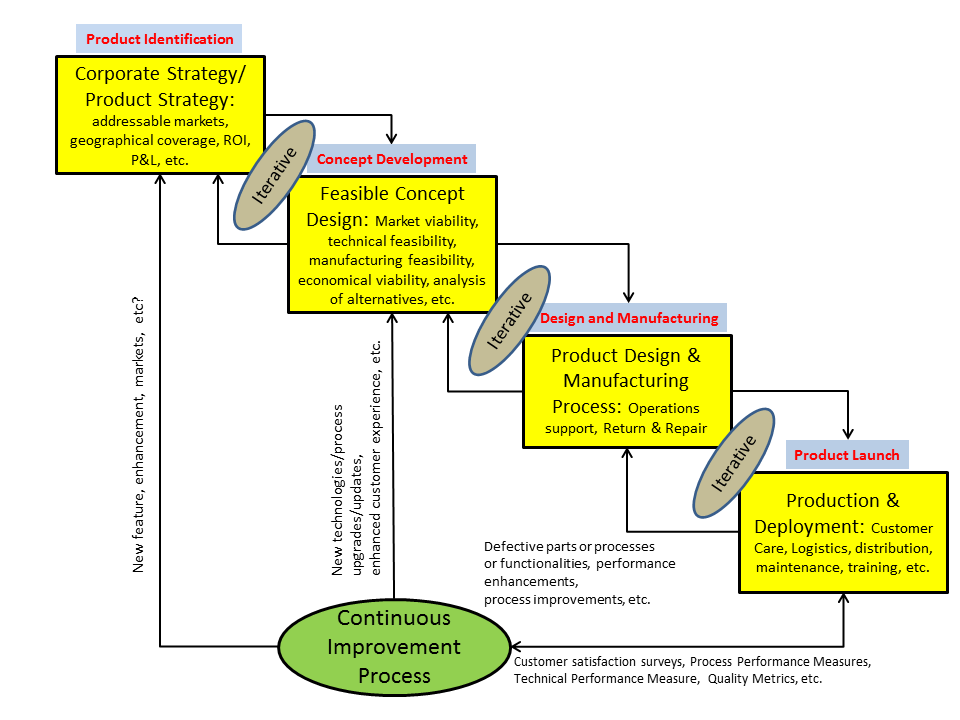
図1. 統合製品開発プロセス。(SEBoK Original)
Product Systems Engineering Background
<center>The "Product Systems Engineering" knowledge area is graciously sponsored by PPI.<center>
「Product Systems Engineering」の知識領域は PPI の厚意によりスポンサードされている。
この図は原典のページに掲載されています。権利の都合により本サイトでは省略しています。原典で見る
A system is by definition composed of elements that interact. The system itself is usually an element of a larger system, and each element can often also be viewed as a system on its own.
システム(system)とは、定義上、相互作用する要素から構成されるものである。システム自体は通常、より大きなシステムの一要素であり、各要素もまた、それ自体を一つのシステムとみなせることが多い。
A system element consists of one or more products. Products need to be produced or acquired. Some can be acquired or procured as-is, without need for fabrication or modification. Others need to be engineered, and in some cases, systems-engineered (Martin 1997). Basic product types are depicted in the figure below.
システム要素(system element)は、1つ以上の製品から構成される。製品は、生産するか取得する必要がある。製作や変更を必要とせず、そのまま取得・調達できるものもあれば、エンジニアリングが必要なもの、場合によってはシステムズエンジニアリングまで必要なものもある(Martin 1997)。基本的な製品のタイプを下図に示す。
Types of products are not limited to hardware or software. Many other types of products perform functions necessary to meet stakeholder needs. Some are only relevant to certain industries or domains, such as structures for civil engineering, or ships for shipping or the naval domain. Systems engineers must remember not to allocate the required behavior for a system to hardware and software elements alone.
製品のタイプはハードウェアやソフトウェアに限らない。ほかにも多くのタイプの製品が、ステークホルダーのニーズを満たすのに必要な機能を果たしている。土木工学における構造物や、海運・海軍ドメインにおける船舶のように、特定の業界やドメインにしか関係しないものもある。システムズエンジニアは、システムに要求される振る舞いをハードウェア要素とソフトウェア要素だけに割り当てないよう、心に留めておかなければならない。
While we may associate the idea of a product with concrete objects like computer chip, phones, aircraft, or even command, control and communications centers, an organization or a process can also be a product. Sometimes a product is not complex enough to justify performing Product SE, and only needs product design engineering. Enterprise SE and Service SE should determine whether a product needs Product SE.
製品という考えを、コンピュータチップ、電話、航空機、さらには指揮・統制・通信センターといった具体的な物と結びつけることもあるが、組織やプロセスも製品となり得る。製品によっては、製品 SE を実施するほどの複雑さがなく、製品設計エンジニアリングだけで済むこともある。エンタープライズ SE とサービス SE は、ある製品に製品 SE が必要かどうかを判断すべきである。
For any system being developed, the systems engineers must decide what are the right elements to be included. This is not self-evident, because basic product types are not necessarily mutually exclusive. For example, some would consider that facilities contain hardware and people. Others would consider facilities to be separate from hardware and people. Some would include material as part of hardware, while others would not. Creating a taxonomy of product types can help the systems engineer think clearly and thoroughly about what components to include.
開発するどのシステムについても、システムズエンジニアは、どのような要素を含めるのが適切かを決定しなければならない。これは自明ではない。基本的な製品のタイプは、必ずしも互いに排他的ではないからである。例えば、施設はハードウェアと人を含むと考える人もいれば、施設はハードウェアや人とは別物だと考える人もいる。材料をハードウェアの一部に含める人もいれば、含めない人もいる。製品タイプの分類体系を作ることは、どの構成要素を含めるべきかについて、システムズエンジニアが明確かつ徹底的に考える助けとなり得る。
When it develops and launches a new product, an enterprise must align that product with its business goals, internal capabilities, and competition. It must align the end product with the systems expected to realize and sustain it.
エンタープライズは、新しい製品を開発・発売する際、その製品を自社の事業目標、内部の能力、そして競争と整合させなければならない。また、最終製品を、それを実現し持続させることが期待されるシステムと整合させなければならない。
The new product concept must be based on analysis that, besides product potential, also explores the ability of the enterprise to exploit that potential, including factors like organizational culture, focus, goals, and processes. Present and future markets and technology must be analyzed. So must several dimensions of competition: competitors’ offerings and their plans, for entry into new markets and for product expansion including new functionality, features, or services. These, and the ability of the enterprise to react to them, must also be monitored for the enterprise to remain competitive in the long term.
新しい製品のコンセプトは、製品の潜在力だけでなく、その潜在力を活かすエンタープライズの能力をも探る分析に基づいていなければならない。これには、組織文化、焦点、目標、プロセスといった要素が含まれる。現在および将来の市場と技術を分析しなければならない。競争のいくつかの側面も同様に分析しなければならない。すなわち、競合他社の提供物と、新しい市場への参入や、新しい機能性・特徴・サービスを含む製品拡張に向けた競合他社の計画である。エンタープライズが長期的に競争力を維持するには、これらと、それらに対応するエンタープライズの能力も監視しなければならない。
Accelerating economic globalization since the 1970s has forced enterprises to respond to global needs, not just local or regional ones. Enterprises in the resulting hyper-competitive business environment must analyze their financial goals, their market positions, and the business segments in which they participate, in order to understand what products are required.
1970年代以降の経済のグローバル化の加速により、エンタープライズは、地域的・地方的なニーズだけでなく、グローバルなニーズにも対応せざるを得なくなった。その結果生じた超競争的なビジネス環境において、エンタープライズは、どのような製品が求められているかを理解するために、自社の財務目標、市場での位置付け、自社が参加している事業セグメントを分析しなければならない。
This is true for completely new products , product enhancements, penetration of new markets, and growth within existing markets.
このことは、まったく新しい製品、製品の改良、新しい市場への浸透、既存市場内での成長のいずれにも当てはまる。
Product development is the process of bringing a new product to market. Product SE (PSE) considers the complete product system–that is the product in the context of all its enabling elements. PSE takes a full life cycle perspective, “from cradle to grave” or “dust to dust.”
製品開発とは、新しい製品を市場に送り出すプロセスである。製品 SE(PSE)は、完全な製品システム、すなわち、そのすべての実現要素というコンテキストの中に置かれた製品を考える。PSE は、『ゆりかごから墓場まで(from cradle to grave)』あるいは『塵から塵へ(dust to dust)』という、ライフサイクル全体にわたる視点を取る。
Technology-based product development may be thought of as coming from two sources. One, where innovation enhances existing technology, is aimed at relatively short-term market windows. The other involves long-term research to identify the technology developments required to realize the concept. These may be technologies whose availability is not foreseen in the near future, meaning that substantial investment and long lead times may be required before the proof of concept, initial operational capabilities (IOCs) or prototyping stages are reached, let alone the commitment to realize the actual product offering. Some authors claim that the systems engineering process and the new product development (NPD) process for this second source are one and the same.
技術ベースの製品開発には、2つの源泉があると考えることができる。一つは、イノベーションによって既存の技術を強化するもので、比較的短期の市場機会を狙う。もう一つは、コンセプトの実現に必要な技術開発を特定するための長期的な研究を伴う。これらの技術は、近い将来に利用可能になるとは見込めないものであることがあり、その場合、実際の製品提供を実現するという確約はおろか、概念実証、初期運用能力(initial operational capabilities、IOCs)、プロトタイピングの段階に到達するまでにも、多額の投資と長いリードタイムが必要になることがある。この第2の源泉については、システムズエンジニアリングプロセスと新製品開発(new product development、NPD)プロセスは同一であると主張する著者もいる。
It is from the second source that strategic initiatives (long-term applied research) realize new products in areas like military aircraft or bioengineering. When research resolves fundamental questions on matters of science or national/regional interest technology, breakthroughs occur.
軍用航空機やバイオエンジニアリングといった領域で、戦略的イニシアチブ(長期的な応用研究)が新しい製品を実現するのは、この第2の源泉からである。研究が科学や国家/地域の関心事である技術に関する根本的な問いに決着をつけると、ブレークスルーが起こる。
This article concentrates on the first source of technology-based product development, that is, the one driven by ever-evolving market needs to enhance existing technology.
本記事では、技術ベースの製品開発の第1の源泉、すなわち、既存の技術の強化を求める絶えず進化する市場ニーズによって駆動されるものに焦点を当てる。
When existing or near-future technology innovations are exploited to generate new product ideas, product development may follow any one of following scenarios (Phillips 2001):
*Product development may use well-established technologies to help the enterprise improve the efficiency of current operations. *Product development may use well-established technologies to help the enterprise into new kinds of operations. *Product development may use leading edge technologies to improve the efficiency of current operations. *Product development may use leading edge technologies to help the enterprise into new kinds of operations.
The product itself may simply be a modification of an existing product or its presentation, it may possess new or different characteristics that offer additional benefits to the customer, and/or it may be entirely new and satisfy a newly-defined customer want or market niche (https://www.businessdictionary.com/definition/product-development.html).
Existing realization or sustainment systems may not be adequate to develop a given product. For example, it might be necessary to change development practices, use different testing methods or facilities, or upgrade manufacturing equipment and procedures. There might need to be improved customer support procedures and newly trained support personnel, upgraded maintenance facilities and tools, or modified spare parts delivery techniques.
既存の、あるいは近い将来の技術革新を活用して新しい製品のアイデアを生み出す場合、製品開発は次のいずれかのシナリオをたどることがある(Phillips 2001)。
製品自体は、単に既存の製品やその見せ方を変更したものであることもあれば、顧客に追加の便益をもたらす新しい特性や異なる特性を備えていることもあり、かつ/または、まったく新しく、新たに定義された顧客の欲求や市場のニッチを満たすものであることもある(https://www.businessdictionary.com/definition/product-development.html)。
既存の実現システムや持続システムは、所与の製品を開発するには適切でないことがある。例えば、開発の実践を変えたり、異なるテスト方法や施設を用いたり、製造設備と手順をアップグレードしたりする必要が生じることがある。改善された顧客サポート手順と新たに訓練されたサポート人員、アップグレードされた保守施設とツール、あるいは変更されたスペアパーツの配送技法が必要になることもある。
The product development process must be dynamic, adaptive, and competitive on cost, time-to-market, performance, and quality on a global scale. This is because in the global economy continuous technology innovation and constantly evolving markets and customer needs demand a rapid response.
製品開発プロセスは、グローバルな規模で、コスト、市場投入までの時間、性能、品質の面で、動的かつ適応的で、競争力のあるものでなければならない。グローバル経済においては、継続的な技術革新と、絶えず進化する市場と顧客のニーズが、迅速な対応を求めるからである。
Products themselves are often multidisciplinary in nature; product development must have close participation, not only from the different specialty engineering fields (mechanical, electrical, industrial, materials, and so on), but also from the finance field to analyze the total cost of development (including production), marketing and sales to understand market behavior and acceptance, manufacturers and distributors, and legal and public relations experts.
製品自体は、しばしば学際的な性質を持つ。製品開発には、さまざまな専門エンジニアリング分野(機械、電気、産業、材料など)だけでなく、(生産を含む)開発の総コストを分析する財務分野、市場の動きと受容を把握するマーケティングと販売、製造業者と流通業者、そして法務と広報の専門家も、密接に参加しなければならない。
All this has mandated enterprises to assess how they create their products and services. The result has been an effort to streamline the development process. One example of this is seen by the deployment of integrated product teams (IPTs) sometimes known as integrated product development teams (IPDTs).
こうしたことすべてにより、エンタープライズは、自社の製品とサービスをどのように生み出しているかを評価せざるを得なくなった。その結果として、開発プロセスを合理化する取り組みが行われてきた。その一例が統合製品チーム(integrated product teams、IPT)の配備であり、これは統合製品開発チーム(integrated product development teams、IPDT)と呼ばれることもある。
Product systems engineering strives for the efficient use of company resources in order to achieve business objectives and deliver a quality product. Product systems engineering activities range from concept to analysis to design and determine how conceptual and physical factors can be altered to manufacture the most cost-effective, environmentally friendly product that satisfies customer requirements. Engineering the product system requires an interdisciplinary approach that includes an analysis of the product and its related elements such as manufacturing, maintenance, support, logistics, phase-out, and disposal; these are all activities which belong to either the realization system or the sustainment system. The proper application of systems engineering and analysis ensures the timely and balanced use of human, financial, and technological assets, and technology investments to minimize problems, harmonize overall results, and maximize customer satisfaction and company profits.
Products are as diverse as the customers that acquire them and there are no universally accepted methods, processes, and technologies (MPTs) for end-to-end analysis of products and their supporting subsystems. Every product needs to adapt existing MPTs based on prior experiences and best practices, such as Toyota (Hitchens 2007), MITRE (Trudeau 2010), and NASA (NASA SELDP 2011). Product systems engineering helps develop the end-to-end analysis of products and sub-systems by performing the following tasks:
* determining the overall scope of needs for the product system; * defining product and system requirements; * considering all interactions between the different elements of the product system; * organizing and integrating engineering disciplines; and * establishing a disciplined approach that includes review, evaluation and feedback, and ensures orderly and efficient progress.
Constantly evolving needs and requirements, along with constant technology innovations, may render a committed product development obsolete even before deployment. This has led to debate among systems engineering professionals on the need for the systems engineering process to become more rapidly adaptable. Platform-based solutions to resolve some of these challenges (infrastructure as a service, platform as a service, and software as a service) are being studied and proposed (MITRE 2010; Boehm 2010).
製品システムズエンジニアリングは、事業目標を達成し、高品質な製品を提供するために、企業の資源を効率的に使用することを目指す。製品システムズエンジニアリングの活動は、コンセプトから分析、設計にまで及び、顧客要求事項を満たす、最もコスト効果が高く環境に優しい製品を製造するために、概念的要素と物理的要素をどのように変更できるかを決定する。製品システムをエンジニアリングするには、製品と、製造、保守、支援、ロジスティクス、段階的廃止、廃棄といった関連要素の分析を含む学際的なアプローチが必要である。これらはすべて、実現システムか持続システムのいずれかに属する活動である。システムズエンジニアリングと分析を適切に適用することで、人的・財務的・技術的な資産と技術投資を時宜を得てバランスよく使用することが確実になり、問題を最小化し、全体の結果を調和させ、顧客満足と企業の利益を最大化できる。
製品は、それを取得する顧客と同じくらい多様であり、製品とその支援サブシステムをエンドツーエンドで分析するための、普遍的に受け入れられた方法、プロセス、技術(methods, processes, and technologies、MPT)は存在しない。どの製品も、Toyota(Hitchens 2007)、MITRE(Trudeau 2010)、NASA(NASA SELDP 2011)などの先行経験やベストプラクティスに基づいて、既存の MPT を適応させる必要がある。製品システムズエンジニアリングは、次のタスクを実施することによって、製品とサブシステムのエンドツーエンドの分析を発展させる助けとなる。
絶えず進化するニーズと要求は、絶え間ない技術革新と相まって、確約された製品開発を配備前にすら時代遅れにしてしまうことがある。このため、システムズエンジニアリングの専門家の間では、システムズエンジニアリングプロセスをより迅速に適応できるものにする必要性について議論が起こっている。これらの課題の一部を解決するためのプラットフォームベースのソリューション(サービスとしてのインフラストラクチャ、サービスとしてのプラットフォーム、サービスとしてのソフトウェア)が研究・提案されている(MITRE 2010; Boehm 2010)。
The integrated product development process (IPDP) starts with understanding market needs and developing a strategy that creates products that satisfy or exceed customer expectations, respond to evolving customer demands, adapt to changing business environments, and incorporate systems thinking to generate novel ideas and co-create value with extensive stakeholders’ participation. IPDP is a continuously evolving process that strives to realize products whose cost, performance, features, and time-to-market help increase company profitability and market share. Magrab, et al. (2010) discussed the IPDP in terms of four different stages; Figure 1 provides a snapshot of an IPDP and the main tasks carried out at each stage.
統合製品開発プロセス(integrated product development process、IPDP)は、市場のニーズを理解し、戦略を策定することから始まる。その戦略とは、顧客の期待を満たすか上回る製品を生み出し、進化する顧客の要求に応え、変化するビジネス環境に適応し、システム思考を取り入れて斬新なアイデアを生み出し、広範なステークホルダーの参加を得て価値を共創する戦略である。IPDP は、コスト、性能、特徴、市場投入までの時間によって企業の収益性と市場シェアの向上に寄与する製品の実現を目指す、継続的に進化するプロセスである。Magrab, et al.(2010)は、IPDP を4つの段階に分けて論じている。図1に、IPDP の概要と、各段階で実施される主要なタスクを示す。
During the product identification stage, the enterprise aims to identify an enterprise-wide strategy that flows down to individual product strategies resulting in a good business investment for the company. During this stage addressable markets for the product are identified in addition to geographical coverage of the product. The developments through this stage result in demonstration of strong customer need, determination of potential markets and geographic scope, the fitness of enterprise core capabilities to the product strategy, business profitability (return on investment, profit & loss), etc.
製品の特定の段階では、エンタープライズは、個々の製品戦略へと展開され、会社にとって良い事業投資につながる全社戦略を特定することを目指す。この段階では、製品の地理的カバレッジに加えて、製品の対応可能な市場が特定される。この段階を通じた検討の結果として、強い顧客ニーズの実証、潜在的な市場と地理的範囲の決定、製品戦略に対するエンタープライズのコア能力の適合性、事業の収益性(投資収益率、損益)などが得られる。
During this stage an integrated product team (IPT) first develops the IPDP for the project, usually by tailoring a corporate IPDP standard. The IPT assesses required technology innovation, feasibility of existing technologies, estimated time and cost of technology development, and the risks associated with markets, finances and technologies risk, etc. This stage also takes into account inputs from the continuous improvement (CI) process to develop new features and enhancements in existing products to address new market needs or customer demands.
この段階では、統合製品チーム(IPT)がまず、通常は企業の IPDP 標準をテーラリングすることによって、プロジェクトの IPDP を策定する。IPT は、必要とされる技術革新、既存技術の実現可能性、技術開発の推定期間とコスト、市場・財務・技術に関連するリスクなどを評価する。この段階では、新しい市場のニーズや顧客の要求に対処するために、既存製品に新しい特徴や改良を開発するための継続的改善(continuous improvement、CI)プロセスからの入力も考慮に入れる。
The main goal of the Concept Development stage is to generate feasible concepts for the potential product and develop MPTs that will satisfy the product’s performance goals of economic viability and customer satisfaction. These concept designs must ensure that the company’s core competencies can satisfy the requirements to produce the products while taking into account the market viability, manufacturability, and technical feasibility through an extensive analysis of alternative process.
コンセプト開発の段階の主な目標は、潜在的な製品について実現可能なコンセプトを生み出し、経済的実現可能性と顧客満足という製品の性能目標を満たす MPT を策定することである。これらのコンセプト設計では、代替プロセスの広範な分析を通じて、市場の成立可能性、製造可能性、技術的実現可能性を考慮しながら、企業のコアコンピテンシーが製品を生産するための要求を満たせることを確実にしなければならない。
During this stage SE supports the IPT in identifying different operational scenarios and modes of operation, functional requirements of the products, technology and performance risks, and the main components of the products and required interfaces among them, etc. This stage involves a highly interactive and iterative exchange of concepts among several IPTs and, depending on complexity of the products, a Systems Engineering Integration Team may be required to ensure analysis of all the possible solutions. During this stage inputs from the CI process helps analyze new technologies/processes including upgrades to existing technologies and create products that result in enhanced customer experiences.
この段階では、SE は IPT を支援して、さまざまな運用シナリオと運用モード、製品の機能要求事項、技術リスクと性能リスク、製品の主要な構成要素とそれらの間に必要なインタフェースなどを特定する。この段階では、複数の IPT の間でコンセプトがきわめてインタラクティブかつ反復的にやり取りされ、製品の複雑さによっては、考え得るすべてのソリューションを確実に分析するために、システムズエンジニアリング統合チームが必要になることもある。この段階では、CI プロセスからの入力が、既存技術のアップグレードを含む新しい技術/プロセスの分析と、顧客体験を向上させる製品の創出に役立つ。
During the design and manufacturing stage the actual product is realized and manufactured. This stage starts with creating engineering drawings for the product, product configuration items specs, "design for X" (DFX), manufacturing design plans, production plans and schedules, test production run to ensure that the product meets customer requirements and quality criteria, and a plan for full production, logistics and distribution.
設計と製造の段階では、実際の製品が実現され、製造される。この段階は、製品のエンジニアリング図面、製品構成品目の仕様、『design for X』(DFX)、製造設計計画、生産計画とスケジュールを作成し、製品が顧客要求事項と品質基準を満たすことを確実にするための試験生産を行い、本格生産、ロジスティクス、流通の計画を作成することから始まる。
During this stage the product design & manufacturing engineering team works closely with operations managers to create MPTs to manage the technical effort for the product from an end-to-end perspective. Some of the SE activities during this stage include product integration, verification and validation plans; modeling, simulation, test & evaluation of the product system under critical scenarios; launch readiness plans including end-user test plans, operational readiness, etc. During this stage MPTs are developed and documented for proper handling of defective parts, processes, or functionalities. The CI process inputs include product and process performance enhancements and sustained life-cycle operations support.
この段階では、製品設計・製造エンジニアリングチームが運用マネージャーと密接に連携し、エンドツーエンドの視点から製品の技術的な取り組みを管理するための MPT を作る。この段階での SE の活動の一部には、製品の統合、検証と妥当性確認の計画、重要なシナリオの下での製品システムのモデリング、シミュレーション、テストと評価、最終利用者のテスト計画や運用準備を含む発売準備計画などがある。この段階では、欠陥のある部品、プロセス、機能性を適切に扱うための MPT も策定され、文書化される。CI プロセスの入力には、製品とプロセスの性能の改良と、ライフサイクルにわたる継続的な運用支援が含まれる。
During the product launch stage, the product is delivered to its potential markets. During production and deployment, MPTs are developed to ensure that the product meets its quality goals, satisfies customer requirements, and realizes the business plan goals. This requires provisions for customer care, logistics, maintenance, training etc., and a CI process to monitor product and product system technical performance and product quality. The CI process is realized through extensive data collection using customer satisfaction surveys and remotely or manually observing, recording, and analyzing process performance metrics, technical performance measure, quality metrics, etc.
製品の発売の段階では、製品が潜在的な市場へ提供される。生産と配備の間、製品が品質目標を満たし、顧客要求事項を満足させ、事業計画の目標を実現することを確実にするための MPT が策定される。そのためには、顧客ケア、ロジスティクス、保守、訓練などへの備えと、製品および製品システムの技術的性能と製品品質を監視する CI プロセスが必要である。CI プロセスは、顧客満足度調査の活用や、プロセス性能メトリクス、技術性能尺度、品質メトリクスなどの遠隔または手作業による観察・記録・分析といった、広範なデータ収集を通じて実現される。
図中の英語
As technological advancement accelerates, product life cycles become shorter, especially for high technology products. As a result, enterprises risk having outdated or obsolete products that have lost pace with markets trends, technology trends, or customer expectations.
技術の進歩が加速するにつれて、製品ライフサイクルは短くなっており、特にハイテク製品でその傾向が強い。その結果、エンタープライズは、市場の動向、技術の動向、顧客の期待に後れを取った、時代遅れの、あるいは陳腐化した製品を抱えるリスクを負っている。
Product systems engineering should bring awareness of technology changes and trends to the analysis of new product ideas or innovations. This affects the time and cost inputs into the technical feasibility analysis of the product. The result should include a road map of required technology developments, which is then used to create the overall road map for the new product offering.
製品システムズエンジニアリングは、新しい製品のアイデアやイノベーションの分析に、技術の変化と動向に対する認識を持ち込むべきである。これは、製品の技術的実現可能性の分析への時間とコストの入力に影響する。その結果には、必要な技術開発のロードマップが含まれるべきであり、このロードマップが次に、新しい製品の提供に向けた全体のロードマップの作成に使われる。
In these cases, new product ideas impose requirements on new technology developments.
このような場合には、新しい製品のアイデアが、新しい技術開発に対して要求を課す。
On the other hand, when technology developments or breakthroughs drive product innovation or the generation of new markets, the technology developments may also generate requirements on product features and functionalities. Factors which dictate decisions about introducing products include the technology readiness levels (TRL), the integration readiness levels (IRL), the manufacturing readiness levels (MRL), the system readiness levels (SRL), and the operational readiness of the enterprise to launch the product system. See the "Readiness Levels" section in the Product Systems Engineering Special Activities article.
一方、技術開発やブレークスルーが製品イノベーションや新しい市場の創出を駆動する場合には、技術開発が製品の特徴と機能性に対する要求を生み出すこともある。製品の導入に関する決定を左右する要素には、技術成熟度レベル(technology readiness levels、TRL)、統合成熟度レベル(integration readiness levels、IRL)、製造成熟度レベル(manufacturing readiness levels、MRL)、システム成熟度レベル(system readiness levels、SRL)、そして製品システムを発売するエンタープライズの業務遂行準備(operational readiness)が含まれる。『Product Systems Engineering Special Activities』の記事の『Readiness Levels』の節を参照されたい。
Understanding the entities (i.e., components or elements) that compose the product is not a trivial task for systems engineers. It is not unusual for a new product to require developments in several technologies, including new materials, electronic components, software, maintenance and repair procedures, processes, or organizational structures. All of these developments must be factored into the IPDP for the successful deployment and proper use of the product.
製品を構成するエンティティ(すなわち、構成要素や要素)を理解することは、システムズエンジニアにとって容易なタスクではない。新しい製品が、新しい材料、電子部品、ソフトウェア、保守・修理手順、プロセス、組織構造を含む、いくつかの技術における開発を必要とすることは珍しくない。製品の配備を成功させ、製品が適切に使用されるよう、これらの開発はすべて IPDP に織り込まれなければならない。
Figure 2. Basic Product Types that Constitute a Product System (Martin 1997). This material is reproduced with permission of John Wiley & Sons, Inc. All other rights are reserved by the copyright owner.
図2. 製品システムを構成する基本的な製品のタイプ(Martin 1997)。This material is reproduced with permission of John Wiley & Sons, Inc. All other rights are reserved by the copyright owner.
この図は原典のページに掲載されています。権利の都合により本サイトでは省略しています。原典で見る
Examples of each product type are shown below (Martin 1997).
各製品タイプの例を以下に示す(Martin 1997)。
表1. 製品のタイプ(Martin 1997)。This material is reproduced with permission of John Wiley & Sons, Inc.
| +Table 1. Product Types (Martin 1997). This material is reproduced with permission of John Wiley & Sons, Inc. |
| Type |
|---|
| Examples |
| Hardware |
| Computer processor unit, radar transmitter, satellite payload, telephone, diesel engine, data storage device, network router, airplane landing gear |
| Software |
| Computer operating system, firmware, satellite control algorithm, robot control code, telephone switching software, database application |
| Personnel |
| Astronaut, computer operator, clerk, business executive, Laika (the cosmonaut dog), bus driver, cashier, maintenance technician |
| Facilities |
| Space rocket launch pad, warehouse building, shipping docks, airport runway, railroad tracks, conference room, traffic tunnel, bridge, local area network cables |
| Data |
| Personnel records, satellite telemetry data, command and control instructions, customer satisfaction scores |
| Materials |
| Graphite composite, paper, gold, concrete, stone, fiberglass, radar absorption material, cladded metals, integrated circuit substrate, magnetic memory core |
| Media |
| Data storage media (tape, disc, memory card), signal transport media (twisted pair wire, fiber optic cable, RF spectrum), communications media (television, radio, magazines), social media (blogs, Twitter, Facebook) |
| Techniques |
| Soldering, trouble trick response process, change notice handling, telephone answering protocol, project scheduling, data sorting algorithm |
| タイプ | 例 |
|---|---|
| ハードウェア | コンピュータのプロセッサユニット、レーダー送信機、衛星ペイロード、電話、ディーゼルエンジン、データストレージデバイス、ネットワークルータ、航空機の着陸装置 |
| ソフトウェア | コンピュータのオペレーティングシステム、ファームウェア、衛星制御アルゴリズム、ロボット制御コード、電話交換ソフトウェア、データベースアプリケーション |
| 人員 | 宇宙飛行士、コンピュータオペレータ、事務員、経営幹部、ライカ(宇宙犬)、バスの運転手、レジ係、保守技術者 |
| 施設 | 宇宙ロケットの発射台、倉庫の建物、出荷ドック、空港の滑走路、鉄道の線路、会議室、交通トンネル、橋、ローカルエリアネットワークのケーブル |
| データ | 人員記録、衛星テレメトリデータ、指揮統制の指示、顧客満足度スコア |
| 材料 | グラファイト複合材料、紙、金、コンクリート、石、ガラス繊維、レーダー吸収材料、被覆金属、集積回路の基板、磁気メモリコア |
| メディア | データストレージメディア(テープ、ディスク、メモリカード)、信号伝送メディア(ツイストペア線、光ファイバケーブル、RF スペクトル)、コミュニケーションメディア(テレビ、ラジオ、雑誌)、ソーシャルメディア(ブログ、Twitter、Facebook) |
| 技法 | はんだ付け、トラブルチケット応答プロセス、変更通知の処理、電話応答プロトコル、プロジェクトのスケジューリング、データソートアルゴリズム |
Materials could be thought of as basic raw materials, like steel, or as complex materials, like cladded metals, graphite composites, or building aggregate material. Personnel are not normally thought of as a “product,” but that can change depending on the type of system in question. The National Aeronautics and Space Administration (NASA) space program “system” certainly produces astronauts. When personnel are considered product(s), it is not usually possible to simply find and hire personnel with the requisite knowledge, skills, and experience. These personnel “products” can often be developed using a product SE approach (Martin 1996). For example, you could specify requirements (i.e., required knowledge, skills, and experience) for each person that is part of the system. Interfaces can be specified for each person, and an assessment can be made as to the maturity of each person (i.e., each potential product). These are a few examples of how product SE can be applied to personnel products.
材料は、鋼のような基本的な原材料と考えることも、被覆金属、グラファイト複合材料、建築用骨材のような複雑な材料と考えることもできる。人員は通常『製品』とは考えられないが、それは当該システムのタイプによって変わり得る。National Aeronautics and Space Administration(NASA)の宇宙プログラムという『システム』は、確かに宇宙飛行士を生産している。人員を製品とみなす場合、必要な知識、スキル、経験を持つ人員を単に見つけて雇用することは、通常はできない。これらの人員『製品』は、しばしば製品 SE アプローチを使って開発できる(Martin 1996)。例えば、システムの一部である各人について、要求事項(すなわち、必要な知識、スキル、経験)を指定できる。各人についてインタフェースを指定でき、各人(すなわち、潜在的な製品のそれぞれ)の成熟度を評価することもできる。これらは、製品 SE を人員製品にどのように適用できるかを示すいくつかの例である。
In enterprise systems engineering, we may need education and training systems to make up a part of our personnel system in order to produce people with the right competencies and capabilities.
エンタープライズシステムズエンジニアリングでは、適切なコンピテンシーと能力を持つ人々を生み出すために、教育・訓練システムを人員システムの一部として組み込む必要が生じることがある。
Academy of Program/Project and Engineering Leadership (APPEL). 2009. ''NASA's Systems Engineering Competencies''. Washington, D.C., USA: US National Aeronautics and Space Association. Available at: https://www.nasa.gov/offices/oce/appel/pm-development/pm_se_competency_framework.html.
Academy of Program/Project and Engineering Leadership (APPEL). 2009. NASA's Systems Engineering Competencies. Washington, D.C., USA: US National Aeronautics and Space Association. Available at: https://www.nasa.gov/offices/oce/appel/pm-development/pm_se_competency_framework.html.
Blanchard, B.S., and W.J. Fabrycky. 2011. Systems Engineering and Analysis, 5th ed. Prentice Hall International Series in Industrial and Systems Engineering. Englewood Cliffs, NJ, USA: Prentice Hall.
Boehm, B. 2010. Systems 2020 Strategic Initiative. Hoboken, NJ, USA: Systems Engineering Research Center (SERC), SERC-2010-TR-009.
Grady, J. 2010. Systems Synthesis - Product and Process Design. Boca Raton, FL, USA: CRC Press.
INCOSE. 2012. Systems Engineering Handbook: A Guide for System Life Cycle Processes and Activities, version 3.2.2. San Diego, CA, USA: International Council on Systems Engineering (INCOSE), INCOSE-TP-2003-002-03.2.2.
Magrab, E., S. Gupta, P. McCluskey, and P. Sandborn. 2010. Integrated Product and Process Design and Development - The Product Realization Process. Boca Raton, FL, USA: CRC Press.
Martin, J.N. 1997. Systems Engineering Guidebook: A process for developing systems and products, 1st ed. Boca Raton, FL, USA: CRC Press.
MITRE. 2010. Platform as a Service: A 2010 Marketplace Analysis, Cloud Computing Series. Bedford, MA, USA: Systems Engineering at MITRE.
Morse, L., and D. Babcock. 2007. Managing Engineering and Technology, 4th ed. Upper Saddle River, NJ, USA: Prentice Hall.
Phillips, F. 2001. Market Oriented Technology Management: Innovating for Profit in Entrepreneurial Times. New York, NY, USA: Springer.
Trudeau, P.N. 2010. Designing and Enhancing a Systems Engineering Training and Development Program. Bedford, MA, USA: The MITRE Corporation.
Wasson, C.S. 2006. System Analysis, Design, and Development. New York, NY, USA: John Wiley & Sons.
Grady, J. 2010. Systems Synthesis - Product and Process Design. Boca Raton, FL, USA: CRC Press.
Magrab, E., S. Gupta, P. McCluskey, and P. Sandborn. 2010. Integrated Product and Process Design and Development - The Product Realization Process. Boca Raton, FL, USA: CRC Press.
Martin, J.N. 1997. Systems Engineering Guidebook: A process for developing systems and product, 1st ed. Boca Raton, FL, USA: CRC Press.
Academy of Program/Project and Engineering Leadership (APPEL). 2009. ''NASA's Systems Engineering Competencies''. Washington, D.C., USA: US National Aeronautics and Space Association. Available at: https://www.nasa.gov/offices/oce/appel/pm-development/pm_se_competency_framework.html.
Academy of Program/Project and Engineering Leadership (APPEL). 2009. NASA's Systems Engineering Competencies. Washington, D.C., USA: US National Aeronautics and Space Association. Available at: https://www.nasa.gov/offices/oce/appel/pm-development/pm_se_competency_framework.html.
Blanchard, B.S., and W.J. Fabrycky. 2011. Systems Engineering and Analysis, 5th ed. Prentice Hall International Series in Industrial and Systems Engineering. Englewood Cliffs, NJ, USA: Prentice Hall.
Boehm, B. 2010. Systems 2020 Strategic Initiative. Hoboken, NJ, USA: Systems Engineering Research Center (SERC), SERC-2010-TR-009.
INCOSE. 2012. Systems Engineering Handbook: A Guide for System Life Cycle Processes and Activities, version 3.2.2. San Diego, CA, USA: International Council on Systems Engineering (INCOSE), INCOSE-TP-2003-002-03.2.2.
MITRE. 2010. Platform as a Service: A 2010 Marketplace Analysis, Cloud Computing Series. Bedford, MA, USA: Systems Engineering at MITRE.
Morse, L., and D. Babcock. 2007. Managing Engineering and Technology, 4th ed. Upper Saddle River, NJ, USA: Prentice Hall.
Phillips, F. 2001. Market Oriented Technology Management: Innovating for Profit in Entrepreneurial Times. New York, NY, USA: Springer.
Trudeau, P.N. 2010. Designing and Enhancing a Systems Engineering Training and Development Program. Bedford, MA, USA: The MITRE Corporation.
Wasson, C.S. 2006. System Analysis, Design, and Development. New York, NY, USA: John Wiley & Sons.