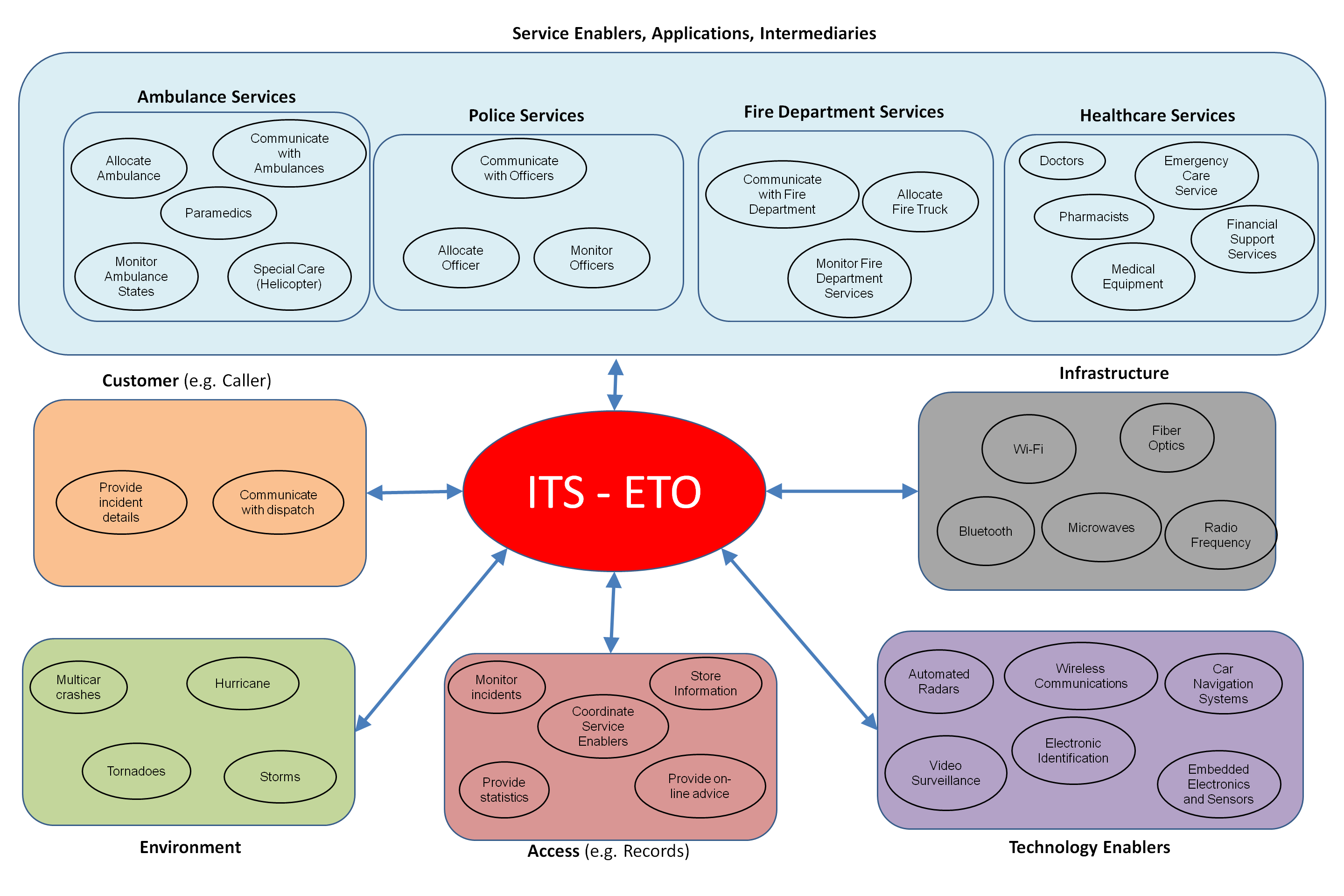
図1. サービスシステムコンテキスト図。(SEBoK Original)
Service Systems Background
Economies are pre-disposed to follow a developmental progression that moves them from heavy proportional reliance on agriculture and mining toward the development of manufacturing, and finally toward more service-based economic activity. As reported by the Organization for Economic Co-Operation and Development (OECD) in its “Science, Technology, and Industry (STI) Forum on The Service Economy":
経済には、農業や鉱業への依存度が高い段階から製造業の発展へ、そして最終的にはよりサービス(service)に基づく経済活動へと移行していく発展の道筋をたどる傾向がある。経済協力開発機構(Organization for Economic Co-Operation and Development, OECD)が「Science, Technology, and Industry(STI)Forum on The Service Economy」で報告しているとおり、
<blockquote>The reason that we see a services economy today, and gather to talk about it and recognize its importance is because technology has allowed service industries to gain the operational leverage that manufacturing achieved 100 years ago. In addition to banks, health systems, telephone and telecommunications networks, and distribution and retailing firms are further examples of sectors that have been able to benefit from economies of scale. As a result, we are now living in a world where global-scale service companies exist for the first time, whereas we have seen global manufacturing companies for 50 years or more. (OECD 2000, 8)</blockquote>
「今日サービス経済が存在し、我々がそれについて語り合い、その重要性を認識するために集うのは、製造業が100年前に達成した運用上のてこ作用を、技術によってサービス産業が得られるようになったからである。銀行、医療システム、電話・通信ネットワークのほか、流通・小売企業も、規模の経済の恩恵を受けることができた部門のさらなる例である。その結果、我々は今、グローバル規模のサービス企業が初めて存在する世界に生きている。一方、グローバルな製造企業については、我々は50年以上前から目にしてきた。」(OECD 2000, 8)
The typical industry example given of this progression toward services is the company International Business Machines (IBM). Even though IBM still produces hardware, they view their business as overwhelmingly service-oriented wherein hardware plays only an incidental role in their business solutions services; the fastest line of business growth within IBM has been the business-to-business (B2B) services: information technology (IT); for example, data centers and call centers; business process outsourcing/re-engineering; systems integration; and organizational change.
このようなサービスへの移行を示す典型的な産業例として挙げられるのが、International Business Machines(IBM)社である。IBM は現在もハードウェアを生産しているが、自社の事業(business)を圧倒的にサービス指向のものと捉えており、ハードウェアは同社のビジネスソリューションサービスにおいて付随的な役割しか果たしていない。IBM 社内で最も急速に成長してきた事業分野は企業間(business-to-business, B2B)サービスであり、具体的には、データセンター(data centers)やコールセンター(call centers)などの情報技術(information technology, IT)、ビジネスプロセスアウトソーシング(business process outsourcing)/リエンジニアリング、システム統合、組織変革である。
Business to government (B2G) is forecasted to have the fastest growth in the years to come (Spohrer 2011). For IBM, this trend started in 1989 with the launch of business recovery services; it accelerated with the acquisition of Price-Waterhouse Coopers Consultants in 2002 and culminated with the 2005 sale of the laptop (ThinkPad) manufacturing, their last major hardware operation.
企業対政府(business to government, B2G)は、今後数年で最も急速に成長すると予測されている(Spohrer 2011)。IBM の場合、この傾向は1989年のビジネスリカバリーサービスの開始に始まり、2002年の Price-Waterhouse Coopers Consultants 買収で加速し、2005年に同社最後の主要なハードウェア事業であったノートパソコン(ThinkPad)製造部門を売却したことで頂点に達した。
IBM exemplifies the services trend which has accelerated in the last 25-30 years and as of 2006, the services produced by private industry accounted for 67.8% of U.S. gross domestic product (GDP). The top sub-sectors included real estate, financial, healthcare, education, legal, banking, insurance, and investment. Production of goods accounted for 19.8% of GDP. The top product sub-sectors included manufacturing, construction, oil and gas, mining, and agriculture (Moran 2006).
IBM は、過去25-30年で加速してきたサービスへの移行傾向を体現している。2006年時点で、民間産業が生み出したサービスは米国の国内総生産(GDP)の67.8%を占めていた。上位のサブセクターには、不動産、金融、ヘルスケア、教育、法律、銀行、保険、投資が含まれていた。財の生産は GDP の19.8%を占めていた。上位の製品(product)サブセクターには、製造業、建設、石油・ガス、鉱業、農業が含まれていた(Moran 2006)。
Beginning in the mid-1990s, the concept of a product-service system (PSS) started to evolve. PSSs have been adopted by businesses interested in using the model to bring not only added value to their existing offerings, but capital-intensive, environmentally favorable products to market (Mont and Tukker 2006).
1990年代半ばから、製品サービスシステム(product-service system, PSS)の概念が発展し始めた。PSS は、既存の提供物に付加価値(value)をもたらすだけでなく、資本集約的で環境に好ましい製品を市場に投入するためにこのモデルを使うことに関心のある企業によって採用されてきた(Mont and Tukker 2006)。
There are some definitional issues in any discussion of PSS, including the fact that services can sometimes be considered as products, and services invariably need physical products to support their provisioning or delivery (2006). A PSS is comprised of tangibles and intangibles (activities) in combination to fulfill specific customer requirements, or ideally, to allow applications to be co-created flexibly by linking loosely coupled agents, typically over a network (Domingue et al. 2009). Research has shown that manufacturing firms are more amenable to producing "results" rather than solely products as specific artifacts and that end users are more amenable to consuming such results (Cook 2004; Wild et al. 2007).
PSS をめぐる議論には、定義上の問題がいくつかつきまとう。たとえば、サービスが製品とみなされる場合があることや、サービスの提供準備や実際の提供を支えるには必ず物理的な製品が必要であること(2006)などである。PSS は有形物と無形物(アクティビティ)の組み合わせで構成され、その目的は、顧客の具体的な要求事項(requirements)を満たすこと、あるいは理想的には、疎結合(loosely coupled)なエージェントを、典型的にはネットワーク(network)を介して結び付けることにより、アプリケーションを柔軟に(flexibly)共創できるようにすることにある(Domingue et al. 2009)。研究によれば、製造企業は、特定の人工物としての製品のみを生み出すよりも「結果」を生み出すことに、より前向きであり、エンドユーザー(users)もそうした結果を消費することに、より前向きである(Cook 2004; Wild et al. 2007)。
The popularity of wikis, blogs, and social networking tools is strong evidence that "Enterprise 2.0" is already well under way; Andrew McAfee describes Enterprise 2.0 as "the use of emergent social software platforms within companies, or between companies and their partners or customers" (McAfee 2009). However, the integrated access to people, media, services, and things, provided by the Future Internet, will enable new styles of societal and economic interactions at unprecedented scales, flexibility, and quality. These applications will exploit the wisdom of crowds and allow for mass collaboration and value co-creation.
ウィキ、ブログ、ソーシャルネットワーキングツールの普及は、「Enterprise 2.0」がすでに大きく進展していることを示す有力な証拠である。Andrew McAfee は Enterprise 2.0 を「企業内、あるいは企業とそのパートナーや顧客との間での、創発的なソーシャルソフトウェアプラットフォームの使用」と説明している(McAfee 2009)。しかし、フューチャーインターネットが提供する、人、メディア、サービス、モノへの統合的なアクセスは、かつてない規模、柔軟性、品質で、新しいスタイルの社会的・経済的相互作用を可能にする。これらのアプリケーションは、群衆の知恵を活用し、大規模な協働と価値共創を可能にする。
The future internet will provide location independent, interoperable, scalable, secure, and efficient access to a coordinated set of services (Tselentis et al. 2009), but such a broad vision demands a sound and well-defined approach for management and governance.
フューチャーインターネットは、調整されたサービスの集合に対する、場所に依存しない、相互運用可能な(interoperable)、拡張可能な(scalable)、安全で効率的なアクセスを提供する(Tselentis et al. 2009)。しかし、このように広範なビジョンには、マネジメントとガバナンス(governance)のための、健全で明確に定義されたアプローチが求められる。
Current application service providers like Amazon, Facebook, Twitter, eBay, and Google must mediate between the business challenges enabled by network and IT convergence and customers (enterprise or consumer) demanding new and more value-adding services enabled by social networks (TMFORUM 2008). The differences between IT and communications technologies are disappearing; internally-focused processes (back-stage processes) for operations optimization are now being strongly tied to the customer facing (front-stage) processes for value co-creation and delivery.
Amazon、Facebook、Twitter、eBay、Google といった現在のアプリケーションサービス提供者は、ネットワークと IT の融合によってもたらされた事業上の課題と、ソーシャルネットワークによって実現される、より付加価値の高い新たなサービスを求める顧客(エンタープライズ(enterprise)または消費者)との間を仲介しなければならない(TMFORUM 2008)。IT と通信技術の違いはなくなりつつある。運用最適化を目的とした内部志向のプロセス(processes)(バックステージのプロセス)は今や、価値の共創と提供を目的とした、顧客と接する(フロントステージの)プロセスと強く結び付けられている。
In this scenario, the enterprise’s internal organization and employees are embedded in the service value chain to benefit customers and stakeholders. In the service-dominant logic (S-DL) for marketing (Vargo and Lusch 2004), service is the application (through deeds, processes, and performances) of specialized operant resources (knowledge and skills) for the benefit of another entity or the entity itself. The emphasis is on the process of doing something for, and with, another entity in order to create value; a service system is thus a system of interacting and interdependent parts (people, technologies, and organizations) that is externally oriented to achieve and maintain a sustainable competitive advantage (IFM 2008; Maglio and Spohrer 2008).
このシナリオでは、エンタープライズの内部組織と従業員は、顧客とステークホルダー(stakeholders)に便益をもたらすべく、サービスバリューチェーン(service value chain)に組み込まれている。マーケティングにおけるサービスドミナントロジック(service-dominant logic, S-DL)(Vargo and Lusch 2004)では、サービスとは、別の実体、または資源を適用する実体自身の便益のために、専門化された働く資源(知識と技能)を(行為、プロセス、遂行を通じて)適用することである。重点が置かれるのは、価値を創造するために、別の実体のために、また別の実体とともに何かを行うプロセスである。したがってサービスシステムとは、相互作用し相互に依存する部分(人、技術、組織)からなるシステムであり、持続可能な競争優位を達成し維持するために外部へと向けられている(IFM 2008; Maglio and Spohrer 2008)。
The future internet is expected to be more agile, scalable, secure, and reliable, demanding rapidly emerging applications/services with different requirements and implications for the Future Internet design that pose a significant set of problems and challenges, in particular, “the fragmentation of knowledge and the isolation of the specialist as well as the need to find new approaches to problems created by earlier 'solution of problems,'” (Skyttner 2006). The service systems engineering discipline may inform the discussion and offer potential multidisciplinary environments and trans-disciplinary solutions.
フューチャーインターネットは、より俊敏で、拡張可能で、安全で信頼できるものになることが期待されており、フューチャーインターネットの設計に対して異なる要求と含意を持つ、急速に創発するアプリケーション/サービスを必要とする。これは、特に「知識の断片化と専門家の孤立、そして以前の『問題の解決』によって生み出された問題に対する新しいアプローチを見出す必要性」(Skyttner 2006)という、かなりの問題と課題の集合をもたらす。サービスシステムズエンジニアリングという学問分野は、この議論に情報を提供し、多分野が関わる環境(environments)や超学際的な解決策を提供し得る。
The internet has been successfully deployed for several decades due to its high flexibility in running over different kinds of physical media and in supporting different high-layer protocols and applications, including traditional file transfer, email, and client-server-based Web applications, among others.
インターネットが数十年にわたって成功裏に展開されてきたのは、さまざまな種類の物理メディア上で動作でき、従来型のファイル転送、電子メール、クライアントサーバ型の Web アプリケーションをはじめとするさまざまな上位層プロトコルやアプリケーションをサポートできるという高い柔軟性による。
Most people and enterprises are heavily dependent on service interactions, including entertainment, communications, retail, education, healthcare, etc., brought about by emerging services, such as video on demand, web conferencing, time-shift services, place-shift and device-shift services, enterprise applications (e.g., enterprise resource planning (ERP), customer relationship management (CRM), manufacturing resource management (MRM), software configuration management (SCM), etc.), software as a service (SaaS), platform as a service (PaaS), cloud services, peer-to-peer (P2P) services, etc. A common denominator in the set of services mentioned is that applications are offered as services by the interaction of service system entities and thus they are service based applications (SBA).
ほとんどの人とエンタープライズは、ビデオオンデマンド、ウェブ会議、タイムシフトサービス、プレイスシフトサービス、デバイスシフトサービス、エンタープライズアプリケーション(例えば企業資源計画(ERP)、顧客関係管理(CRM)、製造資源管理(MRM)、ソフトウェア構成管理(SCM)など)、サービスとしてのソフトウェア(SaaS)、サービスとしてのプラットフォーム(PaaS)、クラウドサービス、ピアツーピア(P2P)サービスなどの新興サービスがもたらした、娯楽、通信、小売、教育、ヘルスケアなどのサービス相互作用に大きく依存している。ここに挙げたサービスに共通するのは、アプリケーションがサービスシステム実体の相互作用によってサービスとして提供されており、したがってそれらがサービスに基づくアプリケーション(SBA)であるという点である。
Thus, “A service based application is obtained by composing various service system entities to satisfy the desired functionality” (Andrikopoulos et al. 2010). SBAs are heavily dependent on web services development, such as Web services 2.0 (WS). Software systems engineering (SwSE) plays a very important role in a business dependent on a service system. However, another important role is played by human interfaces, organizational development and technology development; for instance, governance (rules & regulations) and technology research and development are required for future services in healthcare services, intelligent transportation services, environmental services, energy services, etc. to address societal challenges of the 21st century (sustainability, energy, etc.) as presented by (Vest 2010) if we were to face those challenges as an ecosystem.
したがって、「サービスに基づくアプリケーションは、望ましい機能を満たすようにさまざまなサービスシステム実体を組み合わせることによって得られる」(Andrikopoulos et al. 2010)。SBA は、Web services 2.0(WS)などのウェブサービスの開発に大きく依存している。ソフトウェアシステムズエンジニアリング(SwSE)は、サービスシステムに依存する事業において非常に重要な役割を果たす。しかし、人的インタフェース、組織開発、技術開発もまた重要な役割を担っている。例えば、我々がそれらの課題にエコシステムとして向き合うのであれば、Vest(2010)が提示したように、21世紀の社会課題(持続可能性、エネルギーなど)に対処するために、ヘルスケアサービス、高度道路交通サービス、環境サービス、エネルギーサービスなどの将来のサービスには、ガバナンス(規則と規制)と技術の研究開発が必要である。
In an intelligent transport system-emergency transportation operation (ITS-ETO), the service goal is to provide safe evacuation, prompt medical care, and improved emergency management service. Typically, a traveler can request service through an emergency call or automated crash report feature, or a public safety officer on location can request service based on customer features and access rights.
高度道路交通システム緊急輸送運用(intelligent transport system-emergency transportation operation, ITS-ETO)において、サービスの目標は、安全な避難、迅速な医療ケア、改善された緊急マネジメントサービスを提供することである。典型的には、旅行者が緊急通報または自動衝突通報機能を通じてサービスを要請することができ、あるいは現場にいる公安官が顧客の特性とアクセス権に基づいてサービスを要請することができる。
The ITS-ETO service system utilizes advances in communication and information systems (technology and information enabler) to access essential, real-time data about conditions on routes throughout the affected area and coordinate operational and logistical strategies in cooperation within all service entities (organization processes). In a critical emergency situation, when patient conditions are continuously changing, ITS can help identify the appropriate response and get the correct equipment (infrastructure enabler), such as a helicopter and emergency personnel (people enabler), to and from the scene quickly and safely.
ITS-ETO サービスシステムは、通信・情報システムの進歩(技術と情報のイネーブラ)を活用して、影響を受けた地域全体の経路の状況に関する不可欠なリアルタイムデータにアクセスし、すべてのサービス実体が連携して運用・物流戦略を調整する(組織プロセス)。患者の容態が刻々と変化する危機的な緊急事態において、ITS は、適切な対応を特定し、ヘリコプターなどの適切な装備(インフラストラクチャのイネーブラ)と、緊急対応要員(人のイネーブラ)を、現場との間で迅速かつ安全に行き来させるのに役立つ。
Efficient and reliable voice, data, and video communications (application enabler) further provide agencies with the ability to share information related to the status of the emergency, the operational conditions of the transportation facilities, and the location of emergency response resources to help communicate and coordinate operations and resources in real time. Advances in logistical and decision-making tools can enable commanders and dispatchers to implement strategies as conditions change (decision making).
さらに、効率的で信頼できる音声、データ、ビデオ通信(アプリケーションのイネーブラ)によって、各機関は緊急事態の状況、交通施設の運用状況、緊急対応資源の位置に関する情報を共有できるようになり、運用と資源をリアルタイムで伝達・調整しやすくなる。物流と意思決定のツールの進歩は、指揮官と指令員が、状況が変化するにつれて戦略を実施することを可能にする(意思決定)。
It is also critical to receive information on the environmental conditions (storm, hazardous materials, multi-vehicle crashes, etc.) and/or road closures when coordinating evacuations. The availability of real-time data about transportation conditions, coupled with decision-making tools, enables more effective responses and coordination of resources during emergencies. ITS-ETO also enhances the ability of transportation agencies to coordinate responses with other stakeholders/entities.
避難を調整する際には、環境条件(嵐、有害物質、多重車両衝突など)および/または道路閉鎖に関する情報を入手することも重要である。交通状況に関するリアルタイムデータが利用できることは、意思決定ツールと組み合わさることで、緊急時のより効果的な対応と資源の調整を可能にする。ITS-ETO はまた、交通を所管する機関が他のステークホルダー/実体と対応を調整する能力を高める。
As a result, increased data accuracy, timeliness, and automation leads to better use of resources, and reuse of exchanges, resulting in time and cost savings. Enhanced response and management leads to greater situational awareness and more effective reactions with the ability to identify and utilize the appropriate equipment, resulting in a more efficient response at the right time (output) (US DOT 2011). Figure 1 below lists the possible stakeholders in a service system.
その結果、データの正確性、適時性、自動化が向上することで、資源がより有効に活用され、やり取りされた情報の再利用も進み、時間とコストの節約につながる。対応とマネジメントが強化されることで、状況認識が高まり、適切な装備を特定して活用する能力を伴ったより効果的な対処が可能になり、適切なタイミングで(成果)、より効率的な対応がもたらされる(US DOT 2011)。以下の図1に、サービスシステムにおいて想定されるステークホルダーを列挙する。
図中の英語
As seen in the above example, the service activities are knowledge-intensive; well-defined linkages (including access rights) and relationships among different entities give rise to the needed service systems interactions for the service system to be successful. As the world becomes more widely interconnected, and people become better educated, the services networks created by the interaction of the service systems will be accessible from anywhere, at any time, by anyone with the proper access rights.
上記の例からわかるように、サービスアクティビティは知識集約的である。異なる実体の間で明確に定義された結び付き(アクセス権を含む)と関係が、サービスシステムの成功に必要なサービスシステムの相互作用を生み出す。世界の相互接続がより広がり、人々の教育水準が高まるにつれて、サービスシステムの相互作用によって生み出されるサービスネットワークには、適切なアクセス権を持つ人なら誰でも、どこからでも、いつでもアクセスできるようになる。
Knowledge agents are then humans creating new linkages of information to create new knowledge which “can later be embedded in other people, technology, shared information, and organizations." Thus, people can be considered as individual service systems with “finite life cycles, identities (with associated histories and expectations), legal rights and authority to perform certain functions, perform multitasking as a way to increase individual productivity output in a finite time, and engage in division-of-labor with others to increase collective productive output in finite time” through service transactions enabled by their access rights (Spohrer and Kwan 2008).
知識エージェントとは、情報の新たな結び付きを生み出して新しい知識を創造する人間であり、その知識は「後に他の人、技術、共有情報、組織に組み込むことができる」。したがって人は、自らのアクセス権によって可能になるサービス取引を通じて、「有限のライフサイクル(life cycles)、アイデンティティ(関連する履歴と期待を伴う)、特定の機能を遂行する法的権利と権限を持ち、有限の時間における個人の生産性成果を高める方法としてマルチタスクを遂行し、有限の時間における集団的生産性成果を高めるために他者と分業に従事する」個別のサービスシステムとみなすことができる(Spohrer and Kwan 2008)。
Andrikopoulos, V., A. Bucchiarone, E. Di Nitto, R. Kazhamiakin, S. Lane, V. Mazza, and I. Richardson. 2010. "Chapter 8: Service Engineering," in Service Research Challenges and Solutions for the Future Internet S-Cube – Towards Engineering, Managing and Adapting Service-Based Systems, edited by M. Papazoglou, K. Pohl, M. Parkin, and A. Metzger. Berlin Heidelberg, Germany: Springer-Verlag. p. 271-337.
Cook, M. 2004. "Understanding The Potential Opportunities Provided by Service-Orientated Concepts to Improve Resource Productivity," in Design and Manufacture for Sustainable Development 2004, edited by T. Bhamra and B. Hon. Bury St. Edmonds, Suffolk, UK: Professional Engineering Publishing Limited. p. 123-134.
Domingue, J., D. Fensel, J. Davies, R. González-Cabero, and C. Pedrinaci. 2009. "The Service Web: a Web of Billions of Services," in Towards the Future Internet - A European Research Perspective, edited by G. Tselentis, J. Domingue, A. Galis, A. Gavras, D. Hausheer, S. Krco, V. Lotz, and T. Zehariadis. Amsterdam, The Netherlands: IOS Press.
IFM. 2008. Succeeding through Service Innovation: A service perspective for education, research, business and government. University of Cambridge Institute for Manufacturing (IfM) and International Business Machines Corporation (IBM) report. Cambridge Service Science, Management and Engineering Symposium, July 14-15, 2007, Cambridge, UK.
Maglio P., and J. Spohrer 2008. "Fundamentals of Service Science." Journal of the Academy of Marketing Science. 36 (1): 18-20. DOI: 10.1007/s11747-007-0058-9.
Maglio, P., Weske, M., Yang, J. and Fantinato, Marcelo. 2010. 8th International Conference on Service Oriented Computing (ICSOC 2010). Lecture Notes in Computer Science. Vol. 6470. Springer-Verlag, San Francisco, California. December 2010.
McAfee, A. 2009. ''Enterprise 2.0: New Collaborative Tools for Your Organization's Toughest Challenges''. Boston, MA, USA: Harvard Business School Press.
McAfee, A. 2009. Enterprise 2.0: New Collaborative Tools for Your Organization's Toughest Challenges. Boston, MA, USA: Harvard Business School Press.
Mont, O., and A. Tukker. 2006. "Product-Service Systems." Journal of Cleaner Production. 14 (17): 1451-1454.
Moran, M. 2006. Servicizing Solar Panels. Industry Course Report. Lund University International Master’s Programme in Environmental Studies and Sustainability Science Department (LUMES), Lund University, Sweden.
Moran, M. 2006. Servicizing Solar Panels. Industry Course Report. Lund University International Master's Programme in Environmental Studies and Sustainability Science Department (LUMES), Lund University, Sweden.
Organization for Economic Co-operation and Development (OECD). 2000. The Service Economy. Science Technology Industry (STI) Business and Industry Policy Forum Series. Paris, France: OECD. Available: https://www.oecd.org/dataoecd/10/33/2090561.pdf.
Skyttner, L. 2006. General Systems Theory: Perspectives, Problems, Practice, 2nd ed. Singapore: World Scientific Publishing Company.
Spohrer, J., and S.K. Kwan. 2009. "Service Science, Management, Engineering, and Design (SSMED): An Emerging Discipline - Outline & References." International Journal of Information Systems in the Service Sector. 1 (3): 1-31.
Spohrer, J.C. 2011. "Service Science: Progress & Directions." Presented at the International Joint Conference on Service Science, May 25-27, 2011, Taipei, Taiwan.
TM Forum. 2008. Service Delivery Framework (SDF) Overview, Release 2.0. Morristown, NJ: TeleManagement Forum. Technical Report 139.
Tselentis, G., J. Domingue, A. Galis, A. Gavras, D. Hausheer, S. Krco, V. Lotz, and T. Zahariadis (eds.). 2009. Towards the Future Internet - A European Research Perspective. Amsterdam, The Netherlands: IOS Press.
US DOT. 2011. "Emergency Transportation Operations." Research and Innovative Technology Administration. Accessed June 23, 2011. Last updated June 16, 2011. Available: https://www.its.dot.gov/eto/index.htm.
Vargo, S.L., and R.F. Lusch. 2004. "The Four Service Marketing Myths – Remnants of a Goods-Based Manufacturing Model." Journal of Service Research. 6 (4): 324-335.
Vest, C.M., 2013. "Educating Engineers for 2020 and Beyond" .The Bridge. Washington DC, National Academy of Engineering.
Wild, P.J., J. Jupp, W. Kerley, C. Eckert, and P.J. Clarkson. 2007. "Towards A Framework for Profiling of Products and Services." Presented at 5th International Conference on Manufacturing Research (ICMR), September 11-13, 2007, Leicester, UK.
IFM. 2008. Succeeding through Service Innovation: A service perspective for education, research, business and government. University of Cambridge Institute for Manufacturing (IfM) and International Business Machines Corporation (IBM) report. Cambridge Service Science, Management and Engineering Symposium, July 14-15, 2007, Cambridge, UK.
Organization for Economic Co-operation and Development (OECD). 2000. The Service Economy. Science Technology Industry (STI) Business and Industry Policy Forum Series. Paris, France: OECD. Available: https://www.oecd.org/dataoecd/10/33/2090561.pdf.
Vargo, S.L., and R.F. Lusch. 2004. "The Four Service Marketing Myths – Remnants of a Goods-Based Manufacturing Model." Journal of Service Research. 6 (4): 324-335.
Andrikopoulos, V., A. Bucchiarone, E. Di Nitto, R. Kazhamiakin, S. Lane, V. Mazza, and I. Richardson. 2010. "Chapter 8: Service Engineering," in Service Research Challenges and Solutions for the Future Internet S-Cube – Towards Engineering, Managing and Adapting Service-Based Systems, edited by M. Papazoglou, K. Pohl, M. Parkin, and A. Metzger. Berlin Heidelberg, Germany: Springer-Verlag. p. 271-337.
Cook, M. 2004. "Understanding The Potential Opportunities Provided by Service-Orientated Concepts to Improve Resource Productivity," in Design and Manufacture for Sustainable Development 2004, edited by T. Bhamra and B. Hon. Bury St. Edmonds, Suffolk, UK: Professional Engineering Publishing Limited. p. 123-134.
Domingue, J., D. Fensel, J. Davies, R. González-Cabero, and C. Pedrinaci. 2009. "The Service Web: a Web of Billions of Services," in Towards the Future Internet - A European Research Perspective, edited by G. Tselentis, J. Domingue, A. Galis, A. Gavras, D. Hausheer, S. Krco, V. Lotz, and T. Zehariadis. Amsterdam, The Netherlands: IOS Press.
Maglio P., and J. Spohrer 2008. "Fundamentals of Service Science." Journal of the Academy of Marketing Science. 36 (1): 18-20. DOI: 10.1007/s11747-007-0058-9.
McAfee, A. 2009. ''Enterprise 2.0: New Collaborative Tools for Your Organization's Toughest Challenges''. Boston, MA, USA: Harvard Business School Press.
McAfee, A. 2009. Enterprise 2.0: New Collaborative Tools for Your Organization's Toughest Challenges. Boston, MA, USA: Harvard Business School Press.
Mont, O., and A. Tukker. 2006. "Product-Service Systems." Journal of Cleaner Production. 14 (17): 1451-1454.
Moran, M. 2006. Servicizing Solar Panels. Industry Course Report. Lund University International Master’s Programme in Environmental Studies and Sustainability Science Department (LUMES), Lund University, Sweden.
Moran, M. 2006. Servicizing Solar Panels. Industry Course Report. Lund University International Master's Programme in Environmental Studies and Sustainability Science Department (LUMES), Lund University, Sweden.
Skyttner, L. 2006. General Systems Theory: Perspectives, Problems, Practice, 2nd ed. Singapore: World Scientific Publishing Company.
Spohrer, J., and S.K. Kwan. 2009. "Service Science, Management, Engineering, and Design (SSMED): An Emerging Discipline - Outline & References." International Journal of Information Systems in the Service Sector. 1 (3): 1-31.
Spohrer, J.C. 2011. "Service Science: Progress & Directions." Presented at the International Joint Conference on Service Science, May 25-27, 2011, Taipei, Taiwan.
TM Forum. 2008. Service Delivery Framework (SDF) Overview, Release 2.0. Morristown, NJ: TeleManagement Forum. Technical Report 139.
Tselentis, G., J. Domingue, A. Galis, A. Gavras, D. Hausheer, S. Krco, V. Lotz, and T. Zahariadis (eds.). 2009. Towards the Future Internet - A European Research Perspective. Amsterdam, The Netherlands: IOS Press.
US DOT. 2011. "Emergency Transportation Operations." Research and Innovative Technology Administration. Accessed June 23, 2011. Last updated June 16, 2011. Available: https://www.its.dot.gov/eto/index.htm.
Wild, P.J., J. Jupp, W. Kerley, C. Eckert, and P.J. Clarkson. 2007. "Towards A Framework for Profiling of Products and Services." Presented at 5th International Conference on Manufacturing Research (ICMR), September 11-13, 2007, Leicester, UK.