
図1:PM と SE の重なり(SEBoK Original)
Relationships between Systems Engineering and Project Management
This topic discusses the relationship between systems engineering (SE) and project management (PM). As with software engineering, there is a great deal of overlap. Depending on the environment and organization, the two disciplines can be disjoint, partially intersecting, or one can be seen as a subset of the other. While there is no standard relationship, the project manager and the systems engineer encompass the technical and managerial leadership of a project between them, which requires the enterprise of each project manager and system engineer to work out the particular details for their own context.
本トピックでは、システムズエンジニアリング(systems engineering、SE)とプロジェクトマネジメント(project management、PM)の関係を論じる。ソフトウェアエンジニアリングの場合と同様に、両者の重なりは非常に大きい。環境や組織によって、2つの分野は完全に分かれていることもあれば、部分的に重なり合うこともあり、一方が他方の部分集合と見なされることもある。標準的な関係は存在しないが、プロジェクトマネージャとシステムエンジニアは、両者の間でプロジェクトの技術的リーダーシップとマネジメント上のリーダーシップを担っており、そのため各プロジェクトマネージャとシステムエンジニアが、自らのコンテキストに合わせた具体的な詳細を主体的に詰める必要がある。
There is a great deal of significant overlap between the scope of systems engineering, as described here (in the SEBoK), CMMI (2011), and other resources and the scope of project management, as described in the PMBOK® Guide (PMI 2013), CMMI (2011), and other resources as illustrated in Figure 1.
ここ(SEBoK)、CMMI(2011)、その他の資料で述べられているシステムズエンジニアリングの範囲と、PMBOK® Guide(PMI 2013)、CMMI(2011)、その他の資料で述べられているプロジェクトマネジメントの範囲との間には、図1に示すように、大きく、かつ重要な重なりがある。
図中の英語
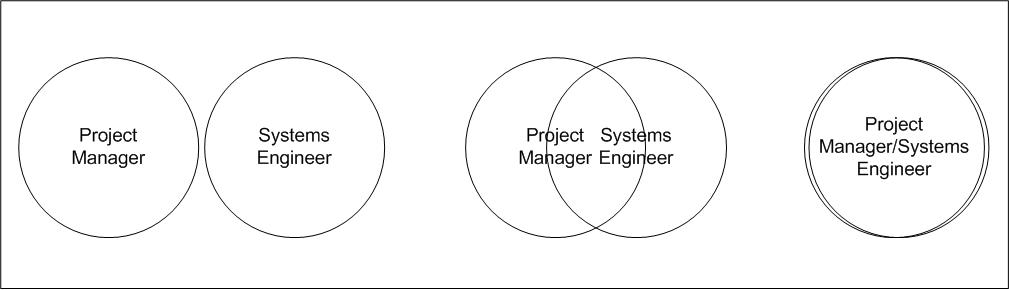
These sources describe the importance of understanding the scope of the work at hand, how to plan for critical activities, how to manage efforts while reducing risk, and how to successfully deliver value to a customer. The systems engineer working on a project will plan, monitor, confront risk, and deliver the technical aspects of the project, while the project manager is concerned with the same kinds of activities for the overall project. Because of these shared concerns, at times there may be confusion and tension between the roles of the project manager and the systems engineer on a given project. As shown in Figure 2, on some projects there is no overlap in responsibility. On other projects, there may be shared responsibilities for planning and managing activities. In some cases, particularly for smaller projects, the project manager may also be the lead technical member of the team performing both roles of project manager and systems engineer.
これらの資料は、目の前の作業の範囲を理解することの重要性、重要なアクティビティの計画の立て方、リスクを低減しながら取り組みをマネジメントする方法、そして顧客に価値を首尾よく提供する方法を述べている。プロジェクトに従事するシステムエンジニアは、プロジェクトの技術的側面を計画し、監視し、リスクに対処し、提供する。一方、プロジェクトマネージャは、プロジェクト全体について同種のアクティビティを担う。こうした関心が共有されているため、所与のプロジェクトにおいて、プロジェクトマネージャとシステムエンジニアの役割の間に混乱や緊張が生じることがある。図2に示すように、責任の重なりがないプロジェクトもある。別のプロジェクトでは、アクティビティの計画とマネジメントについて責任を共有することがある。場合によっては、特に小規模なプロジェクトでは、プロジェクトマネージャがチームの技術リードを兼ね、プロジェクトマネージャとシステムエンジニアの両方の役割を果たすこともある。
図中の英語
Regardless of how the roles are divided up on a given project, the best way to reduce confusion is to explicitly describe the roles and responsibilities of the project manager and the systems engineer, as well as other key team members. The Project Management Plan (PMP) and the Systems Engineering Management Plan (SEMP) are key documents used to define the processes and methodologies the project will employ to build and deliver a product or service.
所与のプロジェクトで役割がどのように分担されるかにかかわらず、混乱を減らす最善の方法は、プロジェクトマネージャ、システムエンジニア、その他の主要なチームメンバーの役割と責任を明示的に記述することである。プロジェクトマネジメント計画(PMP)とシステムズエンジニアリングマネジメントプラン(SEMP)は、製品やサービスを構築し提供するためにプロジェクトが用いるプロセスと方法論を定義する主要な文書である。
The PMP is the master planning document for the project. It describes all activities, including technical activities, to be integrated and controlled during the life of the program. The SEMP is the master planning document for the systems engineering technical elements. It defines SE processes and methodologies used on the project and the relationship of SE activities to other project activities. The SEMP must be consistent with and evolve in concert with the PMP. In addition, some customers have technical management plans and expectations that the project’s SEMP integrate with customer plans and activities. In the U.S. Department of Defense, most government project teams have a systems engineering plan (SEP) with an expectation that the contractor’s SEMP will integrate and remain consistent with customer technical activities. In cases where the project is developing a component of a larger system, the component project’s SEMP will need to integrate with the overall project’s SEMP.
PMP は、プロジェクトのマスター計画文書である。PMP には、技術的アクティビティを含め、プログラムの全期間にわたって統合・管理されるすべてのアクティビティが記述される。SEMP は、システムズエンジニアリングの技術要素に関するマスター計画文書である。SEMP では、プロジェクトで用いる SE プロセスと方法論、および SE アクティビティと他のプロジェクトアクティビティとの関係を定義する。SEMP は PMP と整合していなければならず、PMP と歩調を合わせて進化しなければならない。加えて、技術マネジメント計画を持ち、プロジェクトの SEMP が顧客の計画とアクティビティに統合されることを期待する顧客もいる。米国国防総省では、ほとんどの政府プロジェクトチームがシステムズエンジニアリング計画(systems engineering plan、SEP)を持っており、請負業者の SEMP が顧客の技術的アクティビティに統合され、整合した状態を保つことが期待されている。プロジェクトがより大きなシステムの構成要素を開発している場合、その構成要素プロジェクトの SEMP は、プロジェクト全体の SEMP に統合される必要がある。
Given the importance of planning and managing the technical aspects of the project, an effective systems engineer will need to have a strong foundation in management skills and prior experience, as well as possess strong technical depth. From developing and defending basis of estimates, planning and monitoring technical activities, identifying and mitigating technical risk, and identifying and including relevant stakeholders during the life of the project, the systems engineer becomes a key member of the project’s management and leadership team. Additional information on Technical Management Processes and Stakeholder Needs Definition can be found in Part 3: Systems Engineering and Management.
プロジェクトの技術的側面を計画しマネジメントすることは重要であるため、効果的なシステムエンジニアには、強い技術的深さに加えて、マネジメントスキルと過去の経験という強固な基盤が必要となる。見積り根拠の策定と擁護、技術的アクティビティの計画と監視、技術的リスクの特定と軽減、プロジェクトの期間を通じて関連するステークホルダーを特定し含めることによって、システムエンジニアはプロジェクトのマネジメントとリーダーシップを担うチームの主要メンバーとなる。Technical Management Processes と Stakeholder Needs Definition に関する追加情報は、Part 3: Systems Engineering and Management に記載されている。
Effective communication between the project manager and the system engineer is essential for mission accomplishment. This communication needs to be established early and occur frequently.
プロジェクトマネージャとシステムエンジニアの間の効果的なコミュニケーションは、ミッションの達成に不可欠である。このコミュニケーションは、早い段階で確立し、頻繁に行う必要がある。
Resource reallocation, schedule changes, product/system changes and impacts, risk changes: all these and more need to be quickly and clearly discussed between the PM and SE.
資源の再配分、スケジュールの変更、製品/システムの変更とその影響、リスクの変化:これらすべてとそれ以上のことが、PM と SE の間で迅速かつ明確に議論される必要がある。
CMMI. CMMI for Development: Guidelines for Process Integration and Product Improvement. Old Tappan, NJ: Pearson Education. 2011.
CMMI. CMMI for Development: Guidelines for Process Integration and Product Improvement. Old Tappan, NJ: Pearson Education. 2011.
Project Management Institute (PMI). A Guide to the Project Management Body of Knowledge (PMBOK® Guide), 5th ed. Newtown Square, PA, USA: Project Management Institute. 2013.
Chrissis, M. B., M. Konrad, and S. Shrum. CMMI for Development: Guidelines for Process Integration and Product Improvement, 3rd ed. Boston, MA: Addison-Wesley Professional. 2011.
Chrissis, M. B., M. Konrad, and S. Shrum. CMMI for Development: Guidelines for Process Integration and Product Improvement, 3rd ed. Boston, MA: Addison-Wesley Professional. 2011.
PMI. A Guide to the Project Management Body of Knowledge (PMBOK® Guide), 5th ed. Newtown Square, PA: Project Management Institute. 2013.
NASA. Systems Engineering Handbook, Revision 1. Washington, DC, USA: National Aeronautics and Space Administration. NASA/SP-2007-6105. 2007.