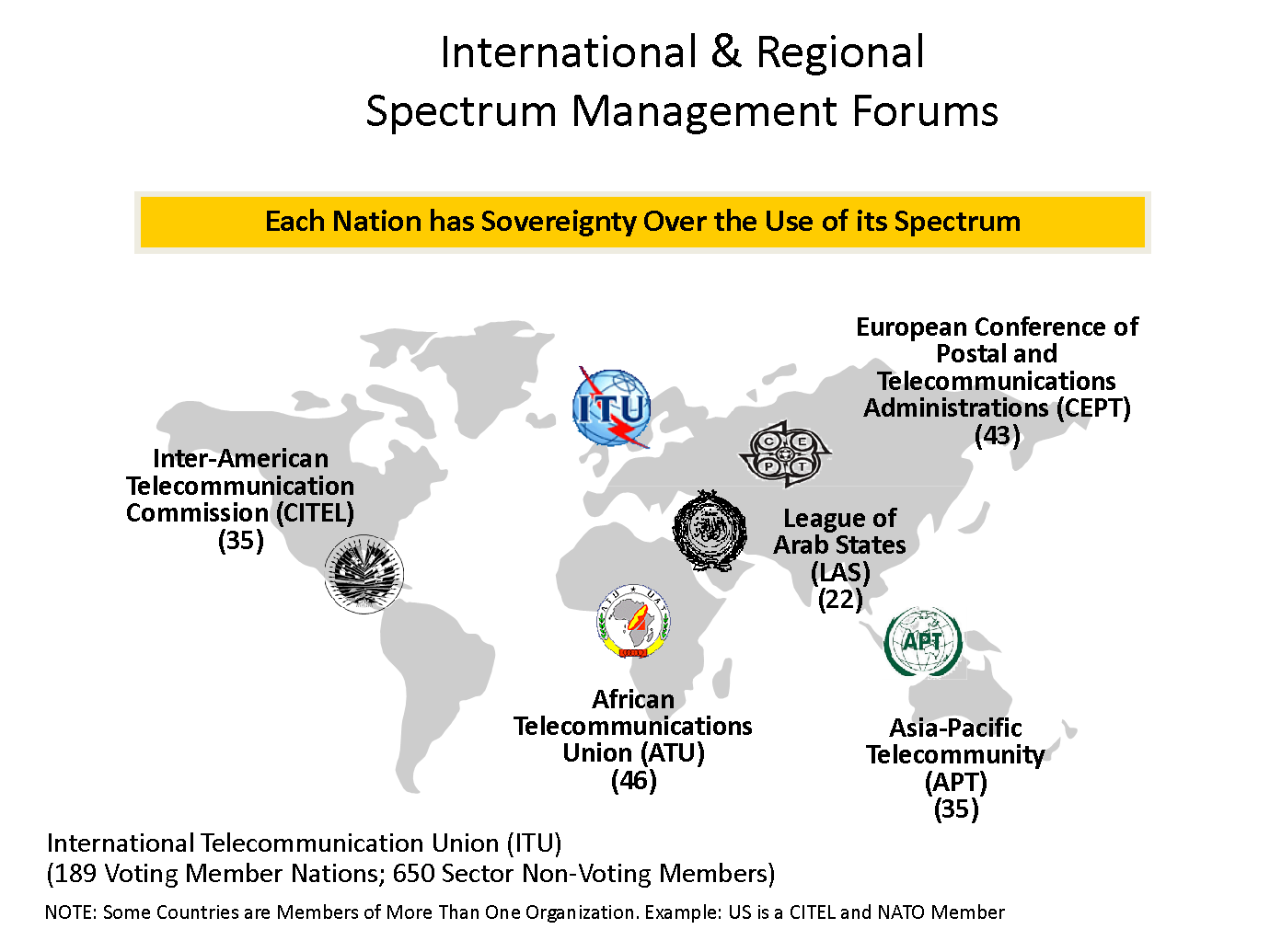
図1. 国際・地域のスペクトル管理フォーラム。(SEBoK Original)
System Resistance to Electromagnetic Interference
Electromagnetic Interference (EMI) is the disruption of operation of an electronic device when it is in the vicinity of an electromagnetic field in the radio frequency (RF) spectrum. Many electronic devices fail to work properly in the presence of strong RF fields. The disturbance may interrupt, obstruct, or otherwise degrade or limit the effective performance of the circuit. The source may be any object, artificial or natural, that carries rapidly changing electrical currents.
電磁干渉(Electromagnetic Interference、EMI)は、電子デバイスが無線周波数(radio frequency、RF)スペクトルの電磁界の近傍にあるときに生じる、そのデバイスの動作に生じる機能中断である。多くの電子デバイスは、強い RF 界の中では正常に動作しない。この擾乱は、回路の実効的な性能を中断、妨害し、あるいはその他の形で低下させたり制限したりする場合がある。発生源は、急激に変化する電流が流れる物体であれば、人工物か自然物かを問わず何でもあり得る。
Electromagnetic Compatibility (EMC) is the ability of systems, equipment, and devices that utilize the electromagnetic spectrum to operate in their intended operational environments without suffering unacceptable degradation or causing unintentional degradation because of electromagnetic radiation or response. It involves the application of sound electromagnetic spectrum management; system, equipment, and device design configuration that ensures interference-free operation; and clear concepts and doctrines that maximize operational effectiveness (DAU 2010, Chapter 7).
電磁両立性(Electromagnetic Compatibility、EMC)は、電磁スペクトルを利用するシステム、機器、デバイスが、電磁放射または電磁応答によって許容できない劣化を被ることも、意図しない劣化を引き起こすこともなく、意図された運用環境で動作する能力である。これには、健全な電磁スペクトル管理の適用、干渉のない運用を確保するシステム・機器・デバイスの設計構成、および運用の有効性を最大化する明確な概念とドクトリンが含まれる(DAU 2010, Chapter 7)。
Each nation has the right of sovereignty over the use of its spectrum and must recognize that other nations reserve the same right. It is essential that regional and global forums exist for the discussion and resolution of spectrum development and infringement issues between bordering and proximal countries that might otherwise be difficult to resolve.
各国は自国のスペクトルの使用について主権を有しており、他国も同じ権利を留保していることを認めなければならない。国境を接する国や近隣の国の間で生じ、そうでなければ解決が困難であり得るスペクトルの開発や侵害をめぐる問題を議論し解決するために、地域的および世界的なフォーラムが存在することが不可欠である。
The oldest, largest, and unquestionably the most important such forum, with 193 member countries, is the International Telecommunications Union (ITU) agency of the United Nations, which manages spectrum at a global level. As stated in Chapter 3 of the NTIA Manual, “The International Telecommunication Union (ITU)...is responsible for international frequency allocations, worldwide telecommunications standards and telecommunication development activities” (NTIA 2011, 3-2). The broad functions of the ITU are the regulation, coordination and development of international telecommunications.
そうしたフォーラムのなかで最も古く、最も大きく、そして疑いなく最も重要なのが、193の加盟国を擁し、世界レベルでスペクトルを管理する国連の機関、国際電気通信連合(International Telecommunications Union、ITU)である。NTIA マニュアルの Chapter 3 に述べられているとおり、「国際電気通信連合(ITU)は…国際的な周波数割当、世界的な電気通信規格、および電気通信の開発アクティビティに責任を負う」(NTIA 2011, 3-2)。ITU の幅広い機能は、国際電気通信の規制、調整、開発である。
The spectrum allocation process is conducted by many different international telecommunication geographical committees. Figure 1 shows the various international forums represented worldwide.
スペクトル割当のプロセスは、地域ごとに置かれた数多くのさまざまな国際電気通信委員会によって実施される。図1は、世界各地のさまざまな国際フォーラムを示す。
図中の英語
Assigning frequencies is very complicated, as shown in the radio spectrum allocation chart in Figure 2. Sometimes, commercial entities try to use frequencies that are actually assigned to US government agencies, such as the Department of Defense (DoD). One such incident occurred when an automatic garage door vendor installed doors on homes situated near a government installation. Random opening and closing of the doors created a problem for the vendor that could have been avoided.
Four ITU organizations affect spectrum management (Stine and Portigal 2004): #World Radio-communication Conference (WRC) #Radio Regulations Board (RRB) #Radio-communications Bureau (RB) #Radio-communication Study Groups (RSG)
The WRC meets every four years to review and modify current frequency allocations. The RB registers frequency assignments and maintains the master international register. The RRB approves the Rules of Procedures used by the BR to register frequency assignments and adjudicates interference conflicts among member nations. The SG analyzes spectrum usage in terrestrial and space applications and makes allocation recommendations to the WRC. Most member nations generally develop national frequency allocation polices that are consistent with the Radio Regulations (RR). These regulations have treaty status.
図2の無線スペクトル割当チャートが示すように、周波数の割当は非常に複雑である。商業事業者が、国防総省(Department of Defense、DoD)などの米国政府機関に実際には割り当てられている周波数を使おうとすることがある。そのような事例の一つは、自動ガレージドアの販売業者が、政府施設の近くにある住宅にドアを設置した際に起きた。ドアが不規則に開閉し、販売業者にとって避けられたはずの問題が生じた。
スペクトル管理に影響を及ぼす ITU の組織は4つある(Stine and Portigal 2004):
WRC は、現在の周波数割当をレビューし変更するために4年ごとに開催される。RB は周波数の割当を登録し、国際登録原簿(master international register)を維持する。RRB は、BR が周波数の割当の登録に用いる手続き規則(Rules of Procedures)を承認するとともに、加盟国間の干渉に関する紛争を裁定する。SG は、地上および宇宙のアプリケーションにおけるスペクトルの使用を解析し、WRC に対して割当に関する勧告を行う。ほとんどの加盟国は一般に、無線通信規則(Radio Regulations、RR)と整合する国内の周波数割当方針を策定する。これらの規則は条約としての地位を持つ。
Whereas most countries have a single government agency to perform the spectrum management function, the US has a dual management scheme intended to insure that *decisions concerning commercial interests are made only after considering their impact on government systems; and *government usage supports commercial interests.
The details of this scheme, established by the Communications Act of 1934, are as follows: *the Federal Communications Commission (FCC) is responsible for all non-government usage *the FCC is directly responsible to Congress; *the president is responsible for federal government usage, and by executive order, delegates the federal government spectrum management to the National *Telecommunications and Information Administration (NTIA); and *the NTIA is under the authority of the Secretary of Commerce.
The FCC regulates all non-federal government telecommunications under Title 47 of the Code of Federal Regulations. For example, see FCC (2009, 11299-11318). The FCC is directed by five Commissioners appointed by the president and confirmed by the Senate for five-year terms. The Commission staff is organized by function. The responsibilities of the six operating Bureaus include processing applications for licenses, analyzing complaints, conducting investigations, implementing regulatory programs, and conducting hearings (https://www.fcc.gov).
The NTIA performs spectrum management function through the Office of Spectrum Management (OSM), governed by the Manual of Regulations and Procedures for Federal Radio Frequency Management. The IRAC develops and executes policies, procedures, and technical criteria pertinent to the allocation, management, and usage of spectrum. The Spectrum Planning and Policy Advisory Committee (SPAC) reviews the reviews IRAC plans, balancing considerations of manufacturing, commerce, research, and academic interests.
Within the DoD, spectrum planning and routine operation activities are cooperatively managed. Spectrum certification is a mandated process designed to ensure that #frequency band usage and type of service in a given band are in conformance with the appropriate national and international tables of frequency allocations; #equipment conforms to all applicable standards, specifications, and regulations; and #approval is provided for expenditures to develop equipment dependent upon wireless communications.
ほとんどの国ではスペクトル管理の機能を単一の政府機関が担っているのに対し、米国には、次の事項の確保を目的とした二重管理の仕組みがある。
1934年の通信法(Communications Act)によって確立されたこの仕組みの詳細は、次のとおりである。
FCC は、連邦規則集(Code of Federal Regulations)の Title 47 に基づき、連邦政府以外のすべての電気通信を規制する。例として FCC (2009, 11299-11318) を参照。FCC を率いるのは、大統領が任命し上院が承認する、任期5年の5人の委員(Commissioner)である。委員会のスタッフは機能別に組織されている。6つの運営局(Bureau)の責務には、免許申請の処理、苦情の分析、調査の実施、規制プログラムの実施、聴聞の実施が含まれる(https://www.fcc.gov)。
NTIA は、連邦無線周波数管理のための規則・手続きマニュアル(Manual of Regulations and Procedures for Federal Radio Frequency Management)に準拠して運営されるスペクトル管理局(Office of Spectrum Management、OSM)を通じて、スペクトル管理の機能を果たす。IRAC は、スペクトルの割当、管理、使用に関する方針、手続き、技術基準を策定し、実行する。スペクトル計画・方針諮問委員会(Spectrum Planning and Policy Advisory Committee、SPAC)は、IRAC の計画をレビューし、製造、商業、研究、学術の各利益への配慮のバランスを取る。
DoD の内部では、スペクトル計画と日常的な運用アクティビティが協調して管理されている。スペクトル認証(spectrum certification)は、次の事項を確保するために設けられた、義務付けられたプロセスである。
In peacetime, international spectrum governance requires military forces to obtain host nation permission — Host Nation Coordination (HNC)/Host Nation Approval (HNA) — to operate spectrum-dependent systems and equipment within a sovereign nation. For example, international governance is honored and enforced within the United States by the US departments of State, Defense, and the user service.
平時において、国際的なスペクトルガバナンスは、軍隊が主権国家の内部でスペクトルに依存するシステムや機器を運用するために、受入国の許可 — 受入国調整(Host Nation Coordination、HNC)/受入国承認(Host Nation Approval、HNA)— を得ることを要求する。例えば米国内では、国際ガバナンスは米国の国務省、国防総省、および使用する軍種によって尊重され、執行されている。
In wartime, international spectrum governance is not honored between warring countries; however, the sovereign spectrum rights of bordering countries must be respected by military forces executing their assigned missions. For example, HNA is solicited by US naval forces to use spectrum-dependent systems and equipment in bordering countries’ airspace and/or on bordering countries’ soil. HNA must be obtained before the operation of spectrum-dependent systems and equipment within a sovereign nation. The combatant commander is responsible for coordinating requests with sovereign nations within his or her area of responsibility. Because the combatant commander has no authority over a sovereign nation, the HNC/HNA process can be lengthy and needs to be started early in the development of a system. Figure 2 illustrates a spectrum example.
戦時において、国際的なスペクトルガバナンスは交戦国の間では尊重されない。しかし、割り当てられたミッションを遂行する軍隊は、国境を接する国の主権的なスペクトルの権利を尊重しなければならない。例えば、米国海軍の部隊は、国境を接する国の空域および/または国土でスペクトルに依存するシステムや機器を使用するために、HNA を求める。HNA は、主権国家の内部でスペクトルに依存するシステムや機器を運用する前に取得しなければならない。戦闘軍の司令官(combatant commander)は、自らの責任領域内にある主権国家との間で要求を調整する責任を負う。戦闘軍の司令官は主権国家に対する権限を持たないため、HNC/HNA プロセスは長期化する場合があり、システム開発の早い段階で開始する必要がある。図2は、スペクトルの例を示す。
図中の英語
EMI/EMC is difficult to achieve for systems that operate world-wide because of the different frequencies in which products are designed to operate in each of the telecommunication areas. Billions of US dollars have been spent in retrofitting US DoD equipment to operate successfully in other countries.
世界中で運用されるシステムでは、電磁干渉(EMI)への対策と電磁両立性(EMC)の確保は難しい。製品が、電気通信の地域ごとに異なる周波数で動作するように設計されているためである。米国 DoD の機器を他国で正常に運用できるよう改修するために、数十億米ドルが費やされてきた。
It is important to note that the nuclear radiation environment is drastically more stressing than, and very different from, the space radiation environment.
核放射線環境は、宇宙放射線環境と比べて格段に過酷であり、性質も大きく異なる点に留意することが重要である。
To help in analyzing conducted and radiated interference effects, EMI is categorized into two types—narrowband and broadband—which are defined as follows: *Narrowband Emissions <blockquote>A narrowband signal occupies a very small portion of the radio spectrum… Such signals are usually continuous sine waves (CW) and may be continuous or intermittent in occurrence… Spurious emissions, such as harmonic outputs of narrowband communication transmitters, power-line hum, local oscillators, signal generators, test equipment, and many other man made sources are narrowband emitters. (Bagad 2009, G-1)</blockquote> *Broadband Emissions <blockquote>A broadband signal may spread its energy across hundreds of megahertz or more… This type of signal is composed of narrow pulses having relatively short rise and fall times. Broadband signals are further divided into random and impulse sources. These may be transient, continuous or intermittent in occurrence. Examples include unintentional emissions from communication and radar transmitters, electric switch contacts, computers, thermostats, ignition systems, voltage regulators, pulse generators, and intermittent ground connections. (Bagad 2009, G-1)</blockquote>
伝導性および放射性の干渉の影響の解析に役立てるため、EMI は狭帯域(narrowband)と広帯域(broadband)の2つの種類に分類され、それぞれ次のように定義される。
TEMPEST is a codename used to refer to the field of emission security. The National Security Agency (NSA) investigations conducted to study compromising emission (CE) were codenamed TEMPEST. National Security Telecommunications Information Systems Security Issuance (NSTISSI)-7000 states: <blockquote>Electronic and electromechanical information-processing equipment can produce unintentional intelligence-bearing emanations, commonly known as TEMPEST. If intercepted and analyzed, these emanations may disclose information transmitted, received, handled, or otherwise processed by the equipment. (NSTISS 1993, 3)</blockquote>
These compromising emanations consist of electrical, mechanical, or acoustical energy intentionally or unintentionally emitted by sources within equipment or systems which process national security information. Electronic communications equipment needs to be secured from potential eavesdroppers while allowing security agencies to intercept and interpret similar signals from other sources. The ranges at which these signals can be intercepted depends upon the functional design of the information processing equipment, its installation, and prevailing environmental conditions.
Electronic devices and systems can be designed, by means of Radiation Hardening techniques, to resist damage or malfunction caused by ionizing and other forms of radiation (Van Lint and Holmes Siedle 2000). Electronics in systems can be exposed to ionizing radiation in the Van Allen radiation belts around the Earth’s atmosphere, cosmic radiation in outer space, gamma or neutron radiation near nuclear reactors, and electromagnetic pulses (EMP) during nuclear events.
A single charged particle can affect thousands of electrons, causing electronic noise that subsequently produces inaccurate signals. These errors could affect safe and effective operation of satellites, spacecraft, and nuclear devices. Lattice displacement is permanent damage to the arrangement of atoms in element crystals within electronic devices. Lattice displacement is caused by neutrons, protons, alpha particles, and heavy ions. Ionization effects are temporary damages that create latch-up glitches in high power transistors and soft errors like bit flips in digital devices. Ionization effects are caused by charged particles.
Most radiation-hardened components are based on the functionality of their commercial equivalents. Design features and manufacturing variations are incorporated to reduce the components’ susceptibility to interference from radiation. Physical design techniques include insulating substrates, package shielding, chip shielding with depleted boron, and magneto-resistive RAM. Logical design techniques include error-correcting memory, error detection in processing paths, and redundant elements at both circuit and subsystem levels (Dawes 1991). Nuclear hardness is expressed as susceptibility or vulnerability for given environmental conditions. These environmental conditions include peak radiation levels, overpressure, dose rates, and total dosage.
TEMPEST は、放射セキュリティ(emission security)の分野を指すのに用いられるコードネームである。漏洩放射(compromising emission、CE)を研究するために国家安全保障局(National Security Agency、NSA)が実施した調査には、TEMPEST というコードネームが付けられた。National Security Telecommunications Information Systems Security Issuance (NSTISSI)-7000 には、次のように記されている。
「電子的および電気機械的な情報処理機器は、一般に TEMPEST として知られる、情報を含む意図しない漏洩(emanation)を生じ得る。これらの漏洩は、傍受され解析されると、その機器によって送信、受信、取り扱い、またはその他の方法で処理された情報を開示する場合がある」(NSTISS 1993, 3)
これらの漏洩放射は、国家安全保障情報を処理する機器やシステムの内部の発生源から、意図的または意図せずに放出される電気的、機械的、または音響的なエネルギーからなる。電子通信機器は、セキュリティ機関が他の発生源からの同様の信号を傍受し解釈することを可能にしつつ、潜在的な盗聴者からは保護される必要がある。これらの信号が傍受され得る距離は、情報処理機器の機能設計、その設置状況、およびその時点の環境条件に依存する。
電子デバイスやシステムは、放射線耐性を高める技法(Radiation Hardening)を用いることで、電離放射線やその他の形態の放射線によって生じる損傷や誤動作に耐えるよう設計できる(Van Lint and Holmes Siedle 2000)。システム内の電子機器は、地球の大気を取り巻くバンアレン放射線帯の電離放射線、宇宙空間の宇宙放射線、原子炉付近のガンマ線や中性子線、核事象の際の電磁パルス(electromagnetic pulses、EMP)に曝される場合がある。
単一の荷電粒子が数千個の電子に影響を及ぼして電子ノイズを引き起こし、その結果として不正確な信号を生じさせることがある。こうしたエラーは、衛星、宇宙機、核デバイスの安全かつ効果的な運用に影響を及ぼす可能性がある。格子変位(lattice displacement)とは、電子デバイス内の元素結晶における原子配列の恒久的な損傷である。格子変位は、中性子、陽子、アルファ粒子、重イオンによって引き起こされる。電離効果は一時的な損傷であり、高出力トランジスタにおけるラッチアップのグリッチや、デジタルデバイスにおけるビット反転などのソフトエラーを生じさせる。電離効果は、荷電粒子によって引き起こされる。
ほとんどの放射線硬化コンポーネントは、対応する商用品の機能を基にしている。放射線による干渉に対するコンポーネントの感受性を低減するため、設計上の特徴と製造上のバリエーションが組み込まれる。物理的な設計技法には、絶縁基板、パッケージの遮蔽、劣化ホウ素(depleted boron)によるチップの遮蔽、磁気抵抗 RAM(magneto-resistive RAM)がある。論理的な設計技法には、エラー訂正メモリ、処理経路におけるエラー検出、回路レベルとサブシステムレベルの両方における冗長要素がある(Dawes 1991)。核硬度(nuclear hardness)は、所与の環境条件に対する感受性または脆弱性として表される。これらの環境条件には、ピーク放射線レベル、過圧、線量率、総線量が含まれる。
Bagad, V.S. 2009. Electronic Product Design, 4th ed. Pune, India: Technical Publications Pune.
DAU. 2010. Defense Acquisition Guidebook (DAG). Ft. Belvoir, VA, USA: Defense Acquisition University (DAU)/U.S. Department of Defense (DoD). February 19, 2010.
NSTISS. 1993. Tempest Countermeasures for Facilities. Ft. Meade, MD, USA: National Security Telecommunications and Information Systems Security (NSTISSI). 29 November, 1993. NSTISSI No. 7000.
NTIA. 2011. Manual of Regulations and Procedures for Federal Radio Frequency Management, May 2011 Revision of the 2008 Edition. Washington, DC, USA: National Telecommunications and Information Administration, U.S. Department of Commerce.
Stine, J. and D. Portigal. 2004. An Introduction to Spectrum Management. Bedford, MA, USA: MITRE Technical Report Spectrum. March 2004.
Van Lint, V.A.J. and A.G. Holmes Siedle. 2000. Radiation Effects in Electronics: Encyclopedia of Physical Science and Technology. New York, NY, USA: Academic Press.
DAU. 2010. Defense Acquisition Guidebook (DAG). Ft. Belvoir, VA, USA: Defense Acquisition University (DAU)/U.S. Department of Defense (DoD). February 19, 2010.
None.