
図1:ISO/IEC/IEEE 15288 の技術プロセスにマッピングされた SEBoK 知識領域の技術トピック。(SEBoK 2022)
Systems Engineering and Industrial Engineering
Systems Engineering (SE) overlaps with many fields, such as Industrial Engineering (IE), Engineering Management, Operations Research, Project Management, and Design Engineering. In fact, the main Industrial Engineering body of knowledge, called the Industrial and Systems Engineering Body of Knowledge (ISEBoK) (IISE 2021), includes the word "systems" in its title and includes a section on systems design and engineering, which references the SEBoK. This article describes the similarities and differences between SE and IE based upon their respective standards, handbooks, and bodies of knowledge. Based on this assessment, this article describes potential roles that systems engineers and industrial engineers perform during a system’s life cycle.
システムズエンジニアリング(SE)は、産業工学(IE)、エンジニアリングマネジメント、オペレーションズリサーチ、プロジェクトマネジメント、設計工学など、多くの分野と重なり合っている。実際、産業工学の主要な知識体系は Industrial and Systems Engineering Body of Knowledge (ISEBoK)(IISE 2021)と呼ばれ、その名称に「systems」という語を含むうえ、SEBoK を参照するシステム設計とエンジニアリングのセクションも設けている。この記事では、SE と IE それぞれの標準、ハンドブック、知識体系に基づいて、両者の類似点と相違点を述べる。そしてこの評価に基づき、システムのライフサイクルにおいてシステムエンジニアと産業エンジニアが担いうる役割を述べる。
When systems engineers and industrial engineers are in the same organization, they have different roles and responsibilities. While job titles vary by organization, many organizations have individuals that perform both SE and IE activities. This article tries to help systems engineers and industrial engineers better understand the different perspectives of the fields and the knowledge needed to meet the needs of their organizations and customers. The article compares the use of international standards and the contents of the bodies of knowledge for SE and IE.
システムエンジニアと産業エンジニアが同じ組織に属する場合、両者の役割と責任は異なる。職名は組織によってさまざまだが、SE と IE の両方のアクティビティを行う人員を抱える組織は多い。この記事は、システムエンジニアと産業エンジニアが、各分野の異なる観点と、自らの組織および顧客のニーズを満たすために必要な知識とを、よりよく理解する助けとなることを目指す。この記事では、SE と IE について、国際標準の使用状況と知識体系の内容を比較する。
The International Council on Systems Engineering (INCOSE) is a “not-for-profit membership organization founded to develop and disseminate the interdisciplinary principles and practices that enable the realization of successful systems.” INCOSE defines systems engineering as<blockquote>a transdisciplinary and integrative approach to enable the successful realization, use, and retirement of engineered systems, using systems principles and concepts, and scientific, technological, and management methods. (INCOSE 2021)</blockquote>Here, the terms “engineering” and “engineered” are used in their widest sense: “the action of working artfully to bring something about.” “Engineered systems” may be composed of any or all of people, products, services, information, processes, and natural elements.
INCOSE aligns its SE Handbook with ISO/IEC/IEEE 15288, System Life Cycle Processes, which focuses on processes. SEBoK Part 3 Systems Engineering and Management, which addresses the major SE technical and management processes, is also organized around 15288 process areas. In this view, SE is process oriented. Each edition of the SE Handbook aligns to an ISO/IEC/IEEE 15288 edition. Figure 1 shows the 15288 processes and how they align with the SE Handbook and SEBoK topic areas. Later in this article, these SEBoK topics and knowledge areas are compared with the knowledge areas of IE. The knowledge areas in Figure 1 align with the system life cycle if started at the top of the first column and traversed to the bottom, continued at the bottom of the second column and traversed to the top, and then continued at the bottom of the third column and traversed to the top.
国際システムズエンジニアリング協議会(International Council on Systems Engineering、INCOSE)は、「成功するシステムの実現を可能にする学際的な原則と実践を開発し普及させるために設立された非営利の会員制組織」である。INCOSE はシステムズエンジニアリングを次のように定義している。
システムズエンジニアリングとは、システムの原則と概念、および科学的・技術的・マネジメント的な方法を用いて、エンジニアード・システムの成功裏の実現、使用、廃止を可能にする、超学際的かつ統合的なアプローチである。(INCOSE 2021)
ここで「engineering(工学)」と「engineered(工学的に作られた)」という用語は、最も広い意味、すなわち「何かを実現するために巧みに働きかける行為」という意味で用いられている。「エンジニアード・システム」は、人、製品、サービス、情報、プロセス、自然要素のいずれか、またはすべてで構成されうる。
INCOSE は、自らの SE ハンドブックを、プロセスに焦点を当てた ISO/IEC/IEEE 15288, System Life Cycle Processes に整合させている。SE の主要な技術プロセスとマネジメントプロセスを扱う SEBoK Part 3 Systems Engineering and Management も、15288 のプロセス領域を軸に構成されている。この見方に立てば、SE はプロセス志向である。SE ハンドブックの各版は、ISO/IEC/IEEE 15288 の版に整合する。図1は、15288 のプロセスと、それらが SE ハンドブックおよび SEBoK のトピック領域とどのように整合するかを示している。この記事の後半では、これらの SEBoK のトピックと知識領域を IE の知識領域と比較する。図1の知識領域は、第1列を上端から下端へたどり、続いて第2列を下端から上端へ、さらに第3列を下端から上端へとたどると、システムライフサイクルと整合する。
図中の英語
The Institute of Industrial and Systems Engineers (IISE) states that it is “the only international, non-profit, professional society dedicated to advancing the technical and managerial excellence of industrial engineers.” (IISE 2021). IISE started in 1948 as the American Institute of Industrial Engineers. In 1981, the organization was renamed the Institute of Industrial Engineers to reflect its growing international membership. In 2016, the membership voted to change the name to the Institute of Industrial and Systems Engineers. This addition reflects a vote by its membership and aligns with the “changing scope of the profession that, while keeping its industrial base, has seen more industrial and systems engineers working with large scale integrated systems in a variety of sectors”.
Institute of Industrial and Systems Engineers (IISE) は、自らを「産業エンジニアの技術面およびマネジメント面の卓越性の向上に専心する、唯一の国際的な非営利専門家団体」であると述べている(IISE 2021)。IISE は1948年に American Institute of Industrial Engineers として発足した。1981年には、国際的な会員の増加を反映して Institute of Industrial Engineers へ改称された。2016年には、会員の投票により、名称を Institute of Industrial and Systems Engineers へ変更することが決まった。この名称への追加は、会員による投票を反映したものであり、「産業的な基盤を保ちつつも、さまざまなセクターで大規模な統合システムに携わる産業・システムエンジニアが増えてきた、この職業の範囲の変化」に沿うものである。
At the turn of this century, industrial engineering was well reflected in two prominent publications: Handbook of Industrial Engineering (Salvendy 2001) and the fifth edition of ''Maynard's Industrial Engineering Handbook'' (Zandin 2001). Salvendy (2001) stated that industrial engineers are trained to design and analyze the components of which man-machine systems are composed. They bring together individual elements that are designed via other engineering disciplines and properly synergize these subsystems together with the people components for a completely integrated man-machine system. Industrial engineers are focused on the improvement of any system that is being designed or evaluated. They make individual human tasks more productive and efficient by optimizing flow, eliminating unnecessary motions, utilizing alternate materials to improve manufacturing, improving the flow of product through processes, and optimizing the configuration of workspaces. Fundamentally, the industrial engineer is charged with reducing costs and increasing profitability through ensuring the efficient use of human, material, physical, and/or financial resources.
今世紀の変わり目には、産業工学は2つの著名な出版物によく反映されていた。『Handbook of Industrial Engineering』(Salvendy 2001)と『Maynard's Industrial Engineering Handbook』第5版(Zandin 2001)である。Salvendy (2001) は、産業エンジニアは人間-機械システムを構成するコンポーネントを設計・分析するよう訓練されていると述べた。産業エンジニアは、他の工学分野で設計された個々の要素を結集し、これらのサブシステムを人というコンポーネントと適切に相乗させて、完全に統合された人間-機械システムを実現する。産業エンジニアは、設計中または評価中のあらゆるシステムの改善に焦点を当てる。彼らは、フローの最適化、不要な動作の排除、製造を改善するための代替材料の活用、プロセスを通じた製品フローの改善、ワークスペース構成の最適化によって、個々の人間の作業をより生産的かつ効率的にする。根本的には、産業エンジニアは、人的、資材、物理的、および/または財務的なリソースの効率的な使用を確保することで、コストを削減し収益性を高める役割を課されている。
The view of IE has evolved over the last two decades. IISE developed the IISE Body of Knowledge in 2021 (IISE 2021). The sixth edition of ''Maynard's Industrial Engineering Handbook'' (Zandin 2022) is expected to be published in 2022. The IISEBoK has 14 knowledge areas, as shown in Figure 2. The first 13 knowledge areas identify the Industrial Engineering knowledge. The fourteenth is Systems Design and Engineering, which references the SEBoK. The IISEBoK provides a short description of each knowledge area, a detailed outline of knowledge area topics, and a list of references. The IISEBoK does not use standards as its foundation. In fact, the Standard Practice for Systems Safety (MIL-STD-0-882D) is the only standard cited in the reference section. IISE does not currently have a handbook developed by or for the Institute, although Zandin (2022) is expected to align with the IISEBoK.
IE の見方はこの20年間で進化してきた。IISE は2021年に IISE Body of Knowledge を策定した(IISE 2021)。『Maynard's Industrial Engineering Handbook』第6版(Zandin 2022)は2022年に刊行される見込みである。IISEBoK には、図2に示すとおり14の知識領域がある。最初の13の知識領域は産業工学の知識を特定するものである。第14は Systems Design and Engineering であり、SEBoK を参照している。IISEBoK は、各知識領域の簡潔な説明、知識領域のトピックの詳細な概要、参考文献のリストを提供している。IISEBoK は標準を基盤としていない。実際、参考文献セクションで引用されている標準は Standard Practice for Systems Safety (MIL-STD-0-882D) のみである。IISE には現在、協会が、あるいは協会のために作成したハンドブックはないが、Zandin (2022) は IISEBoK に整合する見込みである。
Figure 2. Industrial and Systems Engineering Knowledge Areas (IISE 2022, Used with Permission) [https://www.iise.org/BodyofKnowledge
図2:産業・システム工学の知識領域(IISE 2022, Used with Permission)
この図は原典のページに掲載されています。権利の都合により本サイトでは省略しています。原典で見る
]
The 14 topic areas included in the IISEBoK could be tied to many international standards even though the IISEBoK does not use standards as its foundation or provide references to standards in most of its topic areas.
IISEBoK は標準を基盤とせず、ほとんどのトピック領域で標準への参照も示していないが、IISEBoK に含まれる14のトピック領域は多くの国際標準と結び付けることができるだろう。
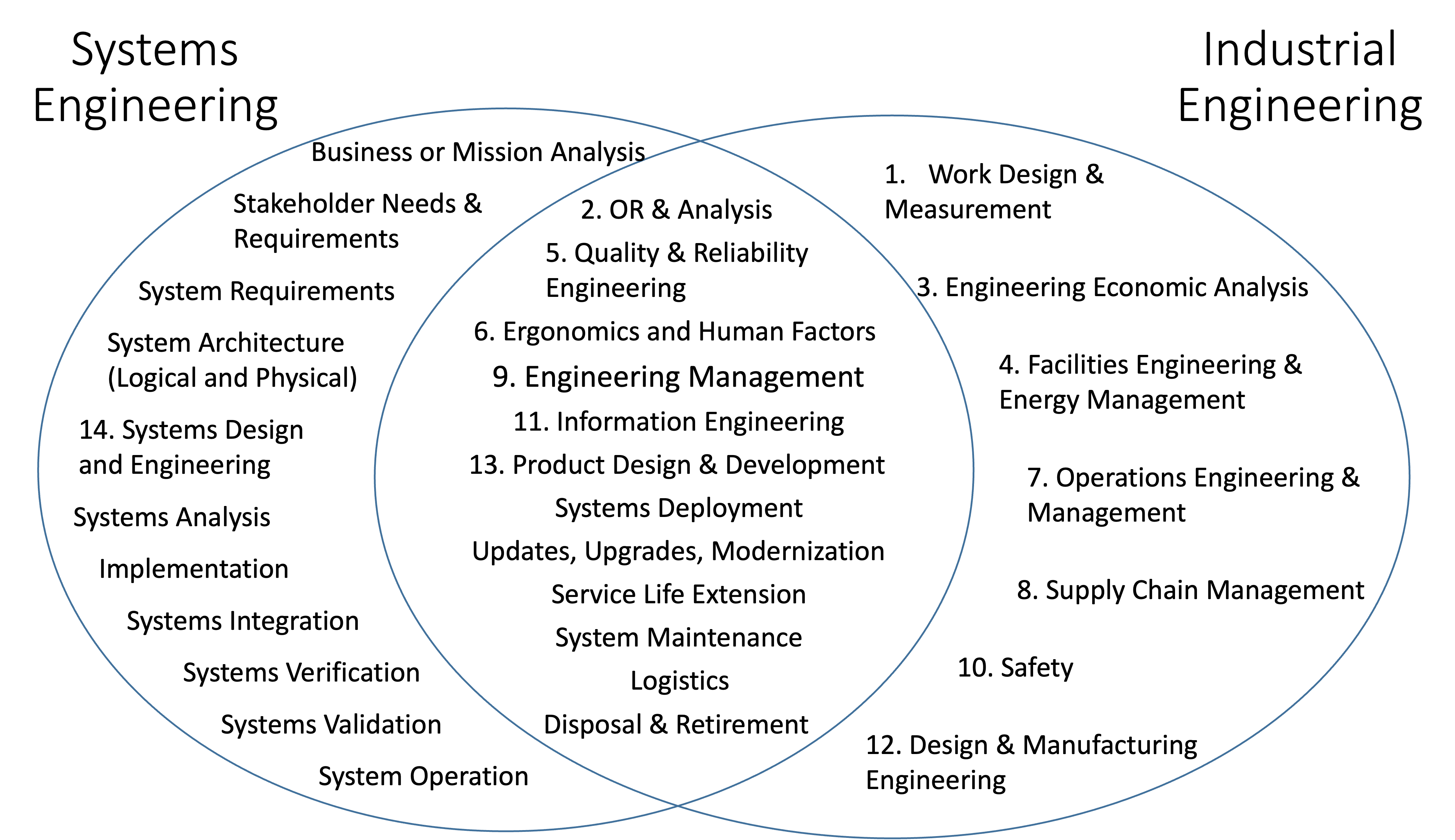
This section compares the two bodies of knowledge. Figure 3 is a Venn Diagram that identifies knowledge areas that are usually performed by systems engineers, ones usually performed by industrial engineers, and ones that are used by both disciplines.
このセクションでは、2つの知識体系を比較する。図3はベン図であり、通常システムエンジニアが実施する知識領域、通常産業エンジニアが実施する知識領域、そして両分野で用いられる知識領域を特定している。
図中の英語
There are 11 primarily SE knowledge areas, 7 primarily IE knowledge areas, and 12 overlapping knowledge areas. Table 1 provides some illustrative examples of the differences in SE and IE focus in the overlapping knowledge areas.
主に SE の知識領域が11、主に IE の知識領域が7、重なり合う知識領域が12ある。表1は、重なり合う知識領域における SE と IE の焦点の違いを示す例をいくつか挙げている。
表1. SE と IE の焦点の違いを示す例
| +Table 1. Illustrative Examples of Differences in SE and IE Focus |
| Knowledge Area |
| Systems Engineering Focus |
| Industrial Engineering Focus |
| 2. Operations Research (OR) and Analysis |
| OR and analysis is used in systems analysis to assess system performance and to evaluate system designs (Levis and Wagenhals 2000; Wagenhals, Shin, Kim, and Levis 2000; Wagenhals, Haider, and Levis 2003; Raz, Kenley, and DeLaurentis 2018) |
| OR and analysis is used to optimize operations, maintenance, and logistics. OR is also used to evaluate and optimize manufacturing systems. |
| 5. Quality & Reliability Engineering |
| Quality and reliability requirements are treated as system-wide performance requirements (Buede and Miller 2016: 157-159; Wymore 1993: 401) that are assessed at the systems level. One example is availability, A<sub>0</sub>, which measures the degree to which a system is either operating or can operate at any time when used in its typical operational and support environment. (DA PAM 70-3 2008: 87) |
| Quality and reliability are used to evaluate and improve the manufacturing process of goods and services. Reliability is also used to evaluate and improve system operations. |
| 6. Ergonomics and Human Factors |
| Ergonomics and human factors are considerations in assessing the potential usability of a system for end-users in an operational environment. According to Buede and Miller (2016: 180), “Performance elements of usability are ease of learning (learnability), ease of use (efficiency), ease of remembering (memorability), error rate, and subjectively pleasing (satisfaction).” |
| Ergonomics and human factors are used to assess and improve manufacturing and operational processes. They are also used to assess and improve the actual usability of products and services. |
| 9. Engineering Management |
| Engineering managers and SEs work with program managers to develop and improve new products and services. |
| Engineering managers and IEs support operations managers responsible for manufacturing processes and the operation of systems providing products and services. |
| 11. Information Engineering |
| Information Engineering is critical to the development of new products and services that are increasingly software intensive. Information engineering is relevant for model-based systems engineering software tools and databases, requirements management software tools and databases, and overall configuration management of the systems design and requirements baseline. |
| The Information Engineering knowledge area focuses on using data in information systems to facilitate decision-making and business communication. |
| 13. Product Design and Development |
| SE focuses on the design of systems that provide products and services and the system life cycle. SE includes the technical processes for system design and verification and the technical management processes for project planning, assessment, and control; risk management; and decision management in the Systems Engineering Handbook (2015: 47-83, 104-121). |
| The knowledge area of the ISEBoK (2021: 53-46) focuses on the design of products and the product life cycle. It closely parallels the technical processes for system design and development of SEBoK. |
| Systems Deployment |
| Systems engineers participate in defining requirements, defining the architecture, and verification and validation of deployment systems needed to the deploy the system of interest, e.g., special transport equipment such as the Shuttle Carrier Aircraft (SCA) that NASA used to transport Space Shuttle orbiters. (Jenkins 2000) |
| Industrial engineers are more focused on air, ground, water, and intermodal logistics to include transportation and distribution of systems and products. |
| Updates, Upgrades, Modernization |
| Systems engineers are involved defining requirements, defining the architecture, and verification and validation of updates, upgrades, and modernization of systems. One way that this has been explained is that a second iteration of the systems engineering V-model is completed as the systems remains in service while a system change project is implemented (Ven, Talik, and Hulse 2012). |
| Industrial engineers are involved in manufacturing processes and supporting operations of systems to provide goods and services. Industrial engineers can help identify the need for updates, upgrades, and modernization of manufacturing and service processes and work with engineering managers, systems engineers, and design engineers to provide improved capabilities. |
| Service Life Extension |
| Systems engineers are involved in service life extension efforts in the same way that they are involved in updates, upgrades, and modernization of systems. |
| Industrial engineers are involved in service life extension efforts in the same way that they are involved in updates, upgrades, and modernization of systems. |
| System Maintenance |
| Systems engineers participate in defining requirements for maintenance across the life cycle of the system, determine the impact of maintenance constraints on the system requirements and the system architecture (Walden, et al. 2015: 97-98). |
| Industrial engineers provide engineering support to production processes maintenance and system maintenance to sustain operation of production and service processes and systems. |
| Logistics |
| Systems engineers participate in defining requirements for logistics across the life cycle of the system, determine the impact of maintenance constraints on the system requirements and the system architecture (Walden, et al. 2015: 97-98). |
| Industrial engineers are very involved in logistics planning and operations including supply chain management, transportation, and distribution. |
| Disposal and Retirement |
| Systems engineers identify requirements, define the architecture, and verification and validation of disposal and retirement needed to the disposition or retire the system of interest, e.g., nuclear material stabilization processes and equipment needed to disposition fissile nuclear materials to enable shutdown of the nuclear production facilities (Kenley, et al. 1999). |
| Industrial engineers plan for disposal and retirement as part of their product design process. Increasingly, industrial engineers must consider environmental impact and sustainability issues. |
| 知識領域 | システムズエンジニアリングの焦点 | 産業エンジニアリングの焦点 |
|---|---|---|
| 2. Operations Research (OR) and Analysis | OR と分析は、システム分析において、システム性能の評価やシステム設計の評価に用いられる(Levis and Wagenhals 2000; Wagenhals, Shin, Kim, and Levis 2000; Wagenhals, Haider, and Levis 2003; Raz, Kenley, and DeLaurentis 2018) | OR と分析は、運用、保全、ロジスティクスの最適化に用いられる。OR は、製造システムの評価と最適化にも用いられる。 |
| 5. Quality & Reliability Engineering | 品質と信頼性の要求事項は、システム全体にわたるパフォーマンス要求事項として扱われ(Buede and Miller 2016: 157-159; Wymore 1993: 401)、システムレベルで評価される。その一例が可用性 A<sub>0</sub> であり、これは、典型的な運用・支援環境で使用されたときに、システムが任意の時点で稼働している、または稼働できる度合いを測るものである。(DA PAM 70-3 2008: 87) | 品質と信頼性は、商品とサービスの製造プロセスの評価と改善に用いられる。信頼性は、システム運用の評価と改善にも用いられる。 |
| 6. Ergonomics and Human Factors | 人間工学とヒューマンファクタは、運用環境におけるエンドユーザーにとってのシステムの潜在的な使用性を評価する際の考慮事項である。Buede and Miller (2016: 180) によれば、「使用性のパフォーマンス要素は、学習の容易さ(学習可能性)、使用の容易さ(効率)、記憶の容易さ(記憶可能性)、エラー率、主観的な満足(満足度)である。」 | 人間工学とヒューマンファクタは、製造プロセスや運用プロセスの評価と改善に用いられる。また、製品とサービスの実際の使用性の評価と改善にも用いられる。 |
| 9. Engineering Management | エンジニアリングマネージャとシステムエンジニアは、プログラムマネージャと協力して、新しい製品とサービスを開発・改善する。 | エンジニアリングマネージャと産業エンジニアは、製造プロセスと、製品・サービスを提供するシステムの運用とに責任を負う運用マネージャを支援する。 |
| 11. Information Engineering | 情報工学は、ソフトウェア集約度がますます高まる新しい製品とサービスの開発にとって決定的に重要である。情報工学は、モデルベースシステムズエンジニアリングのソフトウェアツールとデータベース、要求マネジメントのソフトウェアツールとデータベース、そしてシステム設計と要求ベースラインの全体的な構成管理に関わる。 | 情報工学の知識領域は、意思決定とビジネスコミュニケーションを促進するために、情報システム内のデータを活用することに焦点を当てる。 |
| 13. Product Design and Development | SE は、製品とサービスを提供するシステムの設計と、システムライフサイクルに焦点を当てる。Systems Engineering Handbook(2015: 47-83, 104-121)において、SE には、システム設計と検証のための技術プロセスと、プロジェクトの計画・評価・管理、リスクマネジメント、意思決定マネジメントのための技術マネジメントプロセスが含まれている。 | ISEBoK の知識領域(2021: 53-46)は、製品の設計と製品ライフサイクルに焦点を当てる。これは、SEBoK におけるシステム設計と開発のための技術プロセスと密接に対応している。 |
| Systems Deployment | システムエンジニアは、対象システムの配備に必要な配備システムについて、要求事項の定義、アーキテクチャの定義、検証と妥当性確認に参加する。例えば、NASA がスペースシャトル・オービタの輸送に使用したシャトル輸送機(SCA)のような特殊な輸送装備である。(Jenkins 2000) | 産業エンジニアは、システムと製品の輸送・流通を含む、航空、陸上、水上、複合一貫輸送のロジスティクスに、より重点を置いている。 |
| Updates, Upgrades, Modernization | システムエンジニアは、システムの更新、アップグレード、近代化について、要求事項の定義、アーキテクチャの定義、検証と妥当性確認に関与する。これについての一つの説明として、システム変更プロジェクトが実施される間もシステムがサービスを継続し、その中でシステムズエンジニアリングの V モデルの第2の反復が完了する、というものがある(Ven, Talik, and Hulse 2012)。 | 産業エンジニアは、製造プロセスと、商品・サービスを提供するシステムの運用支援に関与する。産業エンジニアは、製造プロセスやサービスプロセスの更新、アップグレード、近代化の必要性の特定を支援し、エンジニアリングマネージャ、システムエンジニア、設計エンジニアと協力して、改善された能力を提供することができる。 |
| Service Life Extension | システムエンジニアは、システムの更新、アップグレード、近代化に関与するのと同じかたちで、耐用年数延長の取り組みに関与する。 | 産業エンジニアは、システムの更新、アップグレード、近代化に関与するのと同じかたちで、耐用年数延長の取り組みに関与する。 |
| System Maintenance | システムエンジニアは、システムのライフサイクル全体にわたる保守の要求事項の定義に参加し、保守上の制約がシステム要求事項とシステムアーキテクチャに及ぼす影響を判断する(Walden, et al. 2015: 97-98)。 | 産業エンジニアは、生産およびサービスプロセスとシステムの運用を持続するために、生産プロセスの保全とシステム保全に対して工学的な支援を提供する。 |
| Logistics | システムエンジニアは、システムのライフサイクル全体にわたるロジスティクスの要求事項の定義に参加し、保守上の制約がシステム要求事項とシステムアーキテクチャに及ぼす影響を判断する(Walden, et al. 2015: 97-98)。 | 産業エンジニアは、サプライチェーンマネジメント、輸送、流通を含むロジスティクスの計画と運用に深く関与している。 |
| Disposal and Retirement | システムエンジニアは、対象システムの処分または廃止に必要な廃棄・廃止について、要求事項の特定、アーキテクチャの定義、検証と妥当性確認を行う。例えば、核生産施設の閉鎖を可能にするため、核分裂性核物質の処分に必要な核物質安定化プロセスと装備である(Kenley, et al. 1999)。 | 産業エンジニアは、製品設計プロセスの一環として廃棄と廃止を計画する。産業エンジニアは、環境影響や持続可能性の課題をますます考慮しなければならなくなっている。 |
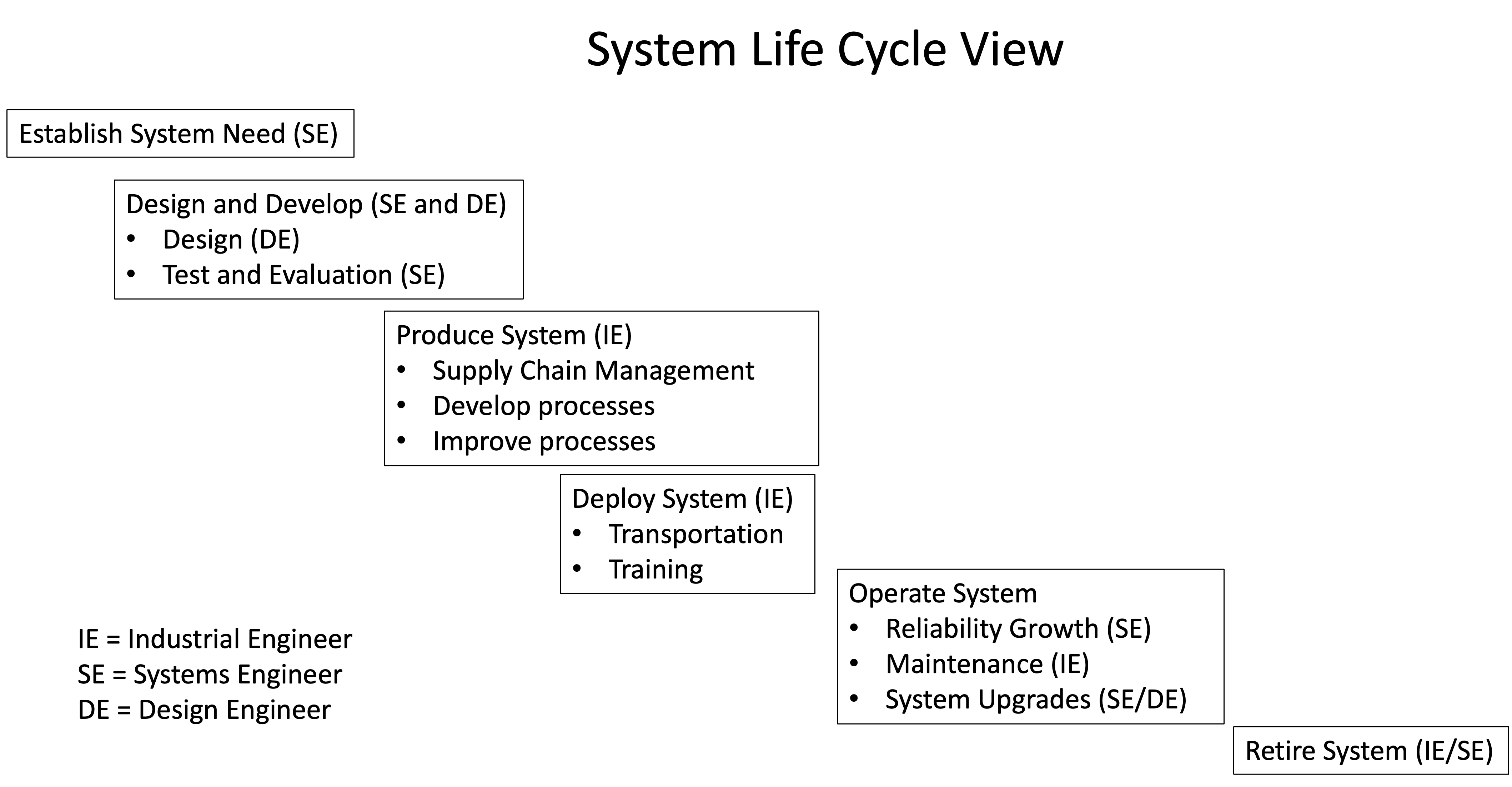
Systems engineers and industrial engineers play important roles in a system life cycle. Figure 4 modifies a format from Buede and Miller (2016). It shows the system life cycle stages and, based on analysis in the previous section, identifies and summarizes the major roles of systems engineers, industrial engineers, and design engineers. Some processes have been aggregated to simplify the figure.
システムエンジニアと産業エンジニアは、システムライフサイクルにおいて重要な役割を果たす。図4は、Buede and Miller (2016) の形式を修正したものである。この図は、システムライフサイクルの段階を示すとともに、前節の分析に基づいて、システムエンジニア、産業エンジニア、設計エンジニアの主要な役割を特定し、要約している。図を簡潔にするため、いくつかのプロセスは集約されている。
図中の英語
In summary:
要約すると、次のとおりである。
• The SEBoK SE and Management Part is based on an ISO standard. IE has several related ISO standards. IISE does not link its body of knowledge to standards.
• SEBoK の『SE and Management』Part は ISO 標準に基づいている。IE には関連する ISO 標準がいくつかある。IISE は、自らの知識体系を標準と結び付けていない。
• The SEBoK is more process focused, while IISEBoK focuses more on concepts and techniques.
• SEBoK がよりプロセスに焦点を当てているのに対し、IISEBoK は概念と技法により重点を置いている。
• SE and IE have overlapping bodies of knowledge.
• SE と IE の知識体系には重なりがある。
• The SEBoK and INCOSE's SE Handbook align with the system life cycle. The IISEBoK does not have an analogous organizing structure.
• SEBoK と INCOSE の SE ハンドブックは、システムライフサイクルに整合している。IISEBoK には、これに類する構成構造はない。
• Systems engineers and industrial engineers both play important roles in the system life cycle with some overlapping responsibilities.
• システムエンジニアと産業エンジニアはいずれもシステムライフサイクルにおいて重要な役割を果たしており、責任の一部は重なっている。
Buede, D. M., and W. D. Miller. The Engineering Design of Systems: Models and Methods. Hoboken, NJ: Wiley. 2016.
Department of the Army. Army Acquisition Procedures. DA PAM 70‑3, January 28, 2008. Washington, DC: Department of the Army. 2008.
Environmental Protection Agency. Guidelines for Preparing Economic Analyses. Accessed November 19, 2021. <nowiki>https://www.epa.gov/environmental-economics/guidelines-preparing-economic-analyses</nowiki>.
Environmental Protection Agency. Guidelines for Preparing Economic Analyses. Accessed November 19, 2021. https://www.epa.gov/environmental-economics/guidelines-preparing-economic-analyses.
IISE (Institute of Industrial and Systems Engineers). IISE Body of Knowledge. 2021. https://www.iise.org/BodyofKnowledge.
Institute of Industrial and Systems Engineers. “Origins of IISE.” Accessed November 13, 2021. https://www.iise.org/details.aspx?id=295.
INCOSE (International Council on Systems Engineering). “What Is Systems Engineering?” Accessed February 17, 2022. <nowiki>https://www.incose.org/about-systems-engineering/system-and-se-definition/systems-engineering-definition</nowiki>.
INCOSE (International Council on Systems Engineering). “What Is Systems Engineering?” Accessed February 17, 2022. https://www.incose.org/about-systems-engineering/system-and-se-definition/systems-engineering-definition.
ISO (International Organization for Standardization). “Standards Website.” Accessed November 14, 2021. https://www.iso.org/standards.html.
ISO/IEC/IEEE. Systems and Software Engineering – System Life Cycle Processes. Geneva: International Organization for Standardization. 2015.
Jenkins, D. R. Boeing 747‑100/200/300/SP. Airliner Tech Series, vol. 6. North Branch, MN: Specialty Press. 2000.
Kenley, B., B. Scott, B. Seidel, D. Knecht, F. Southworth, K. Osborne, N. Chipman, and T. A. Creque. “Program to Stabilize Nuclear Materials as Managed by the Plutonium Focus Area.” Proceedings of Waste Management 1999. Tucson, AZ. 1999.
Levis, A. H., and L. W. Wagenhals. “C4ISR Architectures: I. Developing a Process for C4ISR Architecture Design.” Systems Engineering 3, no. 4: 225–247. 2000.
Raz, A. K., C. R. Kenley, and D. A. DeLaurentis. “System Architecting and Design Space Characterization.” Systems Engineering 21, no. 3: 227–242. 2018.
Salvendy, G., ed. Handbook of Industrial Engineering, Technology and Operations Management. 3rd ed. Hoboken, NJ: John Wiley & Sons. 2001.
Van De Ken, M., J. Talik, and J. Hulse. “An Introduction to Applying Systems Engineering to In‑Service Systems.” Proceedings of the 2012 INCOSE International Symposium 22, no. 1: 879–894. Rome, Italy. 2021. https://doi.org/10.1002/j.2334-5837.2012.tb01377.x.
Wagenhals, L. W., S. Haider, and A. H. Levis. “Synthesizing Executable Models of Object‑Oriented Architectures.” Systems Engineering 6, no. 4: 266–300. 2003.
Wagenhals, L. W., I. Shin, D. Kim, and A. H. Levis. “C4ISR Architectures: II. A Structured Analysis Approach for Architecture Design.” Systems Engineering 3, no. 4: 248–287. 2000.
Walden, D. D., G. J. Roedler, K. J. Forsberg, R. D. Hamelin, and T. M. Shortell, eds. INCOSE Systems Engineering Handbook: A Guide for System Life Cycle Processes and Activities. 4th ed. Hoboken, NJ: Wiley. 2015.
Wymore, A. W. Model‑Based Systems Engineering: An Introduction to the Mathematical Theory of Discrete Systems and to the Tricotyledon Theory of System Design. Boca Raton, FL: CRC Press. 1993.
Zandin, K. B., ed. ''Maynard's Industrial Engineering Handbook.'' 5th ed. New York: McGraw‑Hill. 2001.
Zandin, K. B., ed. Maynard's Industrial Engineering Handbook. 5th ed. New York: McGraw‑Hill. 2001.
Salvendy, G., ed. Handbook of Industrial Engineering, Technology and Operations Management. 3rd ed. Hoboken, NJ: John Wiley & Sons. 2001.
Zandin, K. B., ed. ''Maynard's Industrial Engineering Handbook''. 5th ed. New York: McGraw‑Hill. 2001.
Zandin, K. B., ed. Maynard's Industrial Engineering Handbook. 5th ed. New York: McGraw‑Hill. 2001.
none.