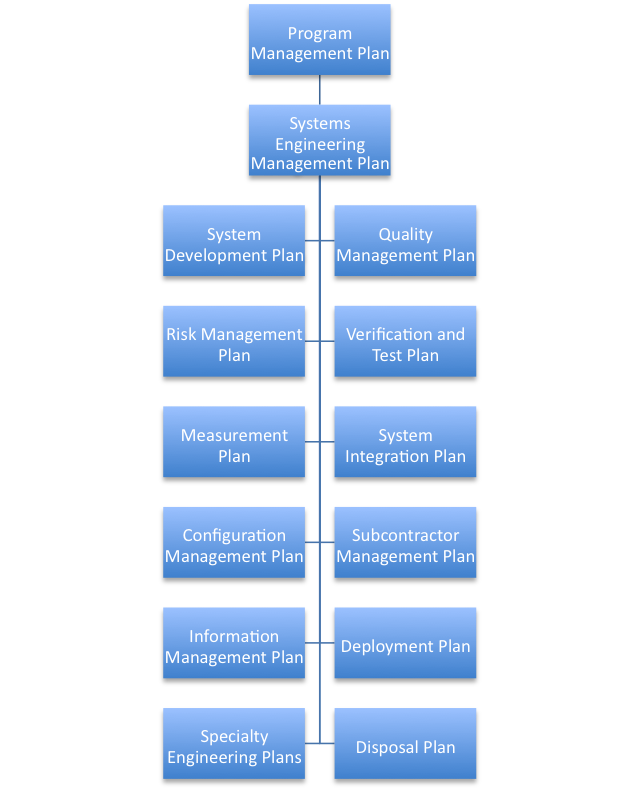
図1. SEMP と統合計画。(SEBoK Original)
Project Planning
Planning is an important aspect of technical management processes (SEM). Systems engineering (SE) planning is performed concurrently and collaboratively with project planning. It involves developing and integrating technical plans to achieve the technical project objectives within the resource constraints and risk thresholds. The planning involves the success-critical stakeholders to ensure that necessary tasks are defined with the right timing in the life cycle in order to manage acceptable risks levels, meet schedules, and avoid costly omissions.
計画立案は、技術マネジメントプロセス(SEM)の重要な側面である。システムズエンジニアリング(Systems Engineering、SE)の計画立案は、プロジェクト計画立案と並行し、かつ協働して行われる。これには、資源制約とリスク閾値の範囲内でプロジェクトの技術目標を達成するための技術計画を策定し、統合することが含まれる。計画立案には、成功に不可欠なステークホルダーが関与し、ライフサイクル(life cycle)における適切な時期に必要なタスクが定義されることを確実にすることで、許容可能なリスク水準を管理し、スケジュールを満たし、コストのかかる漏れを回避する。
SE planning provides the following elements:
*Estimation of technical cost and schedule based on the effort needed to meet the requirements; this estimation becomes input to project cost and schedule planning. *Determination of critical technologies, as well as the associated risks and actions needed to manage and transition these technologies. *Identification of linkages to other project management efforts. *Documentation of and commitment to the technical planning.
SE 計画立案は、以下の要素を提供する。
SE planning begins with analyzing the scope of technical work to be performed and gaining an understanding the constraints, risks, and objectives that define and bound the solution space for the product or service. The planning includes estimating the size of the work products, establishing a schedule (or integrating the technical tasks into the project schedule), identification of risks, and negotiating commitments. Iteration of these planning tasks may be necessary to establish a balanced plan with respect to cost, schedule, technical performance, and quality. The planning continues to evolve with each successive life cycle phase of the project (NASA 2007, 1-360; SEI 1995, 12).
SE 計画立案は、実施すべき技術作業の範囲(scope)を分析し、製品またはサービスのソリューション空間を定義し境界づける制約、リスク、および目標を理解することから始まる。計画立案には、作業成果物の規模の見積もり、スケジュールの策定(または技術タスクのプロジェクトスケジュールへの統合)、リスクの特定、およびコミットメントの交渉が含まれる。コスト、スケジュール、技術的性能、および品質の面でバランスの取れた計画を確立するには、これらの計画立案タスクを反復する必要が生じることもある。計画立案は、プロジェクトのライフサイクルフェーズが進むごとに進化し続ける(NASA 2007, 1-360; SEI 1995, 12)。
SE planning addresses all programmatic and technical elements of the project to ensure a comprehensive and integrated plan for all of the project's technical aspects and should account for the full scope of technical activities, including system development and definition, risk management, quality management, configuration management, measurement, information management, production, verification and testing, integration, validation, and deployment. SE planning integrates all SE functions to ensure that plans, requirements, operational concepts, and architectures are consistent and feasible.
SE 計画立案は、プロジェクトの管理面および技術面のすべての要素を扱い、プロジェクトのあらゆる技術的側面について包括的かつ統合された計画を確保するものである。また、システム開発と定義、リスクマネジメント、品質マネジメント、構成管理、測定、情報マネジメント、生産、検証とテスト、統合、妥当性確認、および展開を含む、技術アクティビティの全範囲を考慮すべきである。SE 計画立案は、計画、要求事項、運用コンセプト、およびアーキテクチャが一貫し実現可能であることを確実にするために、すべての SE 機能を統合する。
The scope of planning can vary from planning a specific task to developing a major technical plan. The integrated planning effort will determine what level of planning and accompanying documentation is appropriate for the project.
計画立案の範囲は、特定のタスクの計画立案から大規模な技術計画の策定まで、さまざまである。どの程度の計画立案とそれに付随する文書がプロジェクトにとって適切かは、統合された計画立案の取り組みを通じて決定される。
The integration of each plan with other higher-level, peer, or subordinate plans is an essential part of SE planning. For the technical effort, the systems engineering management plan (SEMP), also frequently referred to as the systems engineering plan (SEP), is the highest-level technical plan. It is subordinate to the project plan and often has a number of subordinate technical plans providing detail on specific technical focus areas (INCOSE 2011, sec. 5.1.2.2; NASA 2007, appendix J).
各計画を、上位、同位、または下位の他の計画と統合することは、SE 計画立案に不可欠な要素である。技術的取り組みにおいては、システムズエンジニアリングマネジメント計画(systems engineering management plan、SEMP)(システムズエンジニアリング計画(systems engineering plan、SEP)とも呼ばれることが多い)が最上位の技術計画である。SEMP はプロジェクト計画の下位に位置づけられ、特定の技術重点分野の詳細を示す複数の下位技術計画を持つことが多い(INCOSE 2011, sec. 5.1.2.2; NASA 2007, appendix J)。
In U.S. defense work, the terms SEP and SEMP are not interchangeable. The SEP is a high-level plan that is made before the system acquisition and development begins. It is written by the government customer. The SEMP is the specific development plan written by the developer (or contractor). In this context, intent, and content of these documents are quite different. For example, a SEP will have an acquisition plan that would not be included in a SEMP. Figure 1 below shows the SEMP and integrated plans.
米国の防衛分野の業務では、SEP と SEMP という用語は互換ではない。SEP は、システムの取得と開発が始まる前に作成される上位レベルの計画である。これは政府側の顧客が作成する。SEMP は、開発者(または請負業者)が作成する具体的な開発計画である。この文脈では、これらの文書は意図も内容も大きく異なる。たとえば、SEP には取得計画が含まれるが、これは SEMP には含まれない。以下の図1に、SEMP と統合計画を示す。
図中の英語
Task planning identifies the specific work products, deliverables, and success criteria for systems engineering efforts in support of integrated planning and project objectives. The success criteria are defined in terms of cost, schedule, and technical performance at identified project milestones. Detailed task planning identifies specific resource requirements (e.g., skills, equipment, facilities, and funding) as a function of time and project milestones.
タスク計画立案では、統合計画立案とプロジェクト目標を支援するシステムズエンジニアリングの取り組みについて、具体的な作業成果物、納入物、および成功基準を特定する。成功基準は、特定されたプロジェクトマイルストーンにおけるコスト、スケジュール、および技術的性能の観点から定義される。詳細なタスク計画立案では、具体的な資源要件(スキル、設備、施設、資金など)を、時間とプロジェクトマイルストーンの関数として特定する。
SE planning is accomplished by both the acquirer and supplier and the activities for SE planning are performed in the context of the respective enterprise. The activities establish and identify relevant policies and procedures for managing and executing the project management and technical effort, identifying the management and technical tasks, their interdependencies, risks, and opportunities, and providing estimates of needed resources/budgets. Plans are updated and refined throughout the development process based on status updates and evolving project requirements (SEI 2007).
SE 計画立案は取得者(acquirer)と供給者(supplier)の双方が実施し、SE 計画立案のアクティビティはそれぞれのエンタープライズの文脈で行われる。これらのアクティビティでは、プロジェクトマネジメントと技術的取り組みを管理・実施するための関連方針と手順を確立・特定し、管理タスクと技術タスク、それらの相互依存関係、リスクと機会を特定するとともに、必要な資源/予算の見積もりを提供する。計画は、開発プロセス全体を通じて、状況の更新と進化するプロジェクトの要求事項に基づいて更新され、洗練される(SEI 2007)。
The project planning process is closely coupled with the measurement, assessment and control, decision management, and risk management processes.
プロジェクト計画立案プロセスは、測定、評価と管理、意思決定マネジメント、およびリスクマネジメントの各プロセスと密接に結びついている。
The measurement process provides inputs for estimation models. Estimates and other products from planning are used in decision management. SE assessment and control processes use planning results for setting milestones and assessing progress. Risk management uses the planning cost models, schedule estimates, and uncertainty distributions to support quantitative risk analysis (as desired).
測定プロセスは、見積もりモデルへの入力を提供する。計画立案から得られる見積もりやその他の成果物は、意思決定マネジメントで用いられる。SE の評価と管理のプロセスでは、計画立案の結果を用いてマイルストーンを設定し、進捗を評価する。リスクマネジメントでは、(必要に応じて)定量的リスク分析を支援するために、計画立案で得られたコストモデル、スケジュール見積もり、および不確かさの分布を用いる。
Additionally, planning needs to use the outputs from assessment and control as well as risk management to ensure corrective actions have been accounted for in planning future activities. The planning may need to be updated based on results from technical reviews (from assessment and control) addressing issues pertaining to: measurement, problems that were identified during the performance of risk management activities, or decisions made as a result of the decision management activities (INCOSE 2010, sec. 6.1).
さらに、計画立案では、将来のアクティビティを計画する際に是正処置が確実に考慮されるよう、評価と管理、およびリスクマネジメントからの出力を用いる必要がある。計画立案は、測定、リスクマネジメントのアクティビティの実施中に特定された問題、または意思決定マネジメントのアクティビティの結果として行われた意思決定に関する課題を扱う技術レビュー(評価と管理によるもの)の結果に基づいて、更新が必要になることがある(INCOSE 2010, sec. 6.1)。
Some of the key pitfalls encountered in planning and performing SE planning are listed in Table 1.
計画立案と SE 計画立案の実施において遭遇する主な落とし穴の一部を、表1に示す。
表1. 計画立案における主な落とし穴。(SEBoK Original)
| +Table 1. Major Pitfalls with Planning. (SEBoK Original) |
| Name |
|---|
| Description |
| Incomplete and Rushed Planning |
| Inadequate SE planning causes significant adverse impacts on all other engineering activities. Although one may be tempted to save time by rushing the planning, inadequate planning can create additional costs and interfere with the schedule due to planning omissions, lack of detail, lack of integration of efforts, infeasible cost and schedules, etc. |
| Inexperienced Staff |
| Lack of highly experienced engineering staff members, especially in similar projects, will likely result in inadequate planning. Less experienced engineers are often assigned significant roles in the SE planning; however, they may not have the appropriate judgment to lay out realistic and achievable plans. It is essential to assign the SE planning tasks to those with a good amount of relevant experience. |
| 名前 | 説明 |
|---|---|
| 不完全で性急な計画立案 | 不十分な SE 計画立案は、他のすべてのエンジニアリングのアクティビティに著しい悪影響を及ぼす。計画立案を急いで時間を節約したくなることもあるが、不十分な計画立案は、計画の漏れ、詳細の欠如、取り組みの統合の欠如、実現不可能なコストとスケジュールなどによって、追加コストを生み、スケジュールに支障をきたす可能性がある。 |
| 経験の浅いスタッフ | 経験豊富なエンジニアリングスタッフ、特に類似プロジェクトの経験を持つスタッフが不足していると、計画立案が不十分になる可能性が高い。SE 計画立案では経験の浅いエンジニアが重要な役割を任されることが多いが、そうしたエンジニアは、現実的で達成可能な計画を立てるための適切な判断力を備えていないことがある。SE 計画立案のタスクは、関連する経験を十分に積んだ者に割り当てることが不可欠である。 |
Some good practices gathered from the references are in Table 2.
参考文献から収集した優れた実践の一部を、表2に示す。
表2. 計画立案における実証済みの実践。(SEBoK Original)
| +Table 2. Proven Practices with Planning. (SEBoK Original) |
| Name |
|---|
| Description |
| Use Multiple Disciplines |
| Get technical resources from all disciplines involved in the planning process. |
| Early Conflict Resolution |
| Resolve schedule and resource conflicts early. |
| Task Independence |
| Tasks should be as independent as possible. |
| Define Interdependencies |
| Define task interdependencies, using dependency networks or other approaches. |
| Risk Management |
| Integrate risk management with the SE planning to identify areas that require special attention and/or trades. |
| Management Reserve |
| The amount of management reserve should be based on the risk associated with the plan. |
| Use Historical Data |
| Use historical data for estimates and adjust for differences in the project. |
| Consider Lead Times |
| Identify lead times and ensure that you account for them in the planning (e.g., the development of analytical tools). |
| Update Plans |
| Prepare to update plans as additional information becomes available or changes are needed. |
| Use IPDTs |
| An integrated product development team (IPDT) (or integrated product team (IPT)) is often useful to ensure adequate communication across the necessary disciplines, timely integration of all design considerations, as well as integration, testing, and consideration of the full range of risks that need to be addressed. Although there are some issues that need to be managed with them, IPDTs tend to break down the communication and knowledge stovepipes that often exist. |
| 名前 | 説明 |
|---|---|
| 複数の専門分野を用いる | 計画立案プロセスに関与するすべての専門分野から技術的資源を得る。 |
| 早期の競合解決 | スケジュールと資源の競合を早期に解決する。 |
| タスクの独立性 | タスクは可能な限り独立させるべきである。 |
| 相互依存関係を定義する | 依存関係ネットワークまたはその他のアプローチを用いて、タスクの相互依存関係を定義する。 |
| リスクマネジメント | 特別な注意および/またはトレードオフを要する領域を特定するため、リスクマネジメントを SE 計画立案と統合する。 |
| マネジメントリザーブ | マネジメントリザーブの量は、計画に伴うリスクに基づいて決めるべきである。 |
| 過去データを用いる | 見積もりには過去データを用い、プロジェクトの違いを踏まえて調整する。 |
| リードタイムを考慮する | リードタイムを特定し、計画立案において確実にそれを考慮する(例:分析ツールの開発)。 |
| 計画を更新する | 追加情報が利用可能になったり、変更が必要になったりしたときに、計画を更新できるよう備えておく。 |
| IPDT を用いる | 統合製品開発チーム(integrated product development team、IPDT)(または統合プロダクトチーム(integrated product team、IPT))は、必要な専門分野間の十分なコミュニケーション、あらゆる設計上の考慮事項の適時な統合、ならびに、統合とテストの実施、および対処すべきリスクを漏れなく検討することを確実にするうえで有用なことが多い。管理すべき課題もいくつかあるが、IPDT は、しばしば存在するコミュニケーションと知識のサイロを打破する傾向がある。 |
Additional good practices can be found in the Systems Engineering Guidebook for Intelligent Transportation Systems (ITS), NASA Systems Engineering Handbook, the INCOSE Systems Engineering Handbook, and Systems and Software Engineering - Life Cycle Processes - Project Management (Caltrans and USDOT 2005, 278; NASA December 2007, 1-360, sec. 6.1; INCOSE 2011, sec. 5.1; ISO/IEC/IEEE 2009, Clause 6.1).
その他の優れた実践は、Systems Engineering Guidebook for Intelligent Transportation Systems (ITS)、NASA Systems Engineering Handbook、INCOSE Systems Engineering Handbook、および Systems and Software Engineering - Life Cycle Processes - Project Management に記載されている(Caltrans and USDOT 2005, 278; NASA December 2007, 1-360, sec. 6.1; INCOSE 2011, sec. 5.1; ISO/IEC/IEEE 2009, Clause 6.1)。
Caltrans and USDOT. 2005. Systems Engineering Guidebook for Intelligent Transportation Systems (ITS), version 1.1. Sacramento, CA, USA: California Department of Transportation (Caltrans) Division of Research & Innovation/U.S. Department of Transportation (USDOT), SEG for ITS 1.1.
DAU. 2010. Defense Acquisition Guidebook (DAG). Ft. Belvoir, VA, USA: Defense Acquisition University (DAU)/U.S. Department of Defense, February 19.
INCOSE. 2012. INCOSE Systems Engineering Handbook: A Guide for System Life Cycle Processes and Activities. Version 3.2.2. San Diego, CA, USA: International Council on Systems Engineering (INCOSE), INCOSE-TP-2003-002-03.2.2.
ISO/IEC/IEEE. 2009. Systems and Software Engineering - Life Cycle Processes - Project Management. Geneva, Switzerland: International Organization for Standardization (ISO)/International Electrotechnical Commission (IEC)/Institute of Electrical and Electronics Engineers (IEEE), ISO/IEC/IEEE 16326:2009(E).
NASA. 2007. NASA Systems Engineering Handbook. Washington, D.C.: National Aeronautics and Space Administration (NASA), NASA/SP-2007-6105.
SEI. 1995. A systems engineering capability maturity model. Version 1.1. Pittsburgh, PA, USA: Software Engineering Institute (SEI)/Carnegie-Mellon University (CMU), CMU/SEI-95-MM-003.
Caltrans and USDOT. 2005. Systems Engineering Guidebook for Intelligent Transportation Systems (ITS), version 1.1. Sacramento, CA, USA: California Department of Transportation (Caltrans) Division of Reserach & Innovation/U.S. Department of Transportation (USDOT), SEG for ITS 1.1.
DAU. 2010. Defense Acquisition Guidebook (DAG). Ft. Belvoir, VA, USA: Defense Acquisition University (DAU)/U.S. Department of Defense.
INCOSE. 2012. INCOSE Systems Engineering Handbook: A Guide for System Life Cycle Processes and Activities. Version 3.2.2. San Diego, CA, USA: International Council on Systems Engineering (INCOSE), INCOSE-TP-2003-002-03.2.2.
ISO/IEC/IEEE. 2015. Systems and Software Engineering -- System Life Cycle Processes. Geneva, Switzerland: International Organization for Standardisation / International Electrotechnical Commissions / Institute of Electrical and Electronics Engineers. ISO/IEC/IEEE 15288:2015.
ISO/IEC/IEEE. 2009. Systems and Software Engineering - Life Cycle Processes - Project Management. Geneva, Switzerland: International Organization for Standardization (ISO)/International Electrotechnical Commission (IEC)/Institute of Electrical and Electronics Engineers (IEEE), ISO/IEC/IEEE 16326:2009(E).
NASA. 2007. NASA Systems Engineering Handbook. Washington, D.C., USA: National Aeronautics and Space Administration (NASA), NASA/SP-2007-6105.
SEI. 1995. A Systems Engineering Capability Maturity Model, version 1.1. Pittsburgh, PA, USA: Software Engineering Institute (SEI)/Carnegie-Mellon University (CMU), CMU/SEI-95-MM-003.
SEI. 2007. Capability Maturity Model Integrated (CMMI) for Development, version 1.2, measurement and analysis process area. Pittsburgh, PA, USA: Software Engineering Institute (SEI)/Carnegie Mellon University (CMU).
Boehm, B., C. Abts, A.W. Brown, S. Chulani, B.K. Clark, E. Horowitz, R. Madachy, D.J. Reifer, B. Steece. 2000. Software Cost Estimation with COCOMO II. Englewood Cliffs, NJ, USA: Prentice Hall
DeMarco, T. and T. Lister. 2003. Waltzing with Bears; Managing Risks on Software Projects. New York, NY, USA: Dorset House.
ISO/IEC/IEEE. 2009. Systems and Software Engineering - Life Cycle Processes - Project Management. Geneva, Switzerland: International Organization for Standardization (ISO)/International Electrotechnical Commission (IEC)/Institute of Electrical and Electronics Engineers (IEEE), ISO/IEC/IEEE 16326:2009(E).
Valerdi, R. 2008. The Constructive Systems Engineering Cost Model (COSYSMO): Quantifying the Costs of Systems Engineering Effort in Complex Systems. Saarbrücken,Germany: VDM Verlag Dr. Muller