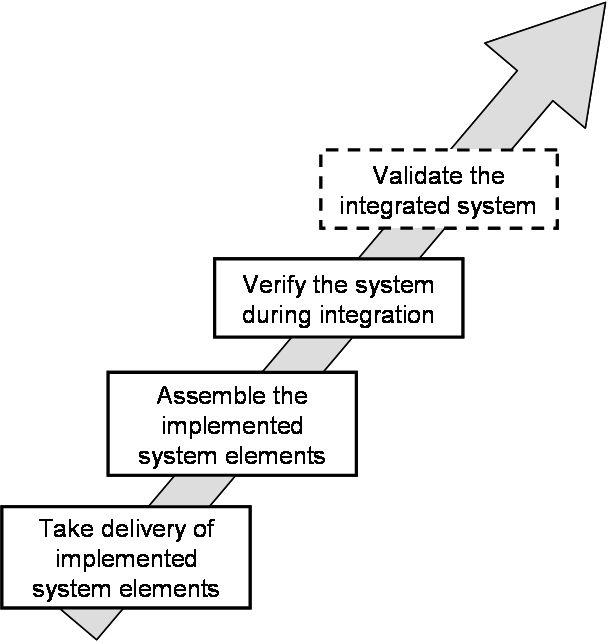
図1. 統合アクティビティの範囲。(SEBoK Original)
System Integration
System integration consists of taking delivery of the implemented system elements which compose the system-of-interest (SoI), assembling these implemented elements together, and performing the verification and validation actions (V&V actions) in the course of the assembly. The ultimate goal of system integration is to ensure that the individual system elements function properly as a whole and satisfy the design properties or characteristics of the system. System integration is one part of the realization effort and relates only to developmental items. Integration should not to be confused with the assembly of end products on a production line. To perform the production, the assembly line uses a different order from that used by integration.
システム統合(System integration)とは、対象システム(system-of-interest、SoI)を構成する実装されたシステム要素の納入を受け、それらの実装された要素を組み立て、その組み立ての過程で検証・妥当性確認アクション(verification and validation actions、V&V アクション)を実施することである。システム統合の究極の目標は、個々のシステム要素が全体として適切に機能し、システムの設計特性または特徴を満たすことを保証することにある。システム統合は実現の取り組みの一部であり、開発品目にのみ関係する。統合を、生産ラインにおける最終製品の組み立てと混同すべきではない。組み立てラインでは、生産を行うにあたり、統合で用いられるものとは異なる順序が用いられる。
System integration consists of a process that “iteratively combines implemented system elements to form complete or partial system configurations in order to build a product or service. It is used recursively for successive levels of the system hierarchy.” (ISO/IEC 15288 2015, 68). The process is extended to any kind of product system, service system, and enterprise system. The purpose of system integration is to prepare the SoI for final validation and transition either for use or for production. Integration consists of progressively assembling aggregates of implemented elements that compose the SoI as architected during design, and to check correctness of static and dynamic aspects of interfaces between the implemented elements.
システム統合は、「製品またはサービスを構築するために、実装されたシステム要素を反復的に組み合わせて、完全な、または部分的なシステム構成を形成する。それは、システム階層の連続するレベルに対して再帰的に用いられる。」(ISO/IEC 15288 2015, 68)プロセスからなる。このプロセスは、あらゆる種類の製品システム(product system)、サービスシステム(service system)、エンタープライズシステム(enterprise system)に拡張される。システム統合の目的は、SoI について、最終的な妥当性確認と、使用または生産に向けた移行の準備を整えることである。統合とは、設計時に定められたアーキテクチャどおりに SoI を構成する、実装された要素の集合体を漸進的に組み立て、実装された要素間のインタフェースについて静的および動的な側面の正確さをチェックすることである。
The U.S. Defense Acquisition University (DAU) provides the following context for integration: The integration process will be used . . . for the incorporation of the final system into its operational environment to ensure that the system is integrated properly into all defined external interfaces. The interface management process is particularly important for the success of the integration process, and iteration between the two processes will occur (DAU 2010).
米国国防取得大学(DAU)は、統合について次のようなコンテキストを示している。「統合プロセスは、定義されたすべての外部インタフェースにシステムが適切に統合されることを保証するために、最終システムを運用環境へ組み入れる際に用いられる。インタフェース管理プロセスは統合プロセスの成功にとって特に重要であり、2つのプロセスの間では反復が生じる」(DAU 2010)。
The purpose of system integration can be summarized as below:
システム統合の目的は、以下のように要約できる。
• Completely assemble the implemented elements to make sure that the they are compatible with each other.
• 実装された要素を完全に組み立て、それらが互いに適合することを確認する。
• Demonstrate that the aggregates of implemented elements perform the expected functions and meet measures of performance/effectiveness.
• 実装された要素の集合体が、期待される機能を果たし、性能・有効性の測定量で定められた基準を満たすことを実証する。
• Detect defects/faults related to design and assembly activities by submitting the aggregates to focused V&V actions.
• 集合体を的を絞った V&V アクションに供することにより、設計アクティビティおよび組み立てアクティビティに関連する欠陥/障害を検出する。
Note: In the systems engineering literature, sometimes the term integration is used in a larger context than in the present topic. In this larger sense, it concerns the technical effort to simultaneously design and develop the system and the processes for developing the system through concurrent consideration of all life cycle stages, needs, and competences. This approach requires the "integration" of numerous skills, activities, or processes.
注:システムズエンジニアリングの文献では、「統合」という用語が本トピックよりも広いコンテキストで用いられることがある。この広い意味での統合は、すべてのライフサイクル段階、ニーズ、能力を同時に考慮することを通じて、システムと、そのシステムを開発するためのプロセスとを同時に設計・開発する技術的な取り組みに関わる。このアプローチでは、多数のスキル、アクティビティ、またはプロセスの「統合」が必要となる。
Integration can be understood as the whole bottom-up branch of the Vee Model, including the tasks of assembly and the appropriate verification tasks. See Figure 1 below:
統合は、組み立てのタスクと適切な検証タスクを含む、Vee モデルのボトムアップの枝全体として理解できる。下記の図1を参照のこと。
図中の英語
The assembly activity joins together, and physically links, the implemented elements. Each implemented element is individually verified and validated prior to entering integration. Integration then adds the verification activity to the assembly activity, excluding the final validation.
組み立てアクティビティは、実装された要素同士を接合し、物理的に結び付ける。実装された各要素は、統合に入る前に個別に検証および妥当性確認を受ける。そのうえで統合は、最終的な妥当性確認を除き、組み立てアクティビティに検証アクティビティを加える。
The final validation performs operational tests that authorize the transition for use or the transition for production. Remember that system integration only endeavors to obtain pre-production prototypes of the concerned product, service, or enterprise. If the product, service, or enterprise is delivered as a unique exemplar, the final validation activity serves as acceptance for delivery and transfer for use. If the prototype has to be produced in several exemplars, the final validation serves as acceptance to launch their production. The definition of the optimized operations of assembly which will be carried out on a production line relates to the manufacturing process and not to the integration process.
最終的な妥当性確認は、使用のための移行、または生産のための移行を承認する運用テストを実施する。システム統合が目指すのは、当該製品、サービス、またはエンタープライズの生産前のプロトタイプを得ることだけであることを忘れてはならない。製品、サービス、またはエンタープライズが単一の個体または一式として引き渡される場合、最終的な妥当性確認アクティビティは、引き渡しおよび使用への移転のための受入れとして機能する。プロトタイプを複数生産しなければならない場合、最終的な妥当性確認は、その生産を開始するための受入れとして機能する。生産ラインで実施される、最適化された組み立て作業の定義は、統合プロセスではなく製造プロセスに関わるものである。
Integration activity can sometimes reveal issues or anomalies that require modifications of the design of the system. Modifying the design is not part of the integration process but concerns only the design process. Integration only deals with the assembly of the implemented elements and verification of the system against its properties as designed. During assembly, it is possible to carry out tasks of finishing touches which require simultaneous use of several implemented elements (e.g., paint the whole after assembly, calibrate a biochemical component, etc.). These tasks must be planned in the context of integration and are not carried out on separate implemented elements and do not include modifications related to design.
統合アクティビティによって、システムの設計の修正を必要とする問題や異常が明らかになることがある。設計の修正は統合プロセスの一部ではなく、設計プロセスのみに関わる。統合が扱うのは、実装された要素の組み立てと、設計どおりの特性に照らしたシステムの検証だけである。組み立ての間に、複数の実装された要素を同時に使用する必要がある仕上げのタスク(例えば、組み立て後に全体を塗装する、生化学コンポーネントを校正するなど)を実施することができる。これらのタスクは統合のコンテキストの中で計画しなければならず、個々の実装された要素に対して別々に実施されるものではなく、設計に関わる修正も含まない。
The integration is used to systematically assemble a higher-level system from lower-level ones (implemented system elements) that have been implemented. Integration often begins with analysis and simulations (e.g., various types of prototypes) and progresses through increasingly more realistic systems and system elements until the final product, service, or enterprise is achieved.
統合は、実装済みの下位レベルのもの(実装されたシステム要素)から、上位レベルのシステムを体系的に組み立てるために用いられる。統合は分析とシミュレーション(simulations)(例えば、さまざまなタイプのプロトタイプ)から始まることが多く、最終的な製品、サービス、またはエンタープライズが達成されるまで、より現実に近いシステムとシステム要素へと段階的に進んでいく。
System integration is based on the notion of an aggregate - a subset of the system made up of several implemented elements (implemented system elements and physical interfaces) on which a set of V&V actions is applied. Each aggregate is characterized by a configuration which specifies the implemented elements to be physically assembled and their configuration status.
システム統合は、集合体(aggregate)という概念に基づく。集合体とは、複数の実装された要素(実装されたシステム要素と物理インタフェース)から構成され、V&V アクションの集合が適用される、システムの部分集合である。各集合体は、物理的に組み立てるべき実装された要素と、それらの構成ステータスとを指定する構成によって特徴づけられる。
To perform V&V actions, a V&V configuration that includes the aggregate plus V&V tools is constituted. The V&V tools are enabling products and can be simulators (simulated implemented elements), stubs or caps, activators (launchers, drivers), harness, measuring devices, etc.
V&V アクションを実施するために、集合体に V&V ツール(V&V tools)を加えた V&V 構成(V&V configuration)が編成される。V&V ツールは実現可能化製品であり、シミュレータ(シミュレーションされた実装済み要素)、スタブまたはキャップ、アクティベータ(ランチャ、ドライバ)、ハーネス、測定装置などであり得る。
According to the Vee Model, system definition (top-down branch) is done by successive levels of decomposition; each level corresponds to the physical architecture of systems and system elements. The integration (bottom-up branch) takes the opposite approach of composition (i.e., a level by level approach). On a given level, integration is done on the basis of the physical architecture defined during system definition.
Vee モデルでは、システム定義(トップダウンの枝)は連続する分解のレベルによって行われ、各レベルはシステムとシステム要素の物理アーキテクチャに対応する。統合(ボトムアップの枝)は、その逆である構成のアプローチ(すなわち、レベルごとのアプローチ)を取る。あるレベルにおいては、統合はシステム定義(system definition)の際に定義された物理アーキテクチャに基づいて行われる。
The integration of implemented elements is generally performed according to a predefined strategy. The definition of the integration strategy is based on the architecture of the system and relies on the way the architecture of the system has been designed. The strategy is described in an integration plan that defines the minimum configuration of expected aggregates, the order of assembly of these aggregates in order to support efficient subsequent verification and validation actions (e.g., inspections and/or testing), techniques to check or evaluate interfaces, and necessary capabilities in the integration environment to support combinations of aggregates. The integration strategy is thus elaborated starting from the selected verification and validation strategy. See the System Verification and System Validation topics.
To define an integration strategy, there are several possible integration approaches/techniques that may be used individually or in combination. The selection of integration techniques depends on several factors; in particular, the type of system element, delivery time, order of delivery, risks, constraints, etc. Each integration technique has strengths and weaknesses which should be considered in the context of the SoI. Some integration techniques are summarized in Table 1 below.
実装された要素の統合は、一般に、事前に定義された戦略に従って実施される。統合戦略の定義は、システムのアーキテクチャに基づくとともに、そのアーキテクチャがどのように設計されたかに依拠する。この戦略は統合計画に記述される。統合計画は、期待される集合体の最小構成、後続の検証・妥当性確認アクション(例えば、検査および/またはテスト)を効率的に行えるよう支援するための集合体の組み立て順序、インタフェースをチェックまたは評価する技法、そして集合体の組み合わせを支援するために統合環境で必要となる能力を定義する。このように統合戦略は、選択された検証と妥当性確認の戦略を出発点として策定される。System Verification と System Validation のトピックを参照のこと。
統合戦略を定義するにあたっては、個別に、あるいは組み合わせて用いることのできる統合アプローチ/技法がいくつかある。統合技法の選択はいくつかの要因に左右され、特に、システム要素のタイプ、納期、納入順序、リスク、制約などに依存する。各統合技法には長所と短所があり、それらは SoI のコンテキストの中で考慮すべきである。いくつかの統合技法を下記の表1に要約する。
表1. 統合技法。(SEBoK Original)
| +Table 1. Integration Techniques. (SEBoK Original) |
| Integration Technique |
|---|
| Description |
| Global Integration |
| Also known as big-bang integration; all the delivered implemented elements are assembled in only one step. |
| Integration "with the Stream" |
| The delivered implemented elements are assembled as they become available. |
| Incremental Integration |
| In a predefined order, either one or a very few implemented elements are added to an already integrated increment of implemented elements. |
| Subsets Integration |
| Implemented elements are assembled by subsets, and then subsets are assembled together (a subset is an aggregate); could also be called "functional chains integration". |
| Top-Down Integration |
| Implemented elements or aggregates are integrated in their activation or utilization order. |
| Bottom-Up Integration |
| Implemented elements or aggregates are integrated in the opposite order of their activation or utilization. |
| Criterion Driven Integration |
| The most critical implemented elements compared to the selected criterion are first integrated (dependability, complexity, technological innovation, etc.). Criteria are generally related to risks. |
| 統合技法 | 説明 |
|---|---|
| 全体統合 | 『ビッグバン統合』とも呼ばれる。納入された実装済み要素のすべてを、1ステップだけで組み立てる。• この技法は単純であり、その時点で利用できない実装済み要素をシミュレーションする必要がない。• 障害の検出と局所化が困難であり、インタフェース障害の検出が遅れる。• 相互作用が少なく、技術的リスクのない少数の実装済み要素からなる単純なシステムに限定すべきである。 |
| 「流れに沿った」統合 | 納入された実装済み要素を、利用可能になり次第組み立てる。• 統合を迅速に開始できる。• まだ利用できない実装済み要素をシミュレーションする必要があるため、実装が複雑になる。エンドツーエンドの「機能チェーン」を制御できず、その結果、全体テストはスケジュールの非常に遅い段階まで延期される。• 十分に把握・管理され、技術的リスクのないシステムに限定すべきである。 |
| 漸進的統合 | 事前に定義された順序に従い、すでに統合された実装済み要素の増分に、1つ、またはごく少数の実装済み要素を追加していく。• 障害を迅速に局所化できる。新たな障害は通常、直近に統合された実装済み要素、または障害のあるインタフェースに依存するものの中に局所化される。• 不在の実装済み要素のためのシミュレータが必要である。実装済み要素を追加するたびに新しい構成の検証と回帰テストが必要になるため、多数のテストケースを要する。• あらゆるタイプのアーキテクチャに適用できる。 |
| 部分集合統合 | 実装済み要素を部分集合ごとに組み立て、次いで部分集合同士を組み立てる(部分集合は集合体である)。「機能チェーン統合」と呼ぶこともできる。• 部分集合を並行して統合することで時間を節約できる。部分的な製品の提供が可能である。増分による統合に比べ、必要な手段もテストケースも少なくて済む。• 部分集合は設計の段階で定義しなければならない。• サブシステムから構成されるアーキテクチャに適用できる。 |
| トップダウン統合 | 実装済み要素または集合体を、その起動または利用の順序に従って統合する。• スケルトンが利用でき、アーキテクチャ上の障害を早期に検出できる。また、現実に近いテストケースの定義や、テストデータセットの再利用が可能である。• 多くのスタブ/キャップを作成する必要がある。最下位レベルの実装済み要素(リーフ)のテストケースの定義が困難である。• 主にソフトウェア領域で用いられる。上位レベルの実装済み要素から始め、最下位レベルの実装済み要素に至るまで、下位レベルの実装済み要素を追加していく。 |
| ボトムアップ統合 | 実装済み要素または集合体を、その起動または利用の順序とは逆の順序で統合する。• テストケースを容易に定義できる。障害を早期に検出できる(障害は通常、最下位レベルの実装済み要素に局所化される)。使用するシミュレータの数を減らせる。集合体はサブシステムであり得る。• ステップごとにテストケースを再定義しなければならず、ドライバの定義と実現が困難で、下位レベルの実装済み要素は「過剰にテスト」され、アーキテクチャ上の障害を迅速に検出できない。• 主にソフトウェア領域で用いられるが、あらゆる種類のシステムで用いることができる。 |
| 基準駆動統合 | 選択された基準(総合信頼性、複雑性、技術革新など)に照らして最も重要な実装済み要素から先に統合する。基準は一般にリスクに関連する。• 重要な実装済み要素を早期かつ集中的にテストでき、設計上の選択を早期に検証できる。• テストケースとテストデータセットの定義が困難である。 |
Usually, a mixed integration technique is selected as a trade-off between the different techniques listed above, allowing optimization of work and adaptation of the process to the system under development. The optimization takes into account the realization time of the implemented elements, their delivery scheduled order, their level of complexity, the technical risks, the availability of assembly tools, cost, deadlines, specific personnel capability, etc.
通常は、上記のさまざまな技法の間のトレードオフとして混合統合技法が選択され、これにより作業を最適化し、プロセスを開発中のシステムに適応させることが可能になる。この最適化では、実装済み要素の実現時間、納入予定順序、複雑性のレベル、技術的リスク、組み立てツールの可用性、コスト、期限、特定の人員の能力などを考慮に入れる。
Major activities and tasks performed during this process include:
*Establishing the integration plan (this activity is carried out concurrently to the design activity of the system) that defines: ** The optimized integration strategy – order of aggregates assembly using appropriate integration techniques. ** The V&V actions to be processed for the purpose of integration. ** The configurations of the aggregates to be assembled and verified. ** The integration means and verification means (dedicated enabling products) that may include assembly procedures, assembly tools (harness, specific tools), V&V tools (simulators, stubs/caps, launchers, test benches, devices for measuring, etc.), and V&V procedures.
** Unpack and reassemble the implemented element with its accessories. ** Check the delivered configuration, conformance of implemented elements and compatibility of interfaces, and ensure the presence of mandatory documentation.
** Gather the implemented elements to be assembled, the integration means (assembly tools, assembly procedures), and the verification means (V&V tools and procedures). ** Connect the implemented elements to each other using assembly tools to constitute aggregates in the order prescribed by the integration plan and in assembly procedures. ** Add or connect the V&V tools to the aggregates as predefined. ** Carry out eventual operations of welding, gluing, drilling, tapping, adjusting, tuning, painting, parametering, etc.
** Check the aggregate is correctly assembled according to established procedures. ** Perform the verification process that uses verification and validation procedures and check that the aggregate shows the right design properties/specified requirements. ** Record integration results/reports and potential issue reports, change requests, etc.
このプロセスで実施される主要なアクティビティとタスクには、以下のものがある。
- 最適化された統合戦略 — 適切な統合技法を用いた、集合体の組み立て順序。 - 統合のために処理すべき V&V アクション。 - 組み立てて検証すべき集合体の構成。 - 統合手段と検証手段(専用の実現可能化製品)。これには、組み立て手順(assembly procedures)、組み立てツール(assembly tools)(ハーネス、特定のツール)、V&V ツール(シミュレータ、スタブ/キャップ、ランチャ、テストベンチ、測定用デバイスなど)、および V&V 手順(V&V procedures)が含まれ得る。
- 実装済み要素を、その付属品とともに開梱し、再組み立てする。 - 納入された構成、実装済み要素の適合性、インタフェースの互換性をチェックし、必須文書がそろっていることを確実にする。
- 組み立てるべき実装済み要素、統合手段(組み立てツール、組み立て手順)、検証手段(V&V ツールと手順)を集める。 - 組み立てツールを用いて実装済み要素同士を接続し、統合計画と組み立て手順で規定された順序で集合体を構成する。 - 事前に定義されたとおりに、V&V ツールを集合体に追加または接続する。 - 必要に応じて、溶接、接着、穴あけ、タッピング、調整、チューニング、塗装、パラメータ設定などの作業を実施する。
- 集合体が、確立された手順に従って正しく組み立てられていることをチェックする。 - 検証と妥当性確認の手順を用いて検証プロセスを実施し、集合体が所定の設計特性を備え、規定された要求事項を満たしていることを確認する。 - 統合結果/レポート、および潜在的な問題レポート、変更要求などを記録する。
This process may create several artifacts such as:
This process utilizes the ontology elements discussed in Table 2.
このプロセスでは、以下のようないくつかの成果物が作成されることがある。
このプロセスでは、表2で取り上げるオントロジー要素を利用する。
表2. システム統合において扱われる主要なオントロジー要素。(SEBoK Original)
| +Table 2. Main Ontology Elements as Handled within System Integration. (SEBoK Original) |
| Element |
|---|
| Definition |
| Aggregate |
| An aggregate is a subset of the system made up of several system elements or systems on which a set of verification actions is applied. |
| Assembly Procedure |
| An assembly procedure groups a set of elementary assembly actions to build an aggregate of implemented system elements. |
| Assembly Tool |
| An assembly tool is a physical tool used to connect, assemble, or link several implemented system elements to build aggregates (specific tool, harness, etc.). |
| Risk |
| An event having a probability of occurrence and a gravity degree on its consequence onto the system mission or on other characteristics (used for technical risk in engineering). A risk is the combination of vulnerability and of a danger or a threat. |
| Rationale |
| An argument that provides the justification for the selection of an engineering element. |
| 要素 | 定義 | 属性 |
|---|---|---|
| 集合体 | 集合体とは、複数のシステム要素またはシステムから構成され、検証アクションの集合が適用される、システムの部分集合である。 | 識別子、名前、説明 |
| 組み立て手順 | 組み立て手順は、実装されたシステム要素の集合体を構築するために、基本的な組み立てアクションの集合をまとめたものである。 | 識別子、名前、説明、期間、時間の単位 |
| 組み立てツール | 組み立てツールとは、集合体を構築する目的で、複数の実装されたシステム要素を接続、組み立て、またはリンクするために用いられる物理的なツール(特定のツール、ハーネスなど)である。 | 識別子、名前、説明 |
| リスク | 発生確率と、システムのミッションまたはその他の特性に及ぼす影響の重大さの程度とを伴うイベント(エンジニアリングにおける技術リスクに用いられる)。リスクは、脆弱性と、危険または脅威との組み合わせである。 | 識別子、名前、説明、ステータス |
| 根拠 | エンジニアリング要素の選択を正当化する論拠。 | 識別子、名前、説明(根拠、集合体・組み立て手順・組み立てツールを定義する理由) |
Note: verification and validation ontology elements are described in the System Verification and System Validation topics.
注:検証と妥当性確認のオントロジー要素は、System Verification と System Validation のトピックで記述される。
The main relationships between ontology elements are presented in Figure 2.
オントロジー要素間の主要な関係を図2に示す。
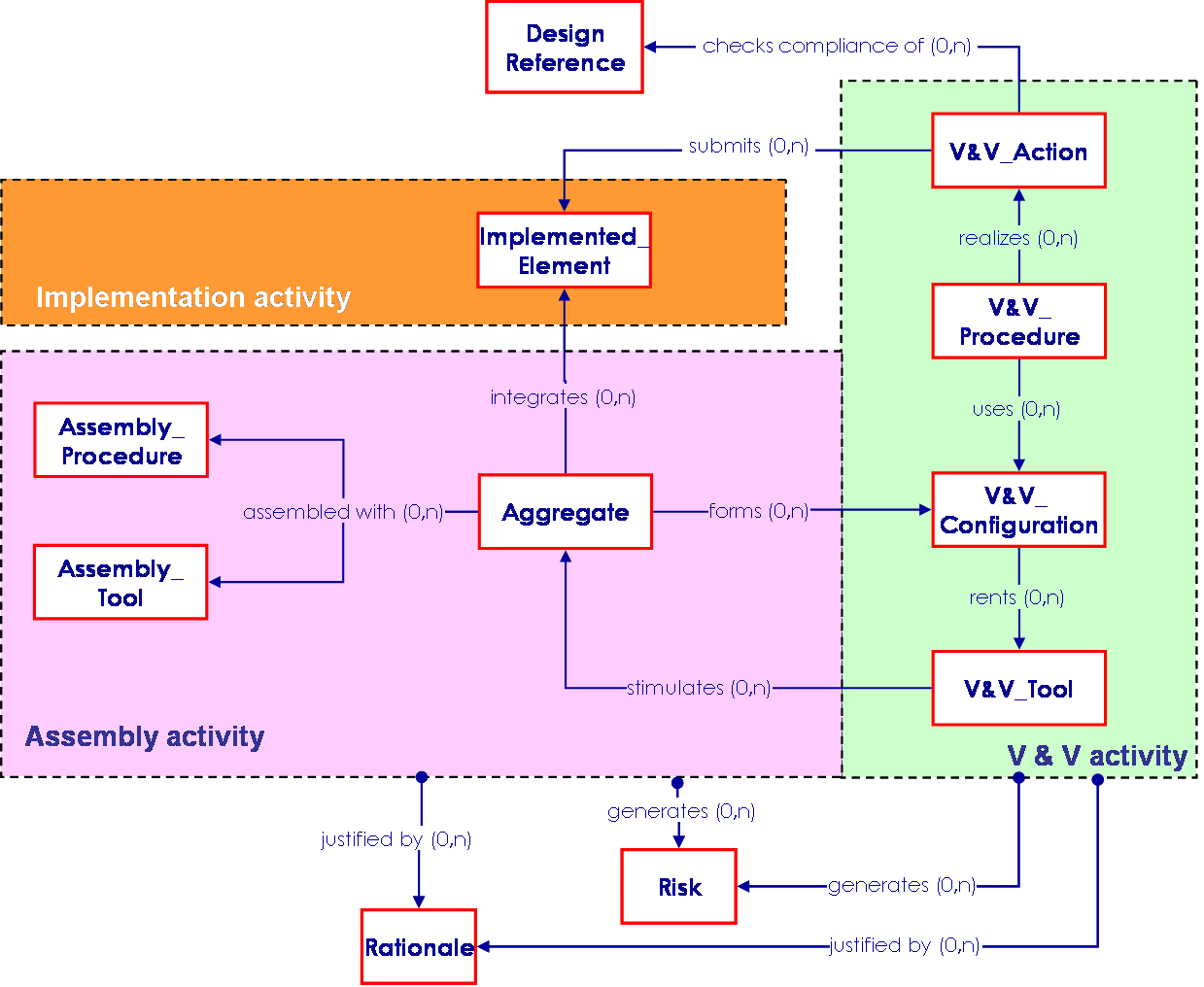
図中の英語
The main items to be checked during the integration process include the following:
統合プロセスの間にチェックすべき主要な項目には、以下のものがある。
• The integration plan respects its template.
• 統合計画が、そのテンプレートに沿っている。
• The expected assembly order (integration strategy) is realistic.
• 期待される組み立て順序(統合戦略)が現実的である。
• No system element and physical interface set out in the system design document is forgotten.
• システム設計文書に定められたシステム要素と物理インタフェースのうち、忘れられているものがない。
• Every interface and interaction between implemented elements is verified.
• 実装済み要素間のすべてのインタフェースと相互作用が検証されている。
• Assembly procedures and assembly tools are available and validated prior to beginning the assembly.
• 組み立て手順と組み立てツールが、組み立ての開始前に利用可能であり、妥当性確認されている。
• V&V procedures and tools are available and validated prior to beginning the verification.
• V&V 手順とツールが、検証の開始前に利用可能であり、妥当性確認されている。
• Integration reports are recorded.
• 統合レポートが記録されている。
Several different approaches are summarized above in the section Integration Strategy (above) that may be used for integration, yet other approaches exist. In particular, important integration strategies for intensive software systems include: vertical integration, horizontal integration, and star integration.
統合に用いることのできるいくつかの異なるアプローチを上記の統合戦略(Integration Strategy)の節で要約したが、ほかにもアプローチは存在する。特に、ソフトウェア集約型システムのための重要な統合戦略としては、垂直統合、水平統合、スター統合がある。
One of the most basic methods to define the aggregates and the order of integration would be the use of N-Squared diagrams (Grady 1994, 190).
集合体と統合の順序を定義する最も基本的な手法の1つとして、N-Squared ダイアグラムの使用が挙げられる(Grady 1994, 190)。
In the integration context, the coupling matrices are useful for optimizing the aggregate definition and verification of interfaces:
統合のコンテキストにおいて、結合行列は、集合体の定義の最適化とインタフェースの検証に役立つ。
• The integration strategy is defined and optimized by reorganizing the coupling matrix in order to group the implemented elements in aggregates, thus minimizing the number of interfaces to be verified between aggregates (see Figure 3).
• 統合戦略は、集合体間の検証すべきインタフェースの数を最小化するために、実装済み要素を集合体にグループ化するよう結合行列を再編成することによって、定義され最適化される(図3を参照)。
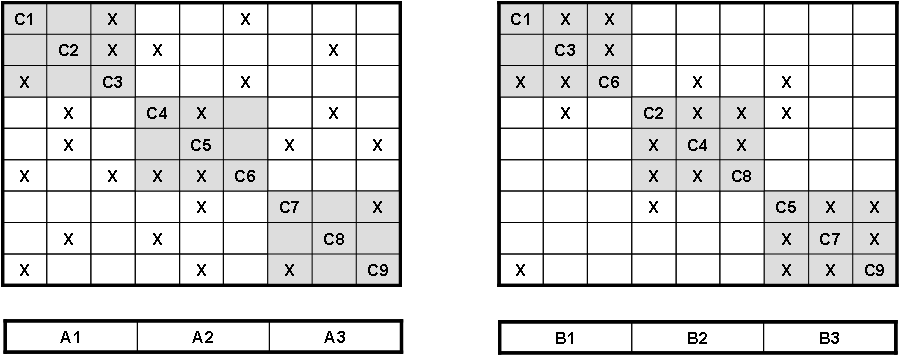
図中の英語
• When verifying the interactions between aggregates, the matrix is an aid tool for fault detection. If by adding an implemented element to an aggregate an error is detected, the fault can be related to the implemented element, to the aggregate, or to the interfaces. If the fault is related to the aggregate, it can relate to any implemented element or any interface between the implemented elements internal to the aggregate.
• 集合体間の相互作用を検証する際、行列は障害検出の支援ツールとなる。実装済み要素を集合体に追加したことで誤りが検出された場合、その障害は、実装済み要素、集合体、またはインタフェースに関連し得る。障害が集合体に関連する場合、それは、集合体の内部にあるいずれかの実装済み要素、またはそれら実装済み要素間のいずれかのインタフェースに関連し得る。
As the nature of implemented system elements and physical interfaces is different for these types of systems, the aggregates, the assembly tools, and the V&V tools are different. Some integration techniques are more appropriate to specific types of systems. Table 3 below provides some examples.
実装されたシステム要素と物理インタフェースの性質はこれらのシステムのタイプごとに異なるため、集合体、組み立てツール、V&V ツールも異なる。統合技法の中には、特定のタイプのシステムにより適したものがある。下記の表3にいくつかの例を示す。
表3. 製品、サービス、エンタープライズの各システムに対する異なる統合要素。(SEBoK Original)
| +Table 3. Different Integration Elements for Product, Service, and Enterprise Systems. (SEBoK Original) |
| Element |
|---|
| Product System |
| Service System |
| Enterprise System |
| System Element |
| Hardware Parts (mechanics, electronics, electrical, plastic, chemical, etc.) |
| Processes, data bases, procedures, etc. |
| Corporate, direction, division, department, project, technical team, leader, etc. |
| Physical Interface |
| Hardware parts, protocols, procedures, etc. |
| Protocols, documents, etc. |
| Protocols, procedures, documents, etc. |
| Assembly Tools |
| Harness, mechanical tools, specific tools |
| Documentation, learning course, etc. |
| Documentation, learning, moving of office |
| Verification Tools |
| Test bench, simulator, launchers, stub/cap |
| Activity/scenario models, simulator, human roles rehearsal, computer, etc. |
| Activity/scenario models, simulator, human roles rehearsal |
| Validation Tools |
| Operational environment |
| Operational environment |
| Operational environment |
| Recommended Integration Techniques |
| Top down integration technique |
| Subsets integration technique (functional chains) |
| Global integration technique |
| 要素 | 製品システム | サービスシステム | エンタープライズシステム |
|---|---|---|---|
| システム要素 | ハードウェア部品(機械、電子、電気、プラスチック、化学など)、オペレータの役割、ソフトウェア部品 | プロセス、データベース、手順など、オペレータの役割、ソフトウェアアプリケーション | 会社、経営層、部門、部署、プロジェクト、技術チーム、リーダーなど、IT コンポーネント |
| 物理インタフェース | ハードウェア部品、プロトコル、手順など | プロトコル、文書など | プロトコル、手順、文書など |
| 組み立てツール | ハーネス、機械ツール、特定のツール、ソフトウェアリンカ | 文書、学習コースなど | 文書、学習、オフィスの移転 |
| 検証ツール | テストベンチ、シミュレータ、ランチャ、スタブ/キャップ | アクティビティ/シナリオモデル、シミュレータ、人間の役割のリハーサル、コンピュータなど、熟練した専門家 | アクティビティ/シナリオモデル、シミュレータ、人間の役割のリハーサル |
| 妥当性確認ツール | 運用環境 | 運用環境 | 運用環境 |
| 推奨される統合技法 | トップダウン統合技法、ボトムアップ統合技法 | 部分集合統合技法(機能チェーン) | 全体統合技法、漸進的統合 |
Key pitfalls and good practices related to system integration are described in the next two sections.
システム統合に関連する主要な落とし穴と良い実践を、次の2つの節で記述する。
Some of the key pitfalls encountered in planning and performing SE Measurement are provided in Table 4.
SE 測定の計画と実施において遭遇する主要な落とし穴のいくつかを、表4に示す。
表4. システム統合における主要な落とし穴。(SEBoK Original)
| +Table 4. Major Pitfalls with System Integration. (SEBoK Original) |
| Pitfall |
|---|
| Description |
| Delay of expected element |
| The experience shows that the implemented elements always do not arrive in the expected order and the tests never proceed or result as foreseen; therefore, the integration strategy should allow a great flexibility. |
| Big-bang not appropriate |
| The "big-bang" integration technique is not appropriate for a fast detection of faults. It is thus preferable to verify the interfaces progressively all along the integration. |
| Integration plan too late |
| The preparation of the integration activities is planned too late in the project schedule, typically when first implemented elements are delivered. |
| 落とし穴 | 説明 |
|---|---|
| 期待された要素の遅延 | 経験上、実装された要素が期待された順序で到着するとは限らず、テストが予見どおりに進むことも、予見どおりの結果になることも決してない。したがって、統合戦略には大きな柔軟性を持たせるべきである。 |
| ビッグバンが適切でない | 「ビッグバン」統合技法は、障害を迅速に検出するのには適していない。したがって、統合の全過程を通じてインタフェースを漸進的に検証することが望ましい。 |
| 統合計画が遅すぎる | 統合アクティビティの準備が、プロジェクトスケジュールの中で遅すぎる時期に計画される。典型的には、最初の実装済み要素が納入される時期である。 |
Some good practices gathered from the references are provided in Table 5.
参考文献から集めた良い実践のいくつかを、表5に示す。
表5. システム統合における実証済みの実践。(SEBoK Original)
| +Table 5. Proven Practices with System Integration. (SEBoK Original) |
| Practice |
|---|
| Description |
| Start earlier development of means |
| The development of assembly tools and verification and validation tools can be taken as long as the system development itself. It should be started as early as possible as soon as the preliminary design is nearly frozen. |
| Integration means seen as enabling systems |
| The development of integration means (assembly tools, verification, and validation tools) can be seen as enabling systems, using system definition and system realization processes as described in this SEBoK, and managed as projects. These projects can be led by the project of the corresponding system-of-interest, but assigned to specific system blocks, or can be subcontracted as separate projects. |
| Use coupling matrix |
| A good practice consists in gradually integrating aggregates in order to detect faults more easily. The use of the coupling matrix applies for all strategies and especially for the bottom up integration strategy. |
| Flexible integration plan and schedule |
| The integration process of complex systems cannot be easily foreseeable and its progress control difficult to observe. This is why it is recommended to plan integration with specific margins, using flexible techniques, and integrating sets by similar technologies. |
| Integration and design teams |
| The integration responsible should be part of the design team. |
| 実践 | 説明 |
|---|---|
| 手段の開発を早く開始する | 組み立てツールと検証・妥当性確認ツールの開発には、システム開発自体と同じくらいの時間がかかることがある。予備設計がほぼ凍結されたら、できるだけ早く開始すべきである。 |
| 統合手段をイネーブリングシステムと位置づける | 統合手段(組み立てツール、検証ツール、妥当性確認ツール)の開発は、本 SEBoK で記述されるシステム定義とシステム実現のプロセスを用いるイネーブリングシステムとして位置づけ、プロジェクトとして管理できる。これらのプロジェクトは、対応する対象システムのプロジェクトが主導できるが、特定のシステムブロックに割り当てられ、あるいは別々のプロジェクトとして下請けに出すことができる。 |
| 結合行列を用いる | 良い実践とは、障害をより容易に検出できるよう、集合体を段階的に統合することである。結合行列の使用はすべての戦略に当てはまり、特にボトムアップ統合戦略に当てはまる。 |
| 柔軟な統合計画とスケジュール | 複雑なシステムの統合プロセスは容易には予見できず、その進捗管理は観察が困難である。そのため、特定のマージンを設けて統合を計画し、柔軟な技法を用い、類似した技術ごとに集合を統合することが推奨される。 |
| 統合チームと設計チーム | 統合の責任者は、設計チームの一員であるべきである。 |
DAU. February 19, 2010. Defense Acquisition Guidebook (DAG). Ft. Belvoir, VA, USA: Defense Acquisition University (DAU)/U.S. Department of Defense (DoD).
DAU. February 19, 2010. "Defense Acquisition Guidebook (DAG)". Ft. Belvoir, VA, USA: Defense Acquisition University (DAU)/U.S. Department of Defense (DoD).
Faisandier, A. 2012. Systems Architecture and Design. Belberaud, France: Sinergy'Com.
Faisandier, A. 2012. "Systems Architecture and Design". Belberaud, France: Sinergy'Com.
ISO/IEC/IEEE. 2015.Systems and Software Engineering - System Life Cycle Processes.Geneva, Switzerland: International Organization for Standardization (ISO)/International Electrotechnical Commission (IEC), Institute of Electrical and Electronics Engineers. ISO/IEC/IEEE 15288:2015.
ISO/IEC/IEEE. 2015."Systems and Software Engineering - System Life Cycle Processes."Geneva, Switzerland: International Organization for Standardization (ISO)/International Electrotechnical Commission (IEC), Institute of Electrical and Electronics Engineers. ISO/IEC/IEEE 15288:2015.
INCOSE. 2010. Systems Engineering Handbook: A Guide for Systems Life Cycle Processes and Activities. Version 3.2. San Diego, CA, USA: International Council on Systems Engineering (INCOSE), INCOSE-TP-2003-002-03.2.
INCOSE. 2010. "Systems Engineering Handbook: A Guide for Systems Life Cycle Processes and Activities". Version 3.2. San Diego, CA, USA: International Council on Systems Engineering (INCOSE), INCOSE-TP-2003-002-03.2.
NASA. 2007. Systems Engineering Handbook. Washington, D.C.: National Aeronautics and Space Administration (NASA), NASA/SP-2007-6105.
NASA. 2007. "Systems Engineering Handbook." Washington, D.C.: National Aeronautics and Space Administration (NASA), NASA/SP-2007-6105.
Buede, D.M. 2009. The Engineering Design of Systems: Models and Methods. 2nd ed. Hoboken, NJ, USA: John Wiley & Sons Inc.
Buede, D.M. 2009. "The Engineering Design of Systems: Models and Methods." 2nd ed. Hoboken, NJ, USA: John Wiley & Sons Inc.
DAU. 2010. Defense Acquisition Guidebook (DAG). Ft. Belvoir, VA, USA: Defense Acquisition University (DAU)/U.S. Department of Defense. February 19, 2010.
DAU. 2010. "Defense Acquisition Guidebook (DAG)". Ft. Belvoir, VA, USA: Defense Acquisition University (DAU)/U.S. Department of Defense. February 19, 2010.
Gold-Bernstein, B. and W.A. Ruh. 2004. Enterprise integration: The essential guide to integration solutions. Boston, MA, USA: Addison Wesley Professional.
Gold-Bernstein, B. and W.A. Ruh. 2004. "Enterprise integration: The essential guide to integration solutions". Boston, MA, USA: Addison Wesley Professional.
Grady, J.O. 1994. System integration. Boca Raton, FL, USA: CRC Press, Inc.
Grady, J.O. 1994. "System integration". Boca Raton, FL, USA: CRC Press, Inc.
Hitchins, D. 2009. "What are the General Principles Applicable to Systems?" INCOSE Insight 12(4):59-63.
Hitchins, D. 2009. "What are the General Principles Applicable to Systems?" INCOSE "Insight" 12(4):59-63.
Jackson, S. 2010. Architecting Resilient Systems: Accident Avoidance and Survival and Recovery from Disruptions. Hoboken, NJ, USA: John Wiley & Sons.
Jackson, S. 2010. "Architecting Resilient Systems: Accident Avoidance and Survival and Recovery from Disruptions". Hoboken, NJ, USA: John Wiley & Sons.
Reason, J. 1997. Managing the Risks of Organizational Accidents. Aldershot, UK: Ashgate Publishing Limited.
Reason, J. 1997. "Managing the Risks of Organizational Accidents." Aldershot, UK: Ashgate Publishing Limited.